Posts Tagged
‘Automation’

Home / Automation

Here’s the number everyone in AI should be paying attention to right now:

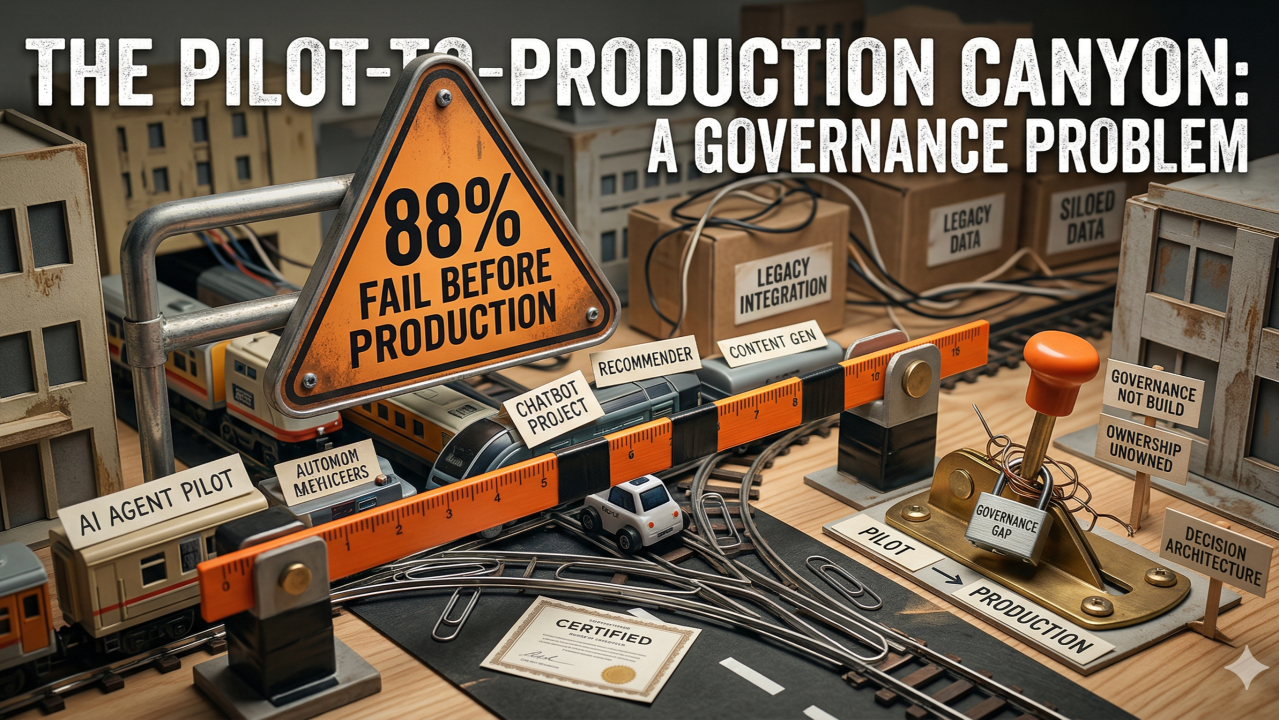
88% of AI agent projects fail to reach production.

Not because the technology doesn’t work.

Not because the models aren’t good enough.

Because — according to the research — “teams build agents before they build controls.”

Let that sink in.

The Deployment Backlog Nobody’s Talking About

78% of enterprises now have AI agent pilots running.

Only 14% have successfully scaled to production.

That’s not a gap. That’s a canyon.

And it gets worse. A March 2026 survey of 650 enterprise technology leaders found that even when pilots show meaningful results — and 67% of them do — only 10% ever make it across the finish line.

This is the largest deployment backlog in enterprise technology history. Double the failure rate of traditional IT projects.

The agents work in the lab. They work in the demo. They impress the steering committee.

And then they stall.

Five Root Causes — And Only One Is Technical

New research has identified the five root causes that account for 89% of scaling failures:

Integration complexity with legacy systems.

Inconsistent output quality at volume.

Absence of monitoring tooling.

Unclear organizational ownership.

Insufficient domain training data.

Look at that list carefully.

Only one — integration complexity — is a technology problem.

The rest? Ownership. Monitoring. Quality control. Governance.

These are leadership problems wearing technical disguises.

And they’re interrelated in a way that makes them compound. Ownership gaps leave monitoring gaps unfilled. Monitoring gaps make quality problems invisible. Invisible quality problems erode executive trust. Eroded trust kills budget.

It’s a chain reaction. And it starts — every time — with the same missing variable:

Nobody owns this.

Agent Sprawl: The Term You’ll Be Hearing Everywhere

There’s a new concept emerging in enterprise AI that perfectly captures what’s happening:

Agent sprawl.

It’s the uncontrolled proliferation of siloed, ungoverned AI agents across an enterprise. It happens when business units move fast to solve immediate problems with AI — without a unifying strategy, shared data infrastructure, or centralized oversight.

Sound familiar?

It should. It’s the same pattern I’ve been naming for two years. I called it “Duct-Tape Adoption” — sticking AI onto broken processes and hoping it creates magic.

The only difference now? The stakes are higher.

When it was chatbots and automation workflows, duct-tape adoption wasted time and budget.

When it’s autonomous agents making decisions, accessing databases, and operating across departments — duct-tape adoption creates organizational risk.

The security data backs this up. 88% of organizations reported confirmed or suspected AI agent security incidents in the last year. 80% documented risky agent behaviors including unauthorized system access and data exposure. And 64% of companies with revenue above $1 billion reported losses exceeding $1 million tied to AI system failures.

These aren’t hypothetical risks. They’re happening right now, in production environments, at scale.

The Readiness Gap in Four Numbers

Research now quantifies exactly how unprepared most organizations are to govern agentic AI. Four readiness categories tell the story:

Infrastructure readiness: 43%.

Data management readiness: 40%.

Governance readiness: 30%.

Talent readiness: 20%.

That last number should stop every AI consultant and advisor in their tracks.

Only 20% of organizations are talent-ready for agentic AI.

And governance — the single most critical variable for moving agents from pilot to production — sits at 30%.

This is why Gartner is now warning that 40%+ of agentic AI projects may be cancelled by 2027.

Not for lack of capability.

For lack of structure.

What This Means If You’re an AI Consultant

This data is both a warning and an opportunity.

The warning: implementation advice alone won’t save a stalled agent deployment. If you’re still leading with tool recommendations and feature demos, you’re solving a problem the market has already moved past.

The opportunity: the organizations that need you most right now aren’t asking “what tool should we use?”

They’re asking something harder:

“How do we govern what we’ve already built?”

“Who owns the decision about what this agent is allowed to do?”

“What happens when it breaks — and who’s accountable?”

Those aren’t consulting questions. They’re governance questions. And they require a fundamentally different operating model than most AI consultants are running.

The consultants who step into that gap — who can install decision architecture, define ownership, and build the 90-day oversight cadence — will own the most valuable real estate in the AI market for the next three years.

The ones who keep leading with tools will wonder why their pipeline dried up.

The Bottom Line

The agentic AI wave isn’t failing because the technology is immature.

It’s failing because organizations are building agents the same way they adopted every other AI tool:

Fast. Excited. Unstructured.

And for the first time, the consequences of that approach aren’t just wasted budget.

They’re security incidents. Unauthorized access. Million-dollar losses.

The market doesn’t need more agents.

It needs more architecture.

Source data:

– 88% failure rate, 78% piloting / 14% production (Apify enterprise research, Digital Applied March 2026 survey)

– 67% of pilots show meaningful results, only 10% scale (Digital Applied)

– 5 root causes account for 89% of failures (ZBrain, HarrisonAIX)

– Agent sprawl and security incidents: 88% confirmed/suspected incidents, 80% risky behaviors (Gravitee State of AI Agent Security 2026)

– 64% of $1B+ companies report $1M+ AI losses (Accelirate)

– Readiness gaps: Governance 30%, Talent 20% (Decidr US AI Readiness Index 2026)

– Gartner: 40%+ agentic AI project cancellation risk by 2027

– Only 22% treat agents as independent identities (Security Boulevard)

Many AI professionals believe the shift from consultant to Fractional CAIO is a pricing upgrade.

It isn’t.

It’s an identity shift.

And most avoid it because it requires structural change, not just confidence.


The Misunderstanding

An AI consultant improves skill.

A Fractional CAIO improves position.

Those are not the same progression.

Consultants ask:

“How do I deliver more value?”

Fractional CAIOs ask:

“How do I install authority?”

The first question expands capability.

The second redesigns structure.


Skillset vs Position

You can:

• Earn certifications • Master frameworks • Understand AI strategy deeply • Deliver strong advisory insights

And still be positioned as an external expert.

External experts are valuable.

But they are not embedded leadership.

Consultants are brought in.

CAIOs are installed.

That is a positional difference — not a technical one.


Execution vs Governance

Consultants operate in execution cycles.

Assess. Recommend. Implement. Exit.

Fractional CAIOs operate in governance cycles.

Evaluate. Prioritize. Oversee. Report. Renew.

Execution is episodic.

Governance is continuous.

If your revenue depends on project flow, you are operating inside an execution identity.

No matter what title you use.


The Resistance

The identity shift is uncomfortable because it requires:

• Defining decision authority • Establishing governance cadence • Creating a 90-day oversight model • Embedding reporting structure • Designing renewal logic

Consulting can feel fluid.

Governance must be structured.

Many professionals prefer fluidity.

Executives require structure.


The Psychological Barrier

Consultants prove value repeatedly.

Fractional CAIOs design systems that make value visible automatically.

That requires confidence in architecture, not just expertise.

It also requires relinquishing the comfort of “expert for hire.”

Because once installed as governance, you are no longer optional support.

You are structural leadership.


The Real Shift

The shift is not:

More AI knowledge. More tools. More certifications.

The shift is:

From execution To governance.

From influence To oversight.

From service provider To installed operating model.


Closing

Many professionals are capable of operating as Fractional CAIOs.

Few redesign their position to do so.

Because the shift is not skill.

The shift is structure.

— Rick Hancock, Architect of Fractional CAIO Governance Systems

You’ve watched an algorithm misclassify an urgent customer complaint as noise, and felt that tight drop in your stomach—the kind that comes when an SLA is breached, a deal slips away, or an employee’s application is mishandled. The promise of AI is speed and scale, but the real risk is handing critical decisions to a system that doesn’t yet share your context, priorities, or judgment. Human-in-the-loop (HITL) design is the antidote: not a retreat from automation, but a surgical integration of people where their judgment matters most.

This article gives a practical framework for deciding exactly where to place humans so workflows remain fast, safe, and continuously improving. You’ll get patterns to apply, concrete escalation and confidence rules to define, metrics to watch, tool choices to consider, and change-management tactics to get teams aligned.

A simple practical framework

  1. Map the decision points and outcomes
    • Break the process into discrete decision nodes (e.g., qualify lead, approve offer, refund ticket).
    • For each node, identify the potential outcomes and their downstream impact: revenue risk, compliance exposure, customer satisfaction, employee morale.
  2. Classify by volume, risk, and ambiguity
    • Volume: how many inputs per day/week?
    • Risk: what happens if the decision is wrong?
    • Ambiguity: how often will edge cases or context be needed?
    • This triage tells you where automation will help most, and where humans must stay involved.
  3. Choose a HITL pattern
    • Pre-screen / auto-reject / flag: let models filter obvious negatives or positives, auto-reject low-value noise, and flag ambiguous or risky items for human review.
    • Human verification for high-impact outcomes: require explicit human approval when financial, legal, or reputational consequences exceed a threshold.
    • Batch review for low-risk cases: consolidate many similar low-risk items into a short human review session to reduce context switching and fatigue.
  4. Define triggers and confidence thresholds
    • Use model confidence scores to route items. High confidence -> auto-action. Low confidence or borderline confidence -> human.
    • Define business-grounded thresholds. For example: if the model predicts “eligible for refund” with 95% confidence, auto-issue; if 60–95% confidence, send to human; below 60%, escalate to senior reviewer.
    • Include context-based triggers: customer status (VIP), legal flags, or recent escalations should override confidence thresholds.
  5. Build feedback loops that retrain and improve
    • Capture human decisions and corrections as labeled data.
    • Prioritize retraining on cases with high disagreement or high impact.
    • Maintain an “edge case” store to analyze failure modes and adjust either the model or the decision rules.

Patterns in practice (how to place people)

  • Pre-screen / auto-reject / flag: Useful for noisy, high-volume inputs. Example: a sales ops team uses a classifier to drop spam or unqualified leads automatically, while leads that look promising but low-confidence are flagged to a human rep who can add context. This reduces distraction while preserving opportunities.
  • Human verification for high-impact outcomes: Use when wrong decisions carry real cost. Example: in HR, a model may narrow candidate pools, but final interview outcomes or offer decisions go to a human hiring manager who considers soft signals the model can’t see.
  • Batch review for low-risk cases: Group low-stakes claims, returns, or policy exceptions into short review windows. This preserves throughput and concentrates human attention, lowering cognitive load and interruptions.

Measuring success: the metrics that matter

  • Accuracy and error type: Track both overall accuracy and the kinds of errors (false positives vs false negatives). Which errors hurt the business most?
  • Throughput and latency: Monitor end-to-end cycle time with and without human steps. Are humans creating unacceptable bottlenecks?
  • Human burden and interruption cost: Measure time per review, queue wait times, and reviewer idle/overload patterns. Optimize for fewer context switches and smarter batching.
  • Escalation rate and rework: How often do escalations occur? Are human decisions reversed later? High rework suggests either thresholds are wrong or training data is insufficient.
  • Model drift indicators: Monitor shifts in input distributions and rising disagreement between model and human reviewers.

Tooling: what to pick and why

  • Auto-labeling & weak supervision: Use auto-labeling frameworks to bootstrap training sets, but treat them as starting points. They speed labeling but require human curation for edge cases.
  • Annotation interfaces: Pick tools that let humans annotate quickly with context (attachments, conversation history), keyboard shortcuts, and quality checks. UX here directly affects review speed and accuracy.
  • Workflow orchestration: Implement a system that routes cases based on confidence, context, and SLAs. Orchestration should handle retry logic, priority overrides, and auditing for compliance.
  • Telemetry & MLOps: Integrate logging of model scores, human decisions, timestamps, and feature drift signals to feed back into model retraining cycles.

Short, concrete examples

  • Sales ops: A lead-scoring model processes hundreds of inbound leads. 60% are low-confidence spam and are auto-rejected; 30% are high-confidence qualified and get routed to reps immediately; the remaining 10% are flagged for a human rep to review in a daily batch. Team burden drops, and reps spend time where judgment yields most value.
  • HR decisions: Resume parsing and role-fit prediction reduce initial screening time. For managerial roles, any candidate with a predicted hire score in the mid-range is escalated to a hiring lead for interview selection. Final offers require human sign-off when compensation bands exceed predefined thresholds.
  • Customer escalations: Support triage auto-resolves common, low-value issues. When a ticket is flagged as high sentiment risk, high monetary value, or shows an anomaly in model confidence, it is immediately escalated to a senior agent who sees customer history and can make judgment calls.

Change management: getting people to trust the loop

  • Start small and measurable: Pilot a single node, measure the outcomes, then expand. Quick wins build trust.
  • Make decisions reversible and visible: Show reviewers the model reasoning, confidence, and an audit trail. Transparency reduces “automation anxiety.”
  • Set SLAs and workload rules: Define clear SLAs for human review to avoid backlog and resentment. Use batching to protect attention.
  • Train reviewers and reward accuracy: Invest in onboarding reviewers on how to interpret model outputs. Recognize the value of high-quality human labels.
  • Iterate on ergonomics: Remove friction—reduce clicks, surface relevant context, and allow bulk actions when appropriate.

Final thought

Designing HITL automation is less about avoiding automation and more about surgical placement of human judgment to amplify what machines do well and to catch what they don’t. When you map decisions, classify risk and volume, choose the right pattern, and close the feedback loop, you get workflows that are faster, safer, and continuously improving.

If you’re looking to put this into practice, MyMobileLyfe can help you evaluate where to insert human oversight, set confident thresholds and escalation paths, choose the right tooling, and build the feedback mechanisms that keep models honest and workflows efficient. Learn more about how MyMobileLyfe helps businesses use AI, automation, and data to improve productivity and save money: https://www.mymobilelyfe.com/artificial-intelligence-ai-services/

You know the feeling: a morning inbox full of exception alerts, a queue of stalled tasks with no clear owner, and an SLA clock quietly bleeding minutes while engineers and agents pass responsibility back and forth. Routine processes that should be predictable instead behave like living organisms — conditionals, edge cases, conflicting data across systems, and human judgment calls everywhere. Simple “if this then that” automation breaks down fast.

Intelligent workflow orchestration gives those processes a backbone. By combining machine learning models, rules engines, and a robust orchestration layer (RPA or workflow platforms), you can automate decision-heavy flows end-to-end — surfacing the right exceptions, predicting the best next action, routing work to the optimal owner, and engaging humans only when required. Below is a pragmatic playbook for operations leaders and automation teams who need to move beyond brittle task automation and build resilient, auditable, decision-aware processes.

Start with the pain: map every decision point

  • Walk the path like a detective. Interview frontline staff and trace a case from start to finish. What alternatives are evaluated manually? Where do data conflicts occur across systems? Which checks cause rework?
  • Capture decision points explicitly — not “step 4,” but “how to resolve price mismatch” or “should this refund be autoapproved?” For each, log inputs, current owner, time to resolution, and business impact (SLA breach, cost, customer churn risk).
  • Prioritize: focus first on decisions that are frequent, time-consuming, and have clear signals in existing data.

Classify decisions: rules vs. predictions

  • Deterministic decisions: these are “hard rules” — regulatory checks, policy thresholds, or boolean validations. Encode these in a rules engine or decision table (Drools, open-source decision tables, or vendor rule modules).
  • Probabilistic decisions: things like fraud likelihood, churn-risk prioritization, or next best action are best handled with predictive models. These models work with noisy signals and give a confidence score that the orchestrator can consume.
  • Many real-world decisions are hybrid: use rules to filter obvious cases, and models to handle ambiguous ones.

Choose models and signals pragmatically

  • Use the simplest model that solves the problem. A gradient-boosted tree may beat a deep network for tabular data and is easier to explain.
  • Build models around actionable signals already available: transaction metadata, customer behavior events, historical resolution times, agent skill tags. Don’t invent new data sources unless there’s a clear ROI for the extraction effort.
  • Log feature lineage. Knowing which signal drove a recommendation is crucial for debugging and compliance.

Design an orchestration layer that thinks, routes, and remembers

  • The orchestration platform is the brain: it evaluates rules and model outputs, decides the next step, and routes tasks. Options include workflow engines (Camunda, Temporal), RPA suites (UiPath, Automation Anywhere, Blue Prism) integrated with orchestration, or event-driven architectures built on Kafka or cloud-native services.
  • Build human-in-the-loop gates into the workflow where model confidence is low or a regulatory override is required. Present clear context to the human reviewer: model score, top contributing signals, suggested actions, and historical outcomes.
  • Create explicit fallback paths for system failures or unavailable models — deterministic rules that keep the business running.

Make feedback loops and audit trails first-class features

  • Every automated decision must be logged with inputs, model version, confidence, rule version, and action taken. Adopt event sourcing or immutable logs so auditors and engineers can reconstruct decisions.
  • Capture human overrides and route those cases back into model training datasets. That continuous feedback loop decreases drift and improves relevance.
  • Version everything: models, rules, orchestration definitions, and connectors. Tie versions to production events for traceability.

Integrate where the data lives — and limit brittle connectors

  • Use API-first integrations and event streams rather than screen-scraping or fragile UI automation for critical decision inputs. Where RPA is necessary (legacy portals), isolate it behind adapters and monitor for UI changes.
  • Centralize contextual data in a decision store or feature store for consistent, low-latency reads across models and workflows.
  • Keep data enrichment services (third-party scoring, name matching, external fraud feeds) modular so you can swap providers without rewriting the orchestrator.

Measure the right things — and measure before/after baselines

  • Baseline metrics: average handle time, touchless rate (fully automated vs. human touch), exception rate, rework incidence, SLA violation minutes, and cost per case.
  • After deployment, track changes in those metrics and also model-specific telemetry: prediction distribution, calibration, false positive/negative rates.
  • Report ROI in terms operations care about: hours saved, reduction in escalations, and cost delta from manual processing.

Mitigate risk: drift, explainability, and compliance

  • Monitor for model drift and data input drift. Alerts should trigger retraining pipelines or automatic rollbacks to validated rule-based behavior.
  • For regulated processes, require explainable outputs: use interpretable models or explainability layers (SHAP, LIME) and surface human-readable reasons for recommended actions.
  • Maintain a governance checklist before each deployment: legal review, audit trail completeness, roll-forward and rollback plans, and SLAs for human response in human-in-loop gates.

Realistic use cases and vendor patterns

  • Invoice processing: rules validate invoices under a threshold; ML predicts which vendor invoices will need manual review; the orchestrator routes probable exceptions to accounts payable specialists with past-resolution context.
  • Customer disputes: a model estimates dispute legitimacy; high-confidence fraudulent claims move to auto-reject rules, low-confidence claims go to a review queue prioritized by predicted churn impact.
  • Loan servicing: deterministic regulatory checks plus risk models determine who needs human underwriting; the orchestrator ensures required documents are present and tracks each decision for compliance.

Vendor patterns you’ll see in the field: a workflow engine (Camunda, Temporal, or a cloud workflow) coordinating tasks, a feature store and ML service (SageMaker, Vertex AI, Azure ML or in-house models), a rules engine or decision table for gatekeeping, and RPA bots for legacy integrations. Use message buses or APIs to decouple services so the orchestrator can evolve without rewriting every connector.

Pitfalls to avoid

  • Don’t automate without measurement. If you can’t show a baseline, you can’t prove value.
  • Avoid black-box blind deployments. If agents can’t understand why the automation suggested an action, they will override or bypass it.
  • Don’t neglect human workflows. Automation that ignores human schedules, skill levels, or ergonomics creates resistance and hidden costs.
  • Beware of connectors that are “cheap” but brittle. They cost more over time than a proper API integration.

Start small, ship often, iterate fast

Begin with a single, high-impact decision point: map it, instrument it, and run a shadow mode where models make recommendations without taking action. Measure alignment with human decisions, tune thresholds, then enable auto-actions for high-confidence cases. Expand outward, keeping observability, governance, and human experience central.

If you’re ready to move beyond rule-only automation and scale intelligent decision-driven workflows, MyMobileLyfe can help. Their AI, automation, and data services specialize in building model-backed orchestration, integrating with existing systems, and setting up governance and monitoring so teams save time and reduce costs while maintaining compliance. Learn more at https://www.mymobilelyfe.com/artificial-intelligence-ai-services/.

There’s a moment when a product manager opens another spreadsheet of customer comments and feels that slow, sinking realization: precious signals are buried in a haystack of complaints, praise, and half-formed ideas. Support teams, product owners, and founders all stare at the same mess—reviews, tickets, survey text, tweets—and know that somewhere inside that unstructured text is the answer that would avert churn, improve onboarding, or fix the feature that customers hate. The problem isn’t collecting feedback; it’s turning that raw, messy conversation into prioritized, trustworthy action.

What follows is a practical, affordable way to do exactly that using natural language processing (NLP): automate categorization, surface emerging pain points, quantify trends, and help you decide what to fix first—without losing the nuance that only humans can provide.

Why automation, and why now

Manual triage works for a handful of tickets. When volume grows, manual systems introduce delays and inconsistency: similar complaints tagged differently, duplicated effort, and slow response to a brewing product crisis. Automated NLP reduces noise and focuses human attention where it matters—on the issues that affect customers most often or most deeply.

Core techniques that turn text into insight

  • Sentiment analysis: Assigns a polarity (positive, neutral, negative) to each piece of feedback so you can track mood over time. Use model-based sentiment for nuance (e.g., “I love the app except the onboarding” should score mixed).
  • Topic modeling: Groups feedback into coherent themes—billing, onboarding, performance—so teams stop guessing where problems live. Methods range from LDA (Latent Dirichlet Allocation) to modern embedding + clustering.
  • Keyword extraction: Pulls out the phrases customers repeat (e.g., “slow checkout,” “password reset,” “delivery delay”) using TF-IDF, RAKE, or newer unsupervised extractors.
  • Clustering and anomaly detection: Groups similar complaints and flags sudden spikes of a new cluster—often the first sign of a regressions or a broken integration.

A practical implementation roadmap

  1. Choose sources deliberately
    Pick the channels that matter for the business outcome you want to influence: app store reviews and support tickets for product beta health; surveys and NPS write-ins for loyalty; social media and public reviews for brand reputation. Prioritize two to three sources to start—wide enough to be meaningful, narrow enough to ship.
  2. Simple preprocessing that pays dividends
    Normalize case, strip HTML, remove obvious boilerplate signatures, and de-duplicate identical entries. Detect and redact personally identifiable information (names, emails, credit card patterns) early to protect privacy. Lightweight steps like correcting obvious typos and expanding contractions improve downstream accuracy without heavy engineering.
  3. Decide no-code/low-code vs developer-first
  • No-code/low-code: These platforms let CX owners prototype pipelines quickly—ingest, classify, and visualize—without writing code. They’re ideal for fast validation and for teams without a data science resource.
  • Developer-first: Libraries like spaCy, Hugging Face transformers, or scikit-learn let engineers build customized models and integrate them deeply into back-end systems. Choose this route when you need fine-grained control or want to run models in-house.

Start with a no-code prototype to prove value, then move to developer-first if you need customization or scale.

  1. Build a feedback-to-action workflow
    Don’t let insights live in a dashboard. Integrate outputs where work happens:
  • Alerts: Configure threshold-based alerts for spikes in negative sentiment or the first appearance of a high-severity keyword.
  • Dashboards: Track trends across topics, sentiment, and volume. Visualize aging issues and their estimated customer impact.
  • Product backlog: Create automated rules to translate high-frequency, high-impact issues into tickets in Jira, Trello, or Asana. Add links to representative feedback and a confidence score from your model.
  1. Measure ROI sensibly
    Define measurable outcomes up front: reduced average time to resolve (TTR), fewer duplicate tickets, faster release cycles for top issues, or improvements in NPS/CSAT tied to addressed themes. Measure before and after automation to quantify time saved and the impact of fixes. Use the confidence scores and human validations to attribute improvements to automation vs. manual efforts.

Governance: privacy, bias, and validation

  • Data privacy: Remove or mask PII at ingestion and follow regulations relevant to your customers (e.g., GDPR). Keep access controls tight so only authorized staff can see raw feedback.
  • Avoiding bias: Models reflect the data they’re trained on. If your training data overrepresents a segment of customers, model recommendations will skew. Ensure your sample set includes diverse voices, and test performance across customer cohorts.
  • Human-in-the-loop checks: Implement regular sampling where humans verify model labels. Use annotation tools for correction; feed corrected labels back into your training set to improve performance iteratively. For high-stakes actions (e.g., legal escalations, policy changes), require human confirmation before automated routing.

Keeping nuance while scaling

Automation should accelerate human judgment, not replace it. Use confidence thresholds: let high-confidence classifications auto-route, keep medium-confidence items for human review, and flag low-confidence or ambiguous messages for follow-up. Capture representative verbatims with each automated tag so reviewers see context, not just a label.

Common pitfalls and how to avoid them

  • Over-reliance on a single metric: Sentiment alone misses topic-specific nuance. Combine sentiment with topic frequency and customer value signals.
  • Cherry-picking data sources: A solution that ignores support tickets but optimizes for app reviews can miss the problems that churn your highest-value customers. Map input channels to business goals.
  • Ignoring retraining: Language evolves—new product names, features, or slang appear. Schedule retraining cycles based on model drift or monthly review.

A bite-sized rollout plan

  • Month 1: Ingest two sources (support tickets + NPS comments), run preprocessing, and set up sentiment + keyword extraction with a no-code tool. Validate on a sample of 500 entries with human review.
  • Month 2–3: Add topic modeling and dashboarding; set up alert rules and one automated backlog creation rule for high-impact items.
  • Month 4+: Move to developer-first stack if needed, expand sources, and automate retraining with human-in-the-loop corrections.

The payoff

Done well, feedback automation gives teams early warning of product regressions, shrinks time between detection and resolution, reduces duplicate work in support, and surfaces the highest-impact fixes so product roadmaps reflect real customer needs. You get less noise and more prioritized action.

If you’re ready to move from manual triage to automated insight, MyMobileLyfe can help. They specialize in using AI, automation, and data to improve productivity and cut costs—building the pipelines, governance, and integrations that turn customer feedback into measurable product and service improvements. Learn more at https://www.mymobilelyfe.com/artificial-intelligence-ai-services/.

You know the scene: a technician’s phone is full of five-second voice memos, half-lit photos of serial numbers, and one-line text updates like “checked pump — looks bad.” Back at the office, supervisors shuffle through messages, trying to stitch together a coherent picture while customers wait. Valuable observations stall in inboxes, and decisions are delayed because data arrives fragmented, unlabeled, and depressingly manual.

Multimodal AI can change that. By processing voice, images, and short text where they are captured, businesses can convert raw field notes into concise visit summaries, prioritized follow-up tasks, and structured records that plug directly into CRMs and ticketing systems. Below is a practical guide—no theory-heavy fluff—on how to design these workflows, protect your data, measure value, and run a small pilot that proves the approach before you scale.

What multimodal automation actually does

  • Voice: Automatic speech-to-text with contextual summarization. Instead of a stack of memos, you get a one-paragraph visit summary and extracted action items (e.g., replace gasket, order part).
  • Photos: Object detection (identify the asset), condition assessment (rust, leakage, wear), and OCR (capture serial numbers, models, tags).
  • Text snippets: Consolidation and normalization of short messages into structured fields (status codes, measurements).
  • Output: A unified visit report, a prioritized task list with attachments and confidence scores, and API-ready payloads for your ticketing/CRM systems.

Integration patterns: edge versus cloud

  • Edge (on-device) processing: Pros—works offline, lower latency, reduced bandwidth, improved privacy because raw media never leaves the device. Cons—limited compute for heavy models, more complex app updates, device heterogeneity to manage.
  • Cloud processing: Pros—scales easily, uses larger/custom models, simpler to maintain, fast iteration. Cons—requires reliable connectivity, raises privacy/scope-of-data concerns, incurs recurring costs.
    Best pattern: hybrid. Do initial transcription and lightweight image tagging on device (to get instant feedback and work offline). Send higher-value or low-confidence content to cloud services for deeper analysis and long-term storage. Use confidence thresholds to decide when to escalate to the cloud or a human reviewer.

Quick-win automation recipes

Start with small, high-impact automations you can implement rapidly:

  • Keyword-to-ticket: If a voice transcription contains “leak”, “unsafe”, or “failed inspection”, auto-create a high-priority ticket in your service platform with attached audio and image snippets.
  • Photo-triggered parts ordering: If image analysis detects a damaged seal or specific part number via OCR, generate a parts requisition draft with the captured photo and suggested vendor codes.
  • Auto-prioritized to-do list: Combine text and vision tags to rank follow-ups by severity and SLA risk, then push the top three actions into the mobile worker’s next-day itinerary.
  • Escalation nudges: If a follow-up task is open beyond a threshold, send a summary and suggested actions to a supervisor with the original media attached.

Data privacy and consent—practical best practices

  • Explicit consent flows: Prompt workers and customers where required before capturing audio or images. Record consent metadata with each visit.
  • Least privilege and minimization: Store only fields you need for the business process; redact or hash PII when possible.
  • Encryption and access control: Encrypt media in transit and at rest; use role-based access and time-limited links for sharing attachments.
  • Audit trails and retention policies: Log who accessed what and why. Define retention schedules for different types of media to limit exposure.
  • Third-party vendors: If you route media through third-party cloud AI providers, include contractual clauses about data use, retention, and deletion.

Measurable ROI metrics to track

Choose a small set of metrics that tie directly to your pain points:

  • Reduced admin time per visit: Measure before/after time to assemble a visit report.
  • Faster resolution rates: Track average time from visit to ticket resolution for issues discovered on-site.
  • Decrease in repeat visits: Track reduction in rework caused by incomplete capture of details.
  • Volume of auto-created tickets and accuracy: Percent of auto-generated tasks that required no human rewrite.
  • SLA compliance and customer feedback: Improvements in meeting SLAs and in customer satisfaction after automation.
    Measure these from logs and by sampling reports; don’t rely solely on surveys—use time stamps, system events, and ticket histories.

Three-step pilot plan

  1. Define a narrow use case and baseline
    • Pick a single pain point (e.g., plumbing inspections, equipment service visits).
    • Instrument a small team (5–15 users) and collect current metrics for two weeks: time to report, ticket creation steps, error rates.
  2. Build a minimal pipeline and validate
    • Implement on-device capture with immediate transcription and basic image tagging.
    • Set simple automations: e.g., “leak” => create ticket, OCR serial => populate part field.
    • Run the pilot for 4–8 weeks, conduct weekly reviews, and log precision/recall for the automations. Include a human-in-the-loop for uncertain items.
  3. Iterate and scale
    • Tune keyword lists, confidence thresholds, and image guidelines (e.g., add a quick framing overlay to photos).
    • Add deeper cloud processing for low-confidence results or complex assessments.
    • Expand to additional teams and workflows based on validated ROI.

Vendor-agnostic toolset recommendations

  • On-device ML frameworks: TensorFlow Lite, ONNX Runtime, Core ML for local models and faster inference.
  • Speech and transcription: Local models for quick capture; cloud ASR for heavy lifting and custom language models.
  • Vision and OCR: Use modular services or hostable models—choose providers with clear data handling policies or open-source models you can host.
  • Orchestration and automation: Low-code automation platforms (or self-hosted tools) that connect mobile apps to ticketing and CRM systems.
  • Mobile app and device management: Use cross-platform frameworks (React Native, Flutter) and an MDM solution to secure devices and control app updates.
    Select components that support a hybrid deployment so you can keep sensitive data local while offloading heavier analysis.

Common implementation pitfalls to avoid

  • Bad UX for capture: If it’s hard to take a usable photo or record a clean voice memo, AI won’t save you. Provide simple framing guides and noise-reduction prompts.
  • Too much automation, too fast: Aggressive auto-actions without human verification create mistrust. Start with suggestions, not irrevocable changes.
  • Poor governance: No consent, unclear retention, and weak access controls amplify risk. Bake governance into the pilot.
  • One-size-fits-all models: Field contexts differ. Fine-tune models with local data and check for bias or misclassification.

If you want to stop letting field observations disappear into voicemail or scattered photos, start small, measure rigorously, and build automation that aides—not replaces—human judgment. Multimodal AI is a practical bridge from messy mobile notes to operational decisions that actually happen.

MyMobileLyfe can help you design and deploy these workflows—combining AI, automation, and data engineering to turn field inputs into actionable outputs while protecting privacy and delivering measurable savings. Learn more about how they help businesses use AI and automation at https://www.mymobilelyfe.com/artificial-intelligence-ai-services/.

You bought the shiny tool. You watched demos where automation answered questions, filled forms, or flagged exceptions. Yet six months later the dashboard is quiet, your team still works late, and the budget is leaking into “pilot” expense lines. The real cost isn’t the tool; it’s the uncertainty: how do you prove, reliably, that this change will save time, reduce errors, and free staff to do higher‑value work?

This playbook gives a practical, no-fluff path to run low-risk AI and automation pilots that produce measurable ROI. It focuses on how to baseline, test, measure, and decide — with simple formulas, templates, and a checklist you can use immediately.

  1. Start with a surgical baseline
    You cannot measure improvement without knowing precisely what you’re improving.
  • Pick the process slice: choose a single, repeatable workflow (e.g., invoice processing, customer onboarding step X, or claims triage).
  • Map the process: record each handoff and decision point. Note average times, wait times, and rework loops.
  • Run time studies: observe or log N instances (choose N to cover typical variation — often 30–50 instances for operational measures). Record: Start time, end time, active work time, idle/wait time, rework occurrences, and exceptions.
  • Track error rates: document defects and their downstream costs (e.g., manual rework minutes, credit memos).

Baseline template (use as a simple spreadsheet)

  • Process name:
  • Step ID / Description:
  • Baseline median time (min):
  • Baseline mean time (min):
  • Rework rate (% of cases):
  • Throughput (cases/day):
  • Fully burdened hourly rate ($):
  • Notes (exceptions, seasonality):
  1. Choose the right KPIs — focus on time and capacity
    Avoid vanity metrics. For pilots, pick 3 primary KPIs:
  • Time per task (median and mean)
  • Throughput (tasks completed per period)
  • Rework or error rate (and time to resolve)

Secondary KPIs: employee capacity (FTEs freed), customer response time, and SLA compliance.

  1. Design a controlled pilot or A/B test
    Put statistical rigor where it matters; keep the pilot small but fair.
  • A/B (parallel) test: route a randomized subset of incoming tasks to the automation and the rest to the human process. Random assignment avoids selection bias.
  • Within-subject (paired) test: have the same staff process identical tasks with and without the tool, one after the other. This controls individual variation and increases statistical power for small samples.
  • Duration: run the pilot long enough to capture normal variation and at least one full business cycle for that process (often 2–4 weeks).
  • Logging: ensure timestamps and case IDs flow into a log you control. Manual notes are noise; prefer automatic logs or time-tracking that validates start/end times.

Statistical confidence for small pilots

Full statistical rigor is ideal, but small pilots must be pragmatic. Aim for:

  • Clear directional signal from paired tests when sample sizes are small.
  • If using hypothesis testing, 95% confidence is conventional; for operational pilots, 80–90% may be acceptable as a go/no-go indicator, provided you build in quick follow-up monitoring on scale-up.
  • Use paired t-tests for within-subject and two-sample t-tests for parallel tests when distributions are roughly normal; otherwise use nonparametric alternatives (e.g., Wilcoxon signed-rank).
  1. Calculate time and cost savings — simple formulas
    Keep formulas transparent so stakeholders can follow the math.
  • Time_saved_per_task = Baseline_time_per_task − New_time_per_task
  • Total_time_saved_per_period = Time_saved_per_task × Volume_per_period
  • Annualized_time_saved = Total_time_saved_per_period × Periods_per_year
  • Labor_cost_savings = Annualized_time_saved × Fully_burdened_hourly_rate
  • Net_savings_first_year = Labor_cost_savings − (Tool_license + Implementation_costs + Training_costs + Changeover_costs + Maintenance_estimate)
  • Payback_period_months = Total_implementation_costs / (Monthly_net_savings)

Be explicit about what counts as a cost:

  • Licensing fees (annual or per-seat)
  • Implementation hours (internal and vendor fees)
  • Training time (staff hours multiplied by burdened rates)
  • Changeover costs (temporary slowdowns, productivity dips)
  • Monitoring and model retraining (for AI models)
  1. Watch for measurement traps
    Some errors quietly erase your ROI.
  • Hawthorne effect: people improve when observed. Use logs and blind routing if possible.
  • Selection bias: don’t route only the easy cases to automation in pilots.
  • Hidden work: missed exceptions or increased downstream review can appear later. Measure rework downstream for several weeks.
  • Over-optimistic baselines: staff may have optimized their manual work already — be realistic about marginal gains.
  • License and scale creep: per-seat costs or high-volume pricing can change economics when you scale.
  1. Interpreting results and decision rules
    Use this simple decision ladder after the pilot:
  • Is the KPI improvement statistically and operationally meaningful? (e.g., time per task reduced enough to free at least one FTE or reduce SLA breaches)
  • Do net savings exceed implementation and recurring costs within an acceptable payback period? (set your internal threshold: 6–18 months is common for SMBs)
  • Is automation robust on edge cases? Are exception rates manageable?
  • Can we support and monitor the solution in production? (SLA, logs, owner)
  • Is compliance and security vetted?

If the answer is yes to most questions, proceed to a phased scale: define rollout waves, backlog of additional use cases, and monitoring dashboards.

  1. Scaling checklist — operationalize success
    Before production roll‑out, confirm:
  • Ownership assigned (process owner, tech owner)
  • Monitoring in place (daily throughput, error rates)
  • Rollback plan for version or model failures
  • Training plan for staff redeployment
  • Contract terms clarified for licensing at scale
  • Budget for ongoing model maintenance or automation tuning
  1. Quick example (no fabricated numbers)
    Imagine tracking invoice processing. Your spreadsheet shows baseline mean time and rework minutes. After a paired pilot, you compute Time_saved_per_task and multiply by current monthly volume to see FTE equivalent. Subtract licensing + implementation to reveal payback. If exception rate jumped, calculate the extra rework minutes and subtract from gross savings. That arithmetic — transparent and repeatable — is all a leader needs to make the call.

Final note: pilots don’t have to be perfect science experiments, but they must be honest measurements. Clarity in what you measure and how you count costs converts faith into decisions that free budget and time.

If you want help building this ROI playbook into your next pilot — from designing the baseline studies to running the A/B tests, calculating payback, and creating monitoring dashboards — MyMobileLyfe can help businesses use AI, automation, and data to improve their productivity and save them money. Learn more at https://www.mymobilelyfe.com/artificial-intelligence-ai-services/.

You know the scene: a Monday morning inbox full of project requests, a tattered spreadsheet with color-coded cells that only one person truly understands, and a calendar of partial commitments that never quite lines up. Someone assigns a developer because they’re “available,” only to discover they lack a crucial skill. The project stalls. Overtime piles up. A client grows impatient. That slow, grinding friction is not just annoying—it is costing you time, margins, and trust.

The problem isn’t people. It’s the way you decide who works on what. Manual staffing reintroduces randomness into work allocation: availability is approximated, skills are misunderstood, and performance history is scattered across disparate systems. AI-powered talent allocation untangles that mess by turning skills, availability, and performance into living inputs that feed a decision engine—and by automating the outreach and assignment workflows that follow.

What an AI-powered talent-allocation system does

  • Recommends the best-fit people for each project by combining declared skills with observed performance.
  • Suggests team compositions using clustering so complementary strengths are grouped together.
  • Forecasts capacity so you know when bottlenecks will appear.
  • Automates outreach, nudges, and assignment approvals so projects ramp without email chains.

Core inputs you must collect (and why they matter)

  • Skills taxonomy: A clear, normalized list of capabilities and proficiency levels. Without this, the engine is guessing. Start simple (e.g., technical domain, tool, seniority) and refine.
  • Availability calendars: Real-time commits from calendars and planned leaves. “Available” in a spreadsheet is useless if folks already have recurring meetings.
  • Historical performance and delivery data: Past completion rates, on-time delivery, and peer feedback. Use these to weight recommendations—someone who delivers reliably on a type of task should be preferred.
  • Project requirements: Scope, duration, required skills, urgency, and preferred team characteristics (e.g., cross-functional, mentor presence).
  • Constraints and rules: Legal restrictions, overtime limits, and team composition policies.

Simple AI techniques that deliver high value

  • Skill-and-performance recommendation engine: Start with nearest-neighbor or weighted matching. Combine declared skills with performance signals so the engine prefers people who have both the skills and a track record of delivering similar work.
  • Clustering for team composition: Use clustering algorithms to form balanced teams—pair specialists with generalists, match complementary experience, and ensure mentorship presence. Even basic clustering (k-means) on dimensions like skill breadth and delivery speed yields better team mixes than random assignment.
  • Capacity forecasting: Use simple time-series approaches (moving averages, exponential smoothing) on historical utilization to predict when skills will be in short supply. Advanced forecasting can come later; the key is to highlight impending bottlenecks before they hit.
  • Prioritization scoring: Score candidate assignments by match quality, availability, and strategic priorities (e.g., upskilling goals or critical client needs).

Automation that removes the busywork

  • Automated outreach: When the system recommends a person, trigger smart messages—Slack pings, calendar tentatives, or email—with role context and a “accept/decline” action. Follow up automatically if no response.
  • Conditional workflows: If a recommended resource declines, the system escalates to the next best candidate and updates the project timeline.
  • Approval automation: Route recommended staffing bundles to managers for quick approval with one-click accept.
  • Updates to systems: When someone accepts, auto-update HRIS, project management tools, and timesheet templates so there’s no manual double entry.

Integration options that make the whole thing sing

  • HRIS: For skill inventories, contract types, and compliance constraints.
  • Project management tools (Jira, Asana, Monday): For project requirements and progress.
  • Calendar systems (Google Workspace, Outlook): For real-time availability.
  • Communication platforms (Slack, Teams): For outreach and approvals.
  • Time and delivery systems: For pulling historical performance signals.

Measurable KPIs to track success

  • Time-to-fill: How long between project request and resource acceptance.
  • Utilization: Actual allocation vs. capacity across teams and skill domains.
  • On-time delivery: Percent of projects delivered on schedule after automation.
  • Ramp-up time: Days from assignment to productive contribution.
  • Satisfaction: Surveys from hiring managers and team members about fit and process.

Common pitfalls—and how to avoid them

  • Data quality: Garbage in, garbage out. Invest time up-front in normalizing skills, cleaning calendars, and consolidating performance signals.
  • Bias: Historical performance can carry bias. Monitor recommendations for demographic skew and give the system constraints or fairness-aware scoring.
  • Privacy and consent: Make sure people opt into skills profiles and know what data is used for staffing decisions.
  • Over-automation: Keep humans in the loop for critical or high-risk assignments. Automation should accelerate decisions, not remove informed judgment.

A practical implementation roadmap

  1. Define minimal viable inputs (weeks 0–2): Decide on a compact skills taxonomy and the project fields you need. Identify which systems will feed data.
  2. Build a recommendation prototype (weeks 2–6): Use low-code/no-code tools (Airtable or Google Sheets as a data store, Zapier or Make for automation, and a simple rule-based engine or a basic nearest-neighbor model implemented in a no-code AI tool). Keep algorithms transparent so managers trust suggestions.
  3. Pilot on a segment (weeks 6–12): Run a pilot with a single team or project type. Measure time-to-fill, utilization, and satisfaction. Solicit qualitative feedback and iterate.
  4. Add automation and integrations (months 3–6): Integrate calendars, PM tools, and HRIS to eliminate manual inputs. Replace ad hoc notifications with automated outreach sequences.
  5. Scale and refine (months 6+): Introduce clustering for team composition, improve forecasting models, and add fairness checks. Expand to additional business units.

Low-code/no-code starter tips

  • Use Airtable or Smartsheet as your canonical staffing view and Zapier/Make to connect to calendars and Slack.
  • Prototype recommendation rules with spreadsheet formulas or a business-rule engine before adding ML.
  • For forecasting, export utilization data to a simple BI tool (Looker Studio, Power BI) and use built-in smoothing functions.
  • Keep dashboards simple: a priority queue of unfilled roles, a short list of recommended candidates, and bottleneck alerts.

How to pilot without disrupting operations

  • Start with non-critical projects or internal initiatives.
  • Keep managers in the loop and make acceptance one click so human approval is effortless.
  • Run the system in “suggestion mode” first—display recommendations without automating outreach—until trust builds.

The payoff

When you stop relying on scattered signals and start driving staffing with consistent inputs, recommendations, and automated workflows, projects ramp faster, utilization evens out, and the constant email triage fades. Teams spend less time asking “who is available?” and more time doing meaningful work.

If you’re ready to move from guesswork to a system that blends simple AI, automation, and your existing systems, MyMobileLyfe can help. Our AI services can design and implement talent-allocation systems that integrate with HRIS, project management, and calendar platforms to improve productivity and save you money: https://www.mymobilelyfe.com/artificial-intelligence-ai-services/

You know the feeling: you open your inbox hoping for one clear task and are instead greeted by a dump of half-answered threads, vendor quotes with missing context, and internal requests that require three people to resolve. Every ping drills a hole in your focus, and before lunch you’ve already lost hours to back-and-forth that should have taken five minutes. That ache of wasted time is not inevitable—it’s a design problem you can fix with a careful, low-risk application of AI and automation.

Below is a practical playbook to transform that overflowing inbox into a predictable, fast-moving pipeline. The goal: automate triage and draft replies so humans only act where judgment matters.

  1. Map the inbox pain points first
  • Inventory the kinds of messages that recur: sales leads, purchase orders, invoice questions, internal approvals, support escalations.
  • For each category, record the ideal owner, the typical response, and any compliance check (e.g., price quotes, contract language).
    This mapping keeps automation focused and prevents one-size-fits-all errors.
  1. Start with rules, then add LLM-powered intent detection
  • Implement deterministic rules (sender domains, subject prefixes, mailing lists, header flags) to catch obvious routings fast.
  • For the grey area—requests that vary in wording—apply an LLM-based intent classifier. Feed it the email body and ask for: intent (categorical), urgency (low/medium/high), required action (reply, assign, escalate), and key metadata (due dates, order numbers).
    Example intent-extraction prompt (to an LLM):
    “Read this email and return a JSON object: {intent: [SalesInquiry | VendorQuestion | InternalRequest | Billing | Other], urgency: [low|medium|high], action: [reply|assign|escalate|archive], keyFields: {customerName, orderNumber, deadline}}. If a field is not present, use null.”
  • Use both rules and the LLM in tandem. Rules handle high-confidence routings; the model handles nuance.
  1. Generate context-aware draft replies and suggested next actions
  • For messages marked reply or for which a suggested next step helps, have the LLM generate a draft reply, a short summary for the assignee, and recommended next actions (e.g., “request PO”, “schedule call”, “escalate to legal”).
  • Provide the model with relevant context: last three messages in the thread, customer record snippets, product catalog entries, and the mapped playbook for the email type.
    Example reply prompt:
    “Using the following three-message thread and customer profile, draft a concise reply no longer than 120 words in a professional, friendly tone. Include next-step options (pick one): ‘Provide quote’, ‘Request clarification’, ‘Schedule demo’. Thread: [insert]. Customer profile: [insert].”
  • Create templates for common scenarios so replies are consistent.
  1. Integrate with no-code automation platforms for safe rollout
  • Use Zapier, Make, or Power Automate to connect your inbox, CRM, and task platform. A typical flow:
    1. New email triggers a Zap.
    2. Apply rule-based filters; if none match, send content to LLM intent classifier.
    3. Based on classification, either (A) create a draft reply in a shared folder for human review, (B) assign a task with context and suggested reply, or (C) route to auto-send if conditions meet your confidence rules.
  • Keep initial automations read-only: create drafts and tasks rather than sending on the system’s behalf until you build trust.
  1. Human-in-the-loop, confidence thresholds, and escalation flows
  • Define confidence thresholds before auto-sending. If your classifier returns a confidence score, set conservative thresholds (for example, auto-send only if confidence >= 0.90 and message type is routine). If no numeric score is available, combine signals: rule match + no red flags + sender known = high confidence.
  • Establish a review queue where human agents approve or edit drafts. The system should capture edits to continually retrain prompts and rules.
  • Escalation flow tips:
    • Urgent + high-risk terms (contract, refund, legal) → immediate alert to owner via Slack/Teams.
    • Low-urgency vendor questions → auto-draft for clerk review.
    • Repeat complaints → escalate to manager automatically.
  • Document decision trees so everyone knows when AI can act and when it must pause.
  1. Example prompts & reply templates (practical starters)
  • Sales inquiry (inbound lead):
    Prompt to LLM: “Summarize intent and propose a 2-sentence warm reply plus a CTA to schedule a demo. Use a helpful, consultative tone.”
    Template draft: “Thanks for reaching out, [Name]. We can help with [brief solution]. Are you available for a 20-minute demo next week? Here are two open slots: [slot1], [slot2].”
  • Vendor question (pricing/lead times):
    Prompt: “Extract order numbers, requested items, and deadline. Draft a polite confirmation asking for any missing details and propose a delivery estimate if stock is known.”
    Template draft: “Thanks for the update. I see request for [item]. Could you confirm quantity and delivery address? Estimated lead time is [X].”
  • Internal request (IT/account access):
    Prompt: “Classify urgency and recommend the correct approver. Draft a short reply asking for business justification if missing.”
    Template draft: “Got it. Please provide the business reason and desired access level so we can route to IT.”
  1. Metrics to track that matter
  • Measure time saved by tracking agent time before vs after automation when handling comparable email categories (track draft creation to final send time).
  • Track response quality using human review scores (approve/edit/reject ratio) and customer satisfaction signals (reply-to-conversion, follow-up escalations).
  • Monitor inbox throughput: number of emails routed, drafts generated, auto-sent messages, escalations.
  • Use these metrics to tighten thresholds, improve prompts, or expand auto-send coverage.
  1. Privacy, security, and compliance best practices
  • Data minimization: only send the relevant parts of an email to the model (redact PII where possible).
  • Maintain an audit trail: store original emails, generated drafts, approval logs, and who approved or edited drafts.
  • Secure credentials: rotate API keys, use least-privilege connections, and prefer enterprise-grade models with contractual data-handling guarantees if you process sensitive info.
  • Consider on-prem or private-instance solutions for regulated data. If using cloud models, vet vendor policies on data retention and model training.
  • Implement a “safety net” rule: if any email contains words like “litigation,” “refund over $X,” “termination,” route to legal/human rather than the model.
  1. Rollout: start small, iterate fast
  • Pilot with one email category (e.g., vendor questions) and a single team. Run the automation in draft mode for 2–4 weeks, gather edits, and tune prompts.
  • Expand gradually to sales inquiries and internal requests once metrics show improved throughput and low rejection rates.

Deploying AI to triage and draft replies doesn’t mean removing human judgment; it means eliminating the grunt work that steals time and dulls focus. With a rules-first posture, careful LLM prompting, clear confidence thresholds, and robust security practices, you can reclaim hours per week and rewire your team toward higher-value work.

If you want help turning this playbook into a working system—integrating AI, automation platforms, and your CRM—MyMobileLyfe can help. They specialize in helping businesses use AI, automation, and data to improve productivity and save money: https://www.mymobilelyfe.com/artificial-intelligence-ai-services/

You know the scene: a fluorescent-lit war room of spreadsheets, a procurement inbox that never empties, three tabs open with competing bids, and a supplier on the phone promising a miracle lead time if only you “sign today.” The clock grows teeth when orders are late, when unexpected price spikes force emergency air freight, or when a new regulation surfaces and you have to hunt through folders for compliance certificates. Small and midsize businesses live this friction every week—time siphoned into repetitive admin instead of strategic negotiation, margins eaten by avoidable rush costs, and relationships strained by reactive firefighting.

AI and automation can change that. Not by replacing human judgment, but by shouldering the rote, error-prone work: scoring suppliers, sending RFQs, forecasting reorder points, and surfacing risky behavior before it becomes a crisis. The result: fewer late nights, cleaner audit trails, faster cycles, and better decisions backed by data.

What automation actually does for procurement

  • Supplier scoring: AI ingests performance history (on-time delivery, quality defects, price variance, contract compliance) and produces an interpretable scorecard that ranks suppliers by total risk-adjusted value—not just price.
  • RFQ automation: Once scoring rules and category criteria exist, AI can draft, populate, and dispatch RFQs to the right suppliers, collect responses, normalize bids, and present clear comparisons.
  • Reorder intelligence: Demand forecasts plus lead-time variability feed models that predict optimal reorder points and reorder quantities, reducing stockouts and excess inventory.
  • Anomaly detection: Machine learning flags supplier behavior that deviates from historical patterns—sudden drops in delivery performance, unusual price jumps, or missing certifications—so procurement teams can intervene earlier.

A step-by-step roadmap to get started (without breaking the business)

  1. Define the pilot scope
    • Choose a single spend category or a group of suppliers that are manageable and impactful. Common starters: MRO parts, packaging, office supplies, or a high-volume commodity with frequent reorders.
  2. Gather and clean the data
    • Required inputs: purchase order history, invoices, delivery lead times, quality/returns reports, contract terms, supplier master data, approved supplier lists, and demand signals (sales forecasts, production schedules).
    • Pull external feeds where relevant: commodity price indices, currency exchange rates, and supplier financial health indicators.
    • Clean duplicates, normalize units and timestamps, and ensure supplier identifiers match across systems.
  3. Build a supplier scoring model
    • Decide on score components: on-time delivery, quality, price volatility, compliance status, capacity, and financial stability.
    • Assemble rules and weightings with procurement stakeholders so scores reflect your priorities. Include a human override and explanation field for transparency.
  4. Automate RFQ and bid handling
    • Define templates, bid evaluation criteria, and turn-around SLAs. Automate dispatch to vendors via email, EDI, or supplier portals and standardize response formats for easy comparison.
  5. Implement reorder point forecasting
    • Integrate demand signals and lead-time distributions. Start with a conservative model and monitor performance—adjust safety stock parameters as you validate predictions.
  6. Add anomaly detection and alerts
    • Train models on historical behavior and set alert thresholds. Route high-priority alerts to named owners and include suggested remedial actions.
  7. Pilot, validate, and expand
    • Run the pilot in parallel with manual processes for a period. Measure cycle time, exception volume, emergency spend and user satisfaction. Iterate rules, then broaden scope.

Data inputs that matter (and why)

  • PO and invoice history: the backbone for lead times, pricing trends, and spend analytics.
  • Delivery and quality records: essential for supplier reliability and quality scoring.
  • Contract terms and certificates: to verify compliance and automatically flag expired or missing documents.
  • Demand signals: sales forecasts, production plans, or usage telemetry—without these AI can’t predict optimal reorder points.
  • External economic and market data: commodity indices and currency rates inform price volatility predictions.
  • Supplier financial and risk data: credit risk or sanctions lists to avoid dependency on high-risk partners.

Vendor and integration considerations

  • ERP connectivity: Look for vendors with off-the-shelf connectors or robust APIs for your ERP (NetSuite, SAP Business One, QuickBooks, etc.). EDI support is essential for trading partners that use it.
  • Security and compliance: Ensure the provider meets appropriate standards (encryption at rest/in transit, role-based access, audit logs). For regulated industries, verify controls around document retention and traceability.
  • Explainability: Choose solutions that provide transparent scoring logic and decision trails. Procurement teams must understand “why” a supplier scored poorly.
  • Cloud vs on-premise: Factor in your IT policies, latency needs, and budget. Cloud systems speed deployment but review data residency and access controls.
  • Avoid vendor lock-in: Prefer platforms that export models, rules, and data. That makes future migration or hybrid concepts easier.
  • Domain expertise: Vendors with procurement experience can supply pre-built templates, scorecards, and integration accelerators.

Maintaining human oversight and supplier relationships

Automation should remove clutter, not relationships. Build human-in-the-loop checkpoints:

  • Threshold approvals: Let AI propose low-value purchases or well-scored suppliers automatically, but route higher-risk or strategic decisions to humans.
  • Exception workflows: When anomalies appear, generate recommended actions—escalation, supplier audit, interim stock adjustments—and log the final decision.
  • Regular supplier reviews: Use AI reports to make quarterly or monthly supplier scorecards conversational tools, not edicts. Share findings with suppliers and collaborate on improvement plans.

Quick ROI examples and how to calculate them

To estimate ROI for your business, calculate current procurement costs and the expected reductions:

  • Labor savings: Multiply the weekly hours buyers spend on manual research and bid comparison by their hourly rate. Estimate the proportion of that time automation can reclaim.
  • Avoided premium freight: Calculate the frequency and average cost of emergency shipments caused by stockouts; estimate reductions due to improved reorder forecasting.
  • Price improvements: Compare historical average unit prices against the likely gains from a broader, faster RFQ process that elicits more competitive bids.
  • Inventory carrying cost: Estimate reductions in excess inventory from better reorder points.

Example framework (hypothetical): if one buyer spends significant hours per week on RFQs and automation halves that time, and your organization avoids one or two rush shipments each month thanks to better forecasts, combine those savings into annualized labor and freight reductions and compare to the solution’s annual cost to get payback timelines.

Getting started without paralysis

Begin with one category, prove the model, and keep humans at the center. The first pilot should aim to remove repetitive tasks and deliver a clean, auditable decision trail. Over time, add forecasting, risk detection, and automated dispatch. The goal is not to outsource judgment but to elevate it—so procurement teams spend less time hunting and more time negotiating and building strategic partnerships.

If you want a partner who understands how to weave AI, automation, and data into practical procurement workflows for small and midsize businesses, MyMobileLyfe can help. They specialize in applying AI-driven services to improve productivity and reduce costs—integrating with your systems, establishing data governance, and delivering measurable improvements while preserving supplier relationships and oversight. Learn more at https://www.mymobilelyfe.com/artificial-intelligence-ai-services/.