Posts Tagged
‘Chief AI Officer’

Home / Chief AI Officer

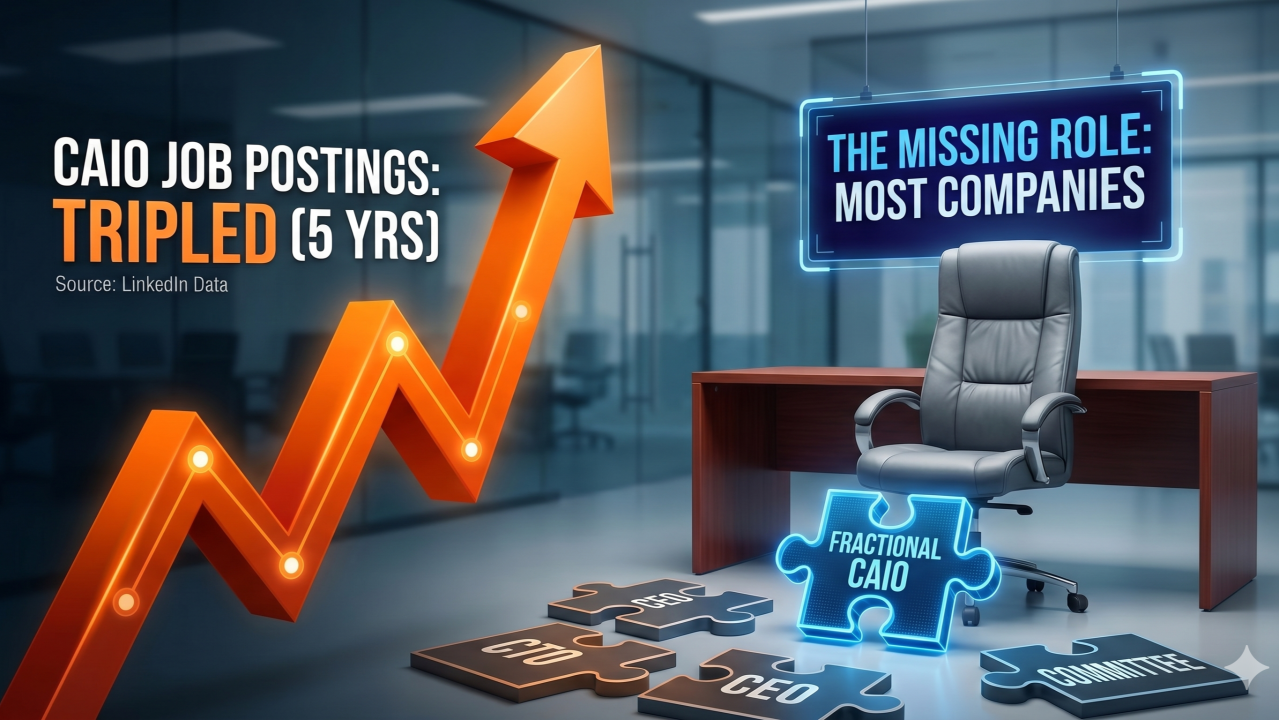
LinkedIn just reported that Chief AI Officer job postings have tripled over the last five years.

It’s now officially one of technology’s fastest-growing executive roles.

But here’s what the headline misses:

Most companies still don’t have one.

Not because they don’t need AI leadership. Because the role, as typically defined, assumes a full-time executive with a dedicated budget and organizational authority.

Most mid-market companies — the ones actually struggling with AI adoption — can’t afford that.

So what happens?

AI ownership defaults to the CEO. Or the CTO. Or a committee.

And when something belongs to everyone, it belongs to no one.

This is exactly where the fractional model changes the game.

A Fractional CAIO isn’t a consultant who advises on AI.

It’s an installed leadership function that governs AI decisions, establishes cadence, and creates accountability — on a retainer, not a project.

The demand signal is clear.

The hiring data says companies want AI leadership.

The market reality says most can’t hire it full-time.

The opportunity for AI professionals who can install governance — not just deliver advice — has never been larger.

But it requires a structural shift.

From: “I help companies with AI.”

To: “I install the decision architecture that makes AI work.”

Those are different identities. Different revenue models. Different outcomes.

Do you see the fractional CAIO model gaining traction in your network? Or is it still mostly consultant-as-title?

DataCamp just published their 2026 AI workforce data.

Two numbers tell the whole story:

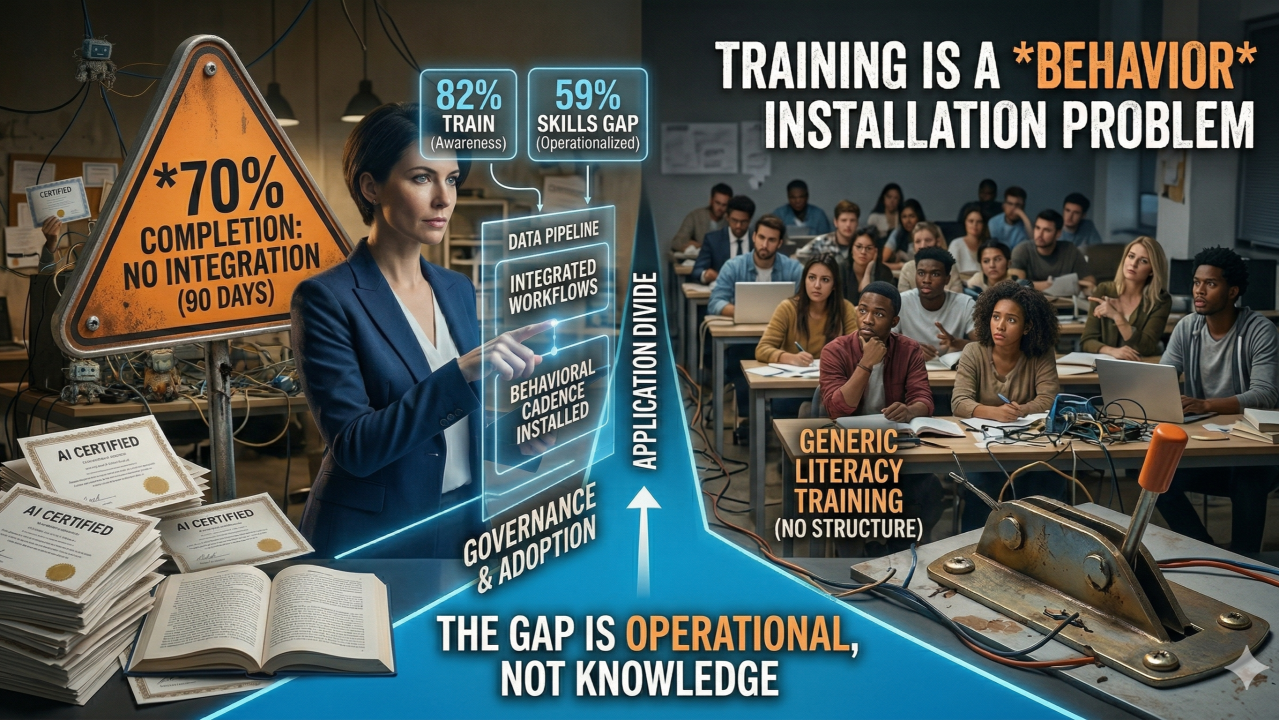
82% of enterprise leaders say their organization provides AI training.

59% still report an AI skills gap.

Read that again. The training is happening. The gap isn’t closing.

Why?

Because the gap isn’t about knowledge. It’s about application.

70% of employees who complete AI courses do not integrate AI tools into daily work within 90 days — without structured follow-up.

The research confirms what I’ve been saying for two years:

The problem isn’t that people don’t understand AI.

The problem is that no one has installed the operational structure that turns understanding into behavior.

Training teaches vocabulary.

Structure installs cadence.

One creates awareness. The other creates adoption.

This is why I stopped asking “How do I teach more people about AI?” and started asking “How do I build systems that make AI adoption inevitable?”

And it’s why, a few weeks ago, we partnered with Teri Moten as In-House AI Trainer at MyMobileLyfe.

What Installed Training Actually Looks Like

Teri doesn’t run generic AI literacy sessions.

Every training she leads is wired to a specific workflow, a specific team, and a specific outcome the business is trying to hit.

Before a session, we map what “installed” looks like for that group. What decision gets faster? What task gets offloaded? What behavior has to change? What’s the metric we’ll look at in 30 days to know whether the training actually landed?

After the session, we measure whether it actually got installed. Not whether people enjoyed it. Not whether they took good notes. Whether the behavior showed up in the work.

That’s the difference between training and installation.

One ends when the Zoom closes.

The other starts there.

I’m not sharing this to pitch a service. I’m sharing it because I refuse to add more noise to a market that already has too much of it.

If the 82/59 gap is going to close, it won’t be because somebody invented a better curriculum.

It’ll close because a small number of people decide to treat training as an installation problem — and build the structure around every session that makes the behavior stick.

That’s the work we’re doing.

And it’s the work I think a lot more of us should be doing.

The market doesn’t have a learning problem.

It has an installation problem.

The digital evolution isn’t waiting for anyone.

For businesses today, the question is no longer if they should use AI: it’s who is orchestrating it. And more importantly, how.


A Personal Journey That Became a Platform

In mid-2024, I started exploring AI with one simple goal: find additional services I could offer through our digital marketing agency, MyMobileLyfe.

I wasn’t coming in as a technologist. I was a business strategist trying to figure out where AI fit into our clients’ worlds. And honestly? I didn’t know much.

I had never heard the title Chief AI Officer. I certainly didn’t understand what the role actually demanded — the governance responsibilities, the ethical frameworks, the strategic depth required to move a company from “we’re experimenting with AI” to measurable, scalable results.

But I started digging.

The deeper I went — including studying the work coming out of organizations like ChiefAIOfficer — the clearer it became: businesses desperately need structured AI leadership, and most of them don’t know where to find it.

That realization didn’t just lead me to write a book. It became the entire foundation for One-Click AI.ai — a platform built specifically for aspiring AI consultants and CAIOs who want to deliver real strategic value to their clients.


Announcing the Second Edition

I’m thrilled to announce the release of the second edition of The Invisible Chief AI Officer: Leading in the Age of Autonomy.

This isn’t a book about AI tools. It’s a field guide for the people responsible for making AI work inside real organizations — business leaders, fractional partners, and especially non-technical certified AI consultants who are navigating clients through one of the most complex transitions in business history.

The second edition goes deeper on the core responsibilities this emerging role demands:

  • Strategic Mandates — Building a long-term AI vision that aligns with a company’s actual mission, not just its budget
  • The Silicon Workforce — Managing hybrid teams where humans and autonomous agentic systems work side by side
  • Governance & Ethics — Conducting bias audits, protecting data privacy, and building transparency into every deployment
  • Operational Models — Helping clients choose between Full-Time, Fractional, or On-Demand CAIO structures based on their specific needs and readiness

Why This Is Your Moment as an AI Consultant

Here’s what I want every non-technical certified AI consultant to understand: your value isn’t in knowing how to build models. It’s in knowing how to lead through them.

Your clients aren’t failing because they don’t have enough AI tools. They’re failing because they don’t have a coherent strategy. They’re stuck in pilot purgatory, burning budget on disconnected solutions that never add up to competitive advantage.

That’s the gap you fill.

You don’t need a hundred-million-dollar R&D budget to compete with industry giants anymore. Through models like the On-Demand CAIO, even small businesses can access the kind of strategic intelligence that was once reserved for the Fortune 500.

Whether you’re serving as a fractional partner or leveraging a platform like OneClickAI.ai to scale your practice, you are the architect of your clients’ AI future.


The Invisible Leader Is the Most Powerful One

We are operating in an era where work is increasingly autonomous — and the leaders who matter most aren’t the loudest ones in the room. They’re the ones quietly building the infrastructure, the governance, and the strategy that makes everything else possible.

That’s who this book is for.

I invite you to pick up the second edition of The Invisible Chief AI Officer and join me in bridging the gap between AI potential and profitable, sustainable business outcomes. I’ve dropped a link in the comments and you can download a Free digital copy.

The future belongs to those who act with intention.

Let’s get started.

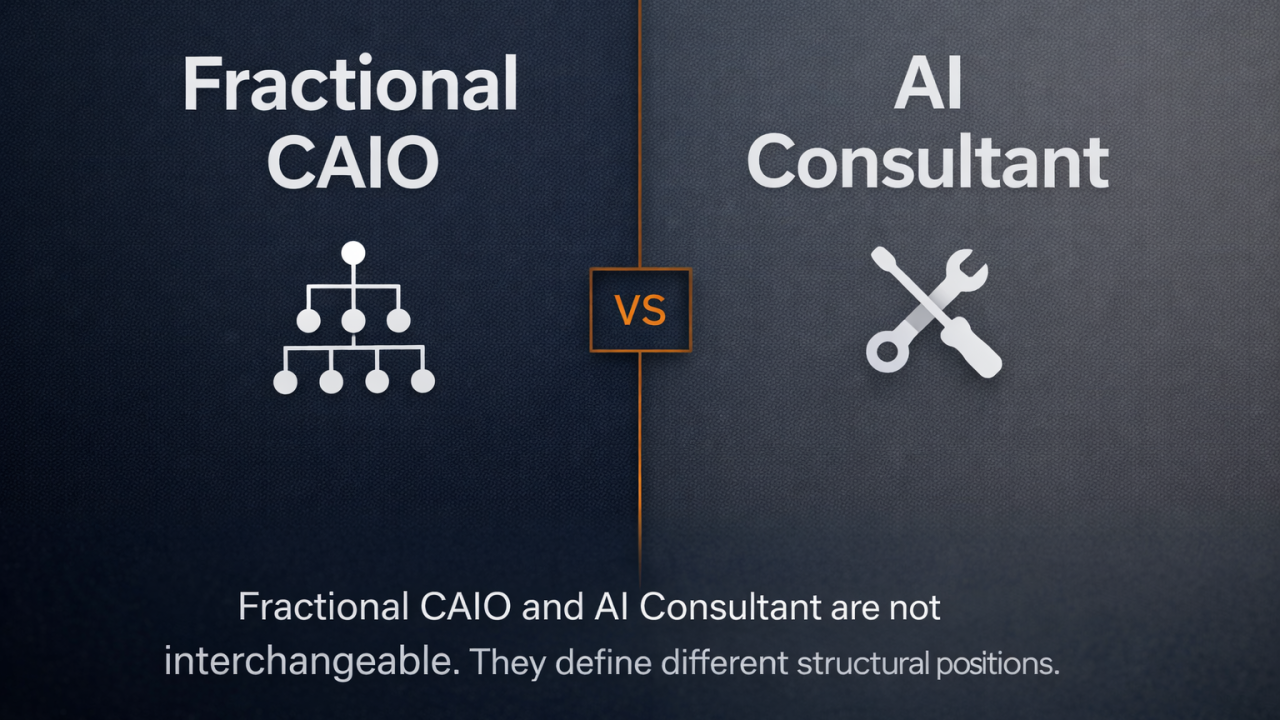
The terms are being used interchangeably.

They should not be.

“AI Consultant” and “Fractional CAIO” describe two different operating positions in the market.

The confusion is understandable.

The distinction is structural.


1️⃣ The AI Consultant

An AI consultant is brought in to:

• Advise on AI initiatives • Evaluate tools and vendors • Design implementation plans • Support execution • Deliver defined outcomes

Compensation Model: Project-based, milestone-based, or scoped advisory retainers.

Authority Level: Influence without ownership.

Identity: External expert.

The consultant’s role is directional.

They recommend.

They guide.

They deliver.

But they do not own governance.


2️⃣ The Fractional CAIO

A Fractional CAIO is installed to:

• Oversee AI governance • Define decision architecture • Establish executive cadence • Align AI initiatives with business objectives • Manage risk and prioritization • Report at leadership level

Compensation Model: Retainer-based executive function.

Authority Level: Oversight and structured decision influence.

Identity: Installed leadership role.

The Fractional CAIO does not simply recommend AI initiatives.

They design how AI decisions get made.

That distinction changes everything.


3️⃣ Influence vs Governance

Consultants answer:

“What should we do?”

Fractional CAIOs answer:

“How will AI decisions be structured, evaluated, and overseen over time?”

One solves problems.

The other installs systems.

One delivers insight.

The other defines operating rhythm.


4️⃣ Execution Model vs Governance Model

AI Consultant: Revenue tied to projects.

Fractional CAIO: Revenue tied to executive oversight.

Projects end.

Governance continues.

Projects must be resold.

Governance renews.


5️⃣ The Title Problem

Many professionals adopt the title “Fractional CAIO.”

Few install a governance model.

Title adoption without structural installation creates confusion in the market.

Fractional CAIO is not a branding upgrade.

It is an operating model.

Without:

• Defined governance cadence • Reporting structure • 90-day oversight rhythm • Budget prioritization logic • Risk management framework

You are operating as a consultant.

Not as a CAIO.


6️⃣ Why This Definition Matters

The AI market is expanding.

But advisory revenue volatility remains high.

The reason is not lack of demand.

It is structural misalignment.

When you operate as a consultant while attempting to earn as a governance executive, friction appears.

Clarity resolves friction.


Closing Definition

AI Consultant: Delivers AI expertise.

Fractional CAIO: Installs AI governance.

Both roles are valid.

They are not the same.

The shift is not skill.

The shift is structure.

Businesses are grappling with the transformative potential of artificial intelligence, understanding that strategic AI adoption is crucial for survival and growth. But navigating this complex landscape requires expertise. Just as companies rely on CFOs to manage finances and CTOs to steer technological development, a dedicated AI leader is becoming increasingly vital. The question, then, isn’t if you need AI leadership, but what kind?

The traditional model of a full-time Chief AI Officer (CAIO) isn’t always the right answer. Many organizations, especially smaller businesses and those in early stages of AI adoption, may find the investment excessive. Fortunately, there are alternative approaches: fractional and on-demand AI leadership. Each model offers distinct advantages and disadvantages, and the optimal choice depends on a company’s size, maturity, industry, and strategic AI goals.

The Full-Time CAIO: Deep Dive and Dedicated Focus

The full-time CAIO is a dedicated executive solely focused on driving the company’s AI strategy. This individual is responsible for:

  • Strategy Development: Defining the overall AI vision, identifying key opportunities, and creating a roadmap for implementation.
  • Team Building and Management: Recruiting, training, and managing a team of data scientists, AI engineers, and other AI specialists.
  • Project Oversight: Overseeing all AI-related projects, ensuring they align with the strategic vision and deliver tangible results.
  • Data Governance and Compliance: Establishing and enforcing policies for data privacy, security, and ethical AI development.
  • Stakeholder Communication: Communicating the value of AI initiatives to internal stakeholders (leadership, employees) and external stakeholders (investors, customers).
  • Staying Ahead of the Curve: Continuously researching and evaluating emerging AI technologies and trends.

Pros:

  • Deep Immersion: Full-time CAIOs can fully immerse themselves in the company’s operations, deeply understand its challenges and opportunities, and tailor AI solutions accordingly.
  • Strong Leadership and Influence: A dedicated executive has the authority and influence to champion AI initiatives across the organization and drive cultural change.
  • Consistent Focus: Unlike fractional or on-demand models, a full-time CAIO provides a constant and consistent focus on AI strategy and execution.
  • Long-Term Vision: They can develop a long-term AI roadmap and build a sustainable AI infrastructure for future growth.
  • Dedicated Team Building: A full-time CAIO can dedicate time and resources to building a highly skilled and cohesive AI team.

Cons:

  • High Cost: Hiring a full-time CAIO, especially one with significant experience, can be a substantial financial investment. This includes salary, benefits, and potential stock options.
  • Potential for Underutilization: If the company is not yet ready to fully embrace AI, the full-time CAIO’s skills and expertise may be underutilized, leading to frustration and a poor return on investment.
  • Difficulty Finding the Right Fit: Finding a CAIO with the right combination of technical expertise, business acumen, and leadership skills can be challenging.
  • Slower Project Start: Can take months to onboard, set up project workflows, and recruit a team, creating a drag on timelines.

The Fractional CAIO: Strategic Guidance, Scalable Expertise

A fractional CAIO provides strategic AI leadership on a part-time basis. This model allows companies to access top-tier AI expertise without the commitment of a full-time hire. Fractional CAIOs typically work with multiple clients simultaneously, allocating their time and resources based on each client’s needs. Their responsibilities are similar to those of a full-time CAIO, but the scope and depth of their involvement may vary.

Pros:

  • Cost-Effective: Fractional CAIOs offer a more affordable option than full-time hires, as companies only pay for the specific time and expertise they need.
  • Access to Specialized Expertise: Companies can tap into a broader range of expertise and experience by working with a fractional CAIO who has worked across different industries and AI applications.
  • Flexibility and Scalability: The fractional model provides flexibility to scale AI leadership up or down as needed, based on project demands and business priorities.
  • Reduced Risk: By working with a fractional CAIO, companies can test the waters of AI adoption before committing to a full-time hire.
  • Objective Perspective: Fractional CAIOs bring an objective, external perspective to the company’s AI strategy, helping to identify blind spots and potential challenges.

Cons:

  • Limited Availability: Fractional CAIOs may not be available on-demand, and scheduling conflicts can arise.
  • Less Immersive: They may not have the same level of immersion in the company’s culture and operations as a full-time CAIO.
  • Potential for Competing Priorities: Fractional CAIOs are managing multiple clients, which can potentially lead to competing priorities and delayed responses.
  • Communication Challenges: Effective communication and coordination are crucial to ensure the fractional CAIO is aligned with the company’s goals and priorities.

The On-Demand AI Leader: Just-in-Time Expertise

The on-demand AI leadership model takes the fractional concept a step further, providing access to AI expertise on a project-by-project or as-needed basis. This approach is ideal for companies that need specific AI skills for a limited time or for tackling targeted challenges. Think of it as “rent-a-CAIO” for specific tasks.

Pros:

  • Highly Flexible and Scalable: On-demand AI leadership provides maximum flexibility, allowing companies to access the exact skills they need, when they need them.
  • Cost-Effective for Short-Term Projects: This model is particularly cost-effective for short-term projects or specific AI initiatives.
  • Access to Niche Expertise: Companies can tap into highly specialized AI expertise for specific tasks, such as developing a chatbot, implementing a machine learning algorithm, or assessing data privacy risks.
  • Quick Deployment: On-demand AI leaders can be deployed quickly, allowing companies to address urgent AI challenges without delay.
  • Reduced Overhead: There are no ongoing salary or benefit costs associated with on-demand AI leadership.

Cons:

  • Limited Strategic Involvement: On-demand AI leaders typically focus on specific tasks or projects, with limited involvement in the overall AI strategy.
  • Potential for Fragmentation: If not properly coordinated, the use of multiple on-demand AI leaders can lead to fragmentation and inconsistencies in the company’s AI approach.
  • Knowledge Transfer Challenges: Ensuring proper knowledge transfer from the on-demand AI leader to the company’s internal team is crucial to avoid dependence.
  • Finding Reliable Providers: Finding reputable and qualified on-demand AI leaders can be challenging.

Choosing the Right Model: A Decision Framework

Choosing the right AI leadership model requires careful consideration of several factors:

  • Company Size and Stage: Startups and small businesses may benefit from fractional or on-demand AI leadership, while larger enterprises may require a full-time CAIO.
  • AI Maturity: Companies in the early stages of AI adoption may start with a fractional or on-demand approach and then transition to a full-time CAIO as their AI needs grow.
  • Strategic Goals: The complexity and scope of the company’s AI strategic goals will influence the type of AI leadership required. Ambitious, company-wide AI transformation requires full-time dedication.
  • Budget: The company’s budget for AI leadership will be a key factor in determining the affordability of each model.
  • Risk Tolerance: Companies with a low risk tolerance may prefer to start with a fractional or on-demand approach to test the waters before committing to a full-time hire.
  • Industry: Certain industries, like healthcare and finance, demand full-time support due to stringent compliance and ethical responsibilities.

One-Click CAIO: A Streamlined Solution for On-Demand AI Leadership

For businesses seeking a swift and efficient way to integrate on-demand AI leadership, services like MyMobileLyfe’s One-Click CAIO offer a compelling solution. This approach simplifies the process of finding and engaging experienced AI professionals, providing immediate access to expertise without the lengthy recruitment process or long-term commitment. This is perfect for businesses targeting rapid AI adoption and strategic implementation.

Ultimately, the best AI leadership model is the one that aligns with your company’s specific needs, resources, and strategic objectives. By carefully evaluating the pros and cons of full-time, fractional, and on-demand options, you can choose the AI navigator that will best guide your business to success in the age of artificial intelligence.

Artificial intelligence. The term conjures images of self-driving cars, hyper-personalized marketing, and automation that streamlines everything from customer service to product development. While these futuristic visions are becoming increasingly real, the path to AI adoption for most businesses is fraught with challenges. From navigating the complex landscape of AI technologies to integrating them effectively into existing workflows, the journey demands strategic planning, expert guidance, and, in many cases, dedicated leadership. This begs the question: Is it time for your company to appoint a Chief AI Officer (CAIO)?

For CEOs and business owners grappling with the burgeoning potential of AI, this question is paramount. A CAIO isn’t just another tech executive; they are a strategic visionary responsible for defining and implementing an organization’s AI strategy, ensuring that AI initiatives align with business goals, mitigate risks, and drive innovation. Ignoring the need for such a leader can lead to fragmented AI efforts, wasted resources, and ultimately, being left behind in a rapidly evolving competitive landscape.

So, how do you know if your organization needs a CAIO? Here are some key indicators:

1. You’re Bombarded with AI Buzz, but Lack a Clear Strategy:

The sheer volume of information surrounding AI can be overwhelming. From machine learning and deep learning to natural language processing and computer vision, the jargon alone can be enough to induce paralysis. If your team is experimenting with various AI tools without a unified strategy, you’re likely wasting time and resources.

A CAIO brings clarity to this chaos. They can help you understand the different types of AI, assess their suitability for your specific business needs, and develop a cohesive strategy that aligns with your overall organizational objectives. They will identify the areas where AI can deliver the most significant impact, prioritize projects, and ensure that efforts are focused on achieving measurable results.

2. AI Projects Are Stalled or Underperforming:

You may have initiated several AI projects, but they’re either stalled in development or failing to deliver the promised ROI. This can be due to a lack of internal expertise, poor data quality, integration challenges, or simply a misalignment between the AI solutions and the actual business needs.

A CAIO acts as a project champion, providing the necessary leadership and oversight to ensure that AI projects are successfully implemented. They will work closely with technical teams, business stakeholders, and data scientists to identify and address roadblocks, optimize performance, and ensure that projects deliver tangible value. This includes ensuring that data is clean, accessible, and used ethically and responsibly.

3. You’re Struggling to Attract and Retain AI Talent:

AI talent is in high demand. Attracting and retaining skilled data scientists, machine learning engineers, and AI specialists requires more than just a competitive salary. They need to feel like they are contributing to a meaningful mission, working on challenging projects, and have opportunities for growth and development.

A CAIO can help you create a compelling vision for AI within your organization, attracting top talent who are passionate about using AI to solve real-world problems. They can also foster a culture of innovation and collaboration, providing opportunities for AI professionals to learn, grow, and advance their careers. Moreover, a CAIO understands the specific skill sets needed and can guide the hiring process to ensure you’re attracting the right people.

4. You’re Concerned About Ethical and Responsible AI:

AI is not without its risks. Biased algorithms, data privacy violations, and the potential for job displacement are all legitimate concerns. Failing to address these ethical considerations can damage your reputation, erode trust with customers, and even lead to legal repercussions.

A CAIO has a crucial role to play in ensuring that AI is developed and deployed ethically and responsibly. They will establish guidelines and policies for data privacy, algorithm transparency, and bias mitigation. They will also work to promote a culture of responsible AI within the organization, educating employees about the potential risks and benefits of AI and encouraging them to use it in a way that benefits society as a whole. This includes staying abreast of evolving regulations and compliance requirements related to AI.

5. Your Competitors Are Leveraging AI to Gain a Competitive Advantage:

In today’s rapidly evolving business landscape, AI is becoming a key differentiator. If your competitors are already using AI to improve their products, services, or operations, you risk falling behind. Ignoring AI is no longer an option; it’s a strategic imperative.

A CAIO can help you identify opportunities to leverage AI to gain a competitive advantage. They will monitor industry trends, assess the capabilities of your competitors, and develop innovative AI solutions that can help you stay ahead of the curve. This could involve using AI to personalize customer experiences, optimize supply chains, automate tasks, or develop new products and services.

6. You’re Not Sure How to Scale Your Existing AI Initiatives:

You might have a few successful AI projects under your belt, but you’re struggling to scale them across the organization. This can be due to a lack of infrastructure, data silos, or simply a lack of organizational readiness.

A CAIO will develop a roadmap for scaling AI initiatives across the organization. This includes identifying the necessary infrastructure, establishing data governance policies, and providing training and support to employees. They will also work to break down silos between departments, fostering a collaborative environment where AI can be used to solve problems across the entire organization.

Appointing a CAIO is a significant decision, and it’s not necessarily the right move for every organization. However, if you’re experiencing any of the symptoms outlined above, it’s worth considering. A dedicated AI leader can provide the strategic vision, technical expertise, and organizational leadership needed to unlock the full potential of AI and drive meaningful business outcomes.

The world of AI is complex and ever-changing. Understanding the nuances and avoiding costly mistakes requires specialized knowledge and strategic thinking. That’s why it’s crucial to have a leader who can navigate the intricacies of AI and guide your organization towards success. To delve deeper into the often unseen, but critical role of AI leadership, we invite you to explore our eBook, The Invisible Chief AI Officer: Why Many Businesses Need a Leader They May Not See. This comprehensive guide provides valuable insights into the importance of AI leadership and how it can transform your business. Purchase your copy today!