Posts Tagged
‘AI Agents’

Home / AI Agents

Here’s a number that should concern every hiring manager, career counselor, and workforce development leader in the country:

Junior tech job postings have declined 67% since 2022.

Not a slowdown. A collapse.

And it’s not just tech. LinkedIn’s hiring rate for entry-level workers dropped 6% between December 2025 and February 2026. Middle-management hiring declined 10% over the same window.

The mechanism is straightforward. Many of the tasks that used to fill entry-level roles — research, drafting, analysis, coordination — can now be accelerated or partially automated by generative AI tools. Companies under cost pressure responded by eliminating the roles that performed those tasks.

But here’s what nobody’s talking about:

We’re building a career ladder with no first rung.

Employers say they want mid-career professionals with five to ten years of experience. But the roles that used to produce those five to ten years are disappearing.

The Paradox Nobody’s Solving

Job postings now routinely demand two to three years of experience for what used to be entry-level positions. You need the job to get the experience. You need the experience to get the job.

Employment for 22-to-25-year-olds in AI-exposed occupations has dropped 13% since late 2022. For software developers in that age range, it’s down 20%.

This isn’t just a Gen Z problem. It’s a pipeline problem.

If you’re an employer cutting entry-level roles today, ask yourself: where does your mid-career talent come from in 2030?

If you’re a workforce development leader, ask yourself: what are you building for the people who can’t get on the ladder at all?

What the Adaptive Workers Are Doing

The workers who are navigating this aren’t waiting for the ladder to come back. They’re building their own.

They’re stacking credentials — not just degrees, but certificates, portfolio projects, and documented AI-augmented work samples.

They’re treating continuous learning as a job requirement, not an extracurricular.

They’re gaining experience through freelance projects, open-source contributions, and apprenticeship-style arrangements before they ever land a full-time role.

It’s not the path anyone drew up. But it’s the path that’s working.

The question for the rest of us — employers, educators, consultants, policymakers — is whether we’re going to keep pretending the old ladder still exists.

Or start building a new one.

If you’re hiring right now — are you still requiring experience that entry-level candidates have no way to get? What would it take to rethink that?

Here’s the stat that should end every debate about whether AI adoption is a training problem:

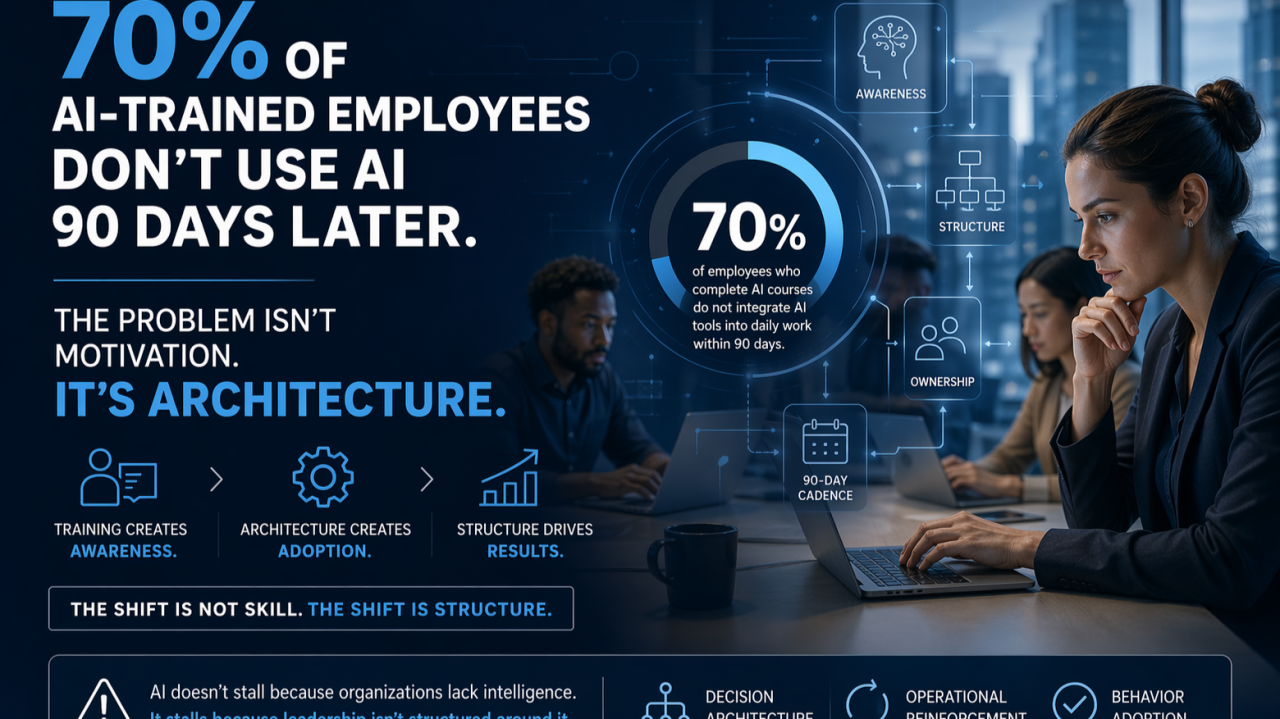
70% of employees who complete AI courses do not integrate AI tools into daily work within 90 days.

Not because they didn’t learn.

Not because they weren’t motivated.

Because there was no structured follow-up.

No operational reinforcement.

No system that turned awareness into behavior.

This is the same pattern at every level:

At the individual level: people learn AI but don’t use it.

At the consultant level: people get certified but can’t close clients.

At the enterprise level: companies pilot AI agents but can’t get them to production.

The thread connecting all three?

The absence of operational architecture.

Training creates awareness.

Architecture creates adoption.

This distinction is the single most important idea in AI right now. And it’s the one almost nobody is building for.

Everyone is building more courses. More tools. More certifications. More agents.

Almost nobody is building the governance layer — the decision architecture, the ownership model, the 90-day cadence — that makes any of it stick.

That’s the gap.

And the people who fill it won’t be the most technically fluent AI professionals.

They’ll be the ones who understand something deeper:

AI doesn’t stall because organizations lack intelligence.

It stalls because leadership isn’t structured around it.

The shift is not skill.

The shift is structure.

Here’s the number everyone in AI should be paying attention to right now:

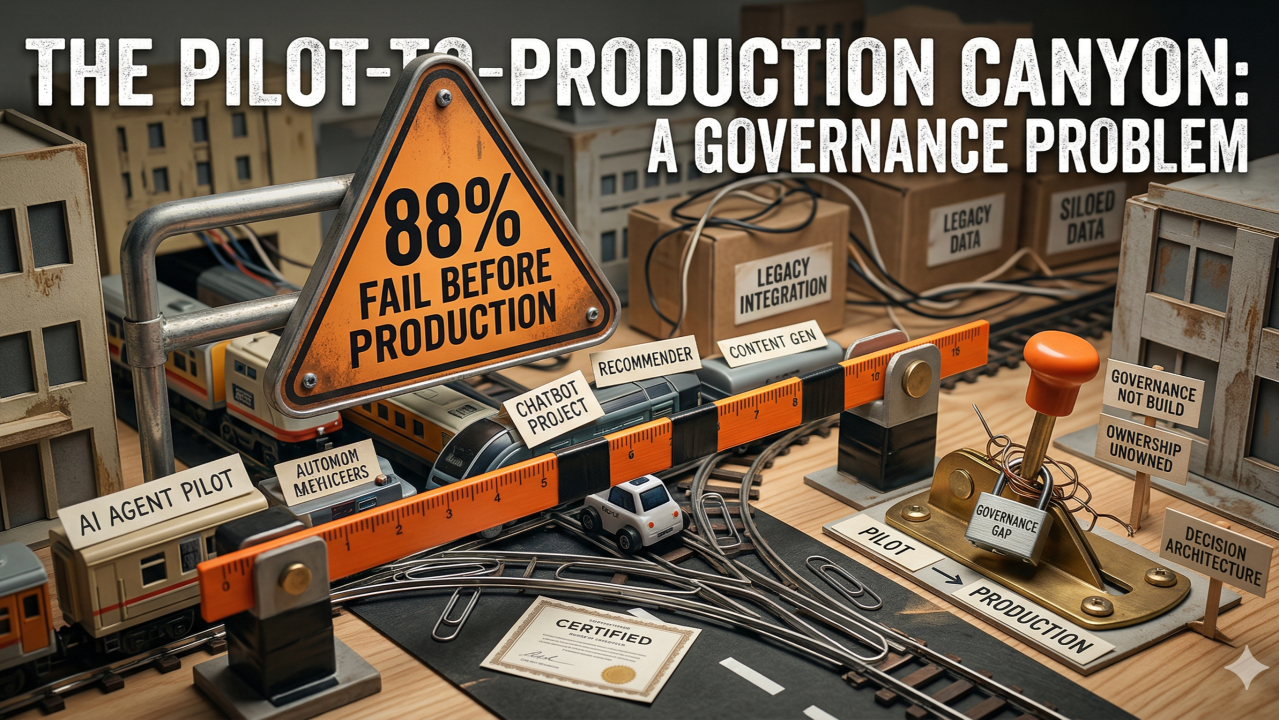
88% of AI agent projects fail to reach production.

Not because the technology doesn’t work.

Not because the models aren’t good enough.

Because — according to the research — “teams build agents before they build controls.”

Let that sink in.

The Deployment Backlog Nobody’s Talking About

78% of enterprises now have AI agent pilots running.

Only 14% have successfully scaled to production.

That’s not a gap. That’s a canyon.

And it gets worse. A March 2026 survey of 650 enterprise technology leaders found that even when pilots show meaningful results — and 67% of them do — only 10% ever make it across the finish line.

This is the largest deployment backlog in enterprise technology history. Double the failure rate of traditional IT projects.

The agents work in the lab. They work in the demo. They impress the steering committee.

And then they stall.

Five Root Causes — And Only One Is Technical

New research has identified the five root causes that account for 89% of scaling failures:

Integration complexity with legacy systems.

Inconsistent output quality at volume.

Absence of monitoring tooling.

Unclear organizational ownership.

Insufficient domain training data.

Look at that list carefully.

Only one — integration complexity — is a technology problem.

The rest? Ownership. Monitoring. Quality control. Governance.

These are leadership problems wearing technical disguises.

And they’re interrelated in a way that makes them compound. Ownership gaps leave monitoring gaps unfilled. Monitoring gaps make quality problems invisible. Invisible quality problems erode executive trust. Eroded trust kills budget.

It’s a chain reaction. And it starts — every time — with the same missing variable:

Nobody owns this.

Agent Sprawl: The Term You’ll Be Hearing Everywhere

There’s a new concept emerging in enterprise AI that perfectly captures what’s happening:

Agent sprawl.

It’s the uncontrolled proliferation of siloed, ungoverned AI agents across an enterprise. It happens when business units move fast to solve immediate problems with AI — without a unifying strategy, shared data infrastructure, or centralized oversight.

Sound familiar?

It should. It’s the same pattern I’ve been naming for two years. I called it “Duct-Tape Adoption” — sticking AI onto broken processes and hoping it creates magic.

The only difference now? The stakes are higher.

When it was chatbots and automation workflows, duct-tape adoption wasted time and budget.

When it’s autonomous agents making decisions, accessing databases, and operating across departments — duct-tape adoption creates organizational risk.

The security data backs this up. 88% of organizations reported confirmed or suspected AI agent security incidents in the last year. 80% documented risky agent behaviors including unauthorized system access and data exposure. And 64% of companies with revenue above $1 billion reported losses exceeding $1 million tied to AI system failures.

These aren’t hypothetical risks. They’re happening right now, in production environments, at scale.

The Readiness Gap in Four Numbers

Research now quantifies exactly how unprepared most organizations are to govern agentic AI. Four readiness categories tell the story:

Infrastructure readiness: 43%.

Data management readiness: 40%.

Governance readiness: 30%.

Talent readiness: 20%.

That last number should stop every AI consultant and advisor in their tracks.

Only 20% of organizations are talent-ready for agentic AI.

And governance — the single most critical variable for moving agents from pilot to production — sits at 30%.

This is why Gartner is now warning that 40%+ of agentic AI projects may be cancelled by 2027.

Not for lack of capability.

For lack of structure.

What This Means If You’re an AI Consultant

This data is both a warning and an opportunity.

The warning: implementation advice alone won’t save a stalled agent deployment. If you’re still leading with tool recommendations and feature demos, you’re solving a problem the market has already moved past.

The opportunity: the organizations that need you most right now aren’t asking “what tool should we use?”

They’re asking something harder:

“How do we govern what we’ve already built?”

“Who owns the decision about what this agent is allowed to do?”

“What happens when it breaks — and who’s accountable?”

Those aren’t consulting questions. They’re governance questions. And they require a fundamentally different operating model than most AI consultants are running.

The consultants who step into that gap — who can install decision architecture, define ownership, and build the 90-day oversight cadence — will own the most valuable real estate in the AI market for the next three years.

The ones who keep leading with tools will wonder why their pipeline dried up.

The Bottom Line

The agentic AI wave isn’t failing because the technology is immature.

It’s failing because organizations are building agents the same way they adopted every other AI tool:

Fast. Excited. Unstructured.

And for the first time, the consequences of that approach aren’t just wasted budget.

They’re security incidents. Unauthorized access. Million-dollar losses.

The market doesn’t need more agents.

It needs more architecture.

Source data:

– 88% failure rate, 78% piloting / 14% production (Apify enterprise research, Digital Applied March 2026 survey)

– 67% of pilots show meaningful results, only 10% scale (Digital Applied)

– 5 root causes account for 89% of failures (ZBrain, HarrisonAIX)

– Agent sprawl and security incidents: 88% confirmed/suspected incidents, 80% risky behaviors (Gravitee State of AI Agent Security 2026)

– 64% of $1B+ companies report $1M+ AI losses (Accelirate)

– Readiness gaps: Governance 30%, Talent 20% (Decidr US AI Readiness Index 2026)

– Gartner: 40%+ agentic AI project cancellation risk by 2027

– Only 22% treat agents as independent identities (Security Boulevard)

The pursuit of efficiency is a constant drumbeat in the business world. Automation has long been a key strategy, but traditional automation often relies on rigid rules and predefined workflows. Now, a new paradigm is emerging: AI agents. These intelligent, autonomous software entities promise to revolutionize how businesses operate by handling complex tasks, making informed decisions, and seamlessly collaborating with both human employees and other systems. For business leaders and operations managers seeking to elevate productivity and unlock new capabilities, understanding and preparing for AI agents is becoming increasingly critical.

What are AI Agents and Agentic Systems?

At their core, AI agents are autonomous entities designed to perceive their environment, process information, and take actions to achieve specific goals. Unlike traditional software programs that execute predetermined commands, AI agents possess a degree of intelligence, allowing them to adapt to changing circumstances and make decisions without explicit human intervention. This intelligence is typically driven by machine learning, natural language processing (NLP), and reasoning capabilities.

Agentic systems are essentially teams of these AI agents working together, often in a distributed manner, to tackle complex problems. Each agent within the system may specialize in a specific area, communicate with other agents, and contribute to a shared objective. This collaborative approach allows agentic systems to handle tasks far beyond the scope of individual AI agents or traditional automation solutions.

A key characteristic that distinguishes AI agents from conventional automation tools is their capacity for reasoning and planning. They can analyze complex situations, formulate strategies, and adjust their actions based on real-time feedback. This empowers them to handle unpredictable scenarios and adapt to dynamic environments, a crucial advantage over rigid, rule-based systems.

Consider this simplified analogy: Imagine a shipping company. Traditional automation might involve software that prints labels and tracks packages based on pre-defined routes. An AI agent, on the other hand, could analyze traffic patterns, weather conditions, and delivery schedules to dynamically reroute packages, proactively avoid delays, and optimize the entire logistics process.

Key Features of AI Agents:

  • Autonomy: Agents operate independently without continuous human supervision.
  • Intelligence: They leverage AI technologies to learn, reason, and make decisions.
  • Adaptability: Agents can adjust their behavior in response to changing conditions.
  • Goal-oriented: They are designed to achieve specific objectives.
  • Interactivity: Agents can communicate and collaborate with other agents and humans.

Real-World Applications: Current Use Cases Demonstrating Impact

While the field is rapidly evolving, AI agents are already demonstrating tangible value in various industries. Here are some illustrative examples:

  • Customer Service: AI-powered virtual assistants are evolving beyond simple chatbots. They can now handle complex customer inquiries, proactively identify and resolve issues, and escalate problems to human agents when necessary. For example, companies like Amelia offer cognitive AI agents that can understand customer intent and personalize interactions, resulting in improved customer satisfaction and reduced support costs.
  • Supply Chain Management: Agentic systems can optimize supply chains by predicting demand, managing inventory levels, and coordinating logistics. These systems can analyze vast amounts of data from various sources, including market trends, supplier performance, and transportation networks, to make proactive decisions that minimize disruptions and improve efficiency. Research from McKinsey highlights the potential of AI to significantly improve supply chain performance, with benefits ranging from reduced costs to increased resilience.
  • Financial Services: AI agents are being used to detect fraud, assess risk, and provide personalized financial advice. These agents can analyze transaction patterns, identify anomalies, and flag suspicious activity for further investigation. They can also use machine learning algorithms to predict market trends and provide customized investment recommendations to clients. Companies like DataVisor leverage AI to combat fraud across various industries, demonstrating the agent’s ability to learn and adapt to evolving fraud patterns.
  • Cybersecurity: AI agents can proactively monitor network traffic, identify potential threats, and automatically respond to security incidents. These agents can learn from past attacks, adapt to new threats, and provide real-time protection against cyberattacks. Darktrace is an example of an autonomous response technology that uses AI to detect and neutralize cyber threats in real-time.
  • Software Development: AI agents can assist with tasks such as code generation, testing, and debugging. They can also automate repetitive tasks, freeing up developers to focus on more creative and strategic work. GitHub Copilot, powered by OpenAI’s Codex, is a prime example of an AI pair programmer that suggests code snippets and helps developers write code more efficiently.

Preparing for the Integration of AI Agents

Implementing AI agents requires a strategic approach and careful planning. Here are key steps that businesses should consider:

  1. Identify Opportunities: Begin by identifying specific areas within your organization where AI agents could deliver the most significant impact. Focus on processes that are data-intensive, complex, and require a high degree of adaptability.
  2. Define Clear Objectives: Establish clear, measurable goals for the implementation of AI agents. What specific outcomes do you want to achieve? How will you measure success?
  3. Build a Data Infrastructure: AI agents rely on high-quality data to learn and make informed decisions. Ensure that you have a robust data infrastructure in place that can collect, process, and store the data required by your AI agents.
  4. Develop a Human-AI Collaboration Strategy: AI agents are not intended to replace human employees entirely. Instead, they should be seen as tools that augment human capabilities and enable employees to focus on higher-value tasks. Develop a strategy for how AI agents and human employees will collaborate to achieve shared goals.
  5. Address Ethical Considerations: As AI agents become more autonomous, it’s crucial to address ethical considerations, such as bias, fairness, and accountability. Ensure that your AI agents are designed and deployed in a way that aligns with your company’s values and ethical principles.
  6. Invest in Training and Development: Provide employees with the training and development they need to effectively work with AI agents. This includes training on how to use and manage the agents, as well as training on the skills that will be most valuable in a world where AI agents are prevalent.
  7. Start Small and Iterate: Begin with a pilot project to test and refine your approach before deploying AI agents on a larger scale. This will allow you to identify potential challenges and make adjustments as needed.
  8. Choose the Right Platform: Selecting the appropriate platform is critical. Look for solutions that offer flexibility, scalability, and robust security features. Consider both open-source frameworks and commercially available AI agent platforms.

The Future of Work: A Symbiotic Relationship

AI agents are not just a technological innovation; they represent a fundamental shift in how work is performed. By automating complex tasks, enhancing decision-making, and facilitating collaboration, AI agents have the potential to unlock unprecedented levels of efficiency and productivity. However, successful integration requires a proactive approach, a commitment to ethical considerations, and a focus on building a symbiotic relationship between humans and machines.

As AI technology continues to advance, AI agents will become even more sophisticated and capable. Businesses that embrace this technology and strategically integrate it into their operations will be well-positioned to thrive in the increasingly competitive landscape of the future. The era of the digital team member is dawning, and the companies that are prepared to welcome them will be the ones that lead the way.

For innovation leads and CTOs, the relentless march of technology demands constant vigilance. We’ve witnessed AI evolve from a theoretical concept to a collection of powerful tools – predictive analytics, machine learning models, natural language processing engines. Now, a new evolution is underway: the rise of agentic systems, AI constructs capable of autonomous action and complex decision-making. This shift is not merely incremental; it’s a fundamental reimagining of how work gets done, and it demands your immediate attention.

Agentic AI marks a significant departure from the passive, reactive AI of the recent past. Traditional AI typically requires human intervention at multiple stages: defining the problem, structuring the data, training the model, validating the results, and finally, implementing the solution. Agentic systems, on the other hand, are designed to operate with a degree of independence, learning from their environment, adapting to new information, and executing tasks without constant human oversight.

Think of a self-driving car navigating city streets. It’s not simply following pre-programmed routes; it’s constantly processing sensor data, reacting to unforeseen obstacles, and making split-second decisions in real-time. This level of autonomy, powered by sophisticated AI agents, is increasingly being applied across diverse industries, revolutionizing everything from supply chain management to customer service.

The Anatomy of an Agentic System

To understand the transformative potential of agentic AI, it’s crucial to understand its underlying architecture. These systems are typically comprised of several key components:

  • Perception: This layer is responsible for gathering data from the environment. It relies on a range of sensors, APIs, and data streams to collect relevant information. This could include anything from market trends and competitor pricing to customer feedback and real-time inventory levels.
  • Planning: This component analyzes the collected data and formulates a plan of action to achieve a specific goal. It leverages sophisticated algorithms and decision-making models to identify the optimal strategy. This stage involves assessing potential risks and rewards, considering constraints, and prioritizing tasks.
  • Action: This is the execution phase, where the agentic system translates the plan into concrete actions. This might involve automating processes, triggering alerts, initiating transactions, or interacting with other systems and individuals.
  • Learning: This is the crucial feedback loop that allows the system to improve its performance over time. By analyzing the outcomes of its actions, the agentic AI learns from its mistakes, refines its strategies, and adapts to changing conditions. This continuous learning process is what distinguishes agentic systems from traditional rule-based automation.

Reshaping Workflows and Decision-Making

The implications of agentic AI for workflows and decision-making are profound. Consider the following examples:

  • Supply Chain Optimization: Imagine an agentic system that monitors global supply chains in real-time. It tracks weather patterns, political instability, and supplier performance, proactively identifying potential disruptions and automatically adjusting sourcing strategies to minimize delays and cost overruns. This proactive approach can dramatically improve supply chain resilience and efficiency.
  • Personalized Customer Experiences: Agentic AI can analyze customer data from multiple sources – browsing history, purchase patterns, social media activity – to create highly personalized customer experiences. It can anticipate customer needs, offer tailored recommendations, and proactively resolve issues before they escalate. This level of personalization can drive customer loyalty and increase sales.
  • Automated Content Creation: Agentic systems are now capable of generating high-quality content for various purposes. They can write blog posts, create marketing copy, and even produce video scripts, freeing up human writers to focus on more strategic and creative tasks. This can significantly reduce content creation costs and accelerate marketing efforts.
  • Risk Management: In finance, agentic AI can continuously monitor market conditions, identify potential risks, and automatically adjust investment portfolios to mitigate losses. It can also detect fraudulent transactions and prevent financial crimes, enhancing security and compliance.

The Evolving Role of the Employee

The rise of agentic AI inevitably raises questions about the future of work. While some fear widespread job displacement, the reality is more nuanced. Agentic systems are not intended to replace human workers entirely, but rather to augment their capabilities and free them from mundane and repetitive tasks.

This shift will require employees to develop new skills and adapt to new roles. The focus will shift from execution to oversight, from data entry to data analysis, from task completion to problem-solving. Employees will need to become proficient in working alongside agentic systems, understanding their limitations, and intervening when necessary.

This means investing in training and development programs to equip employees with the skills they need to thrive in an AI-powered workplace. It also means fostering a culture of collaboration and innovation, where employees are encouraged to experiment with new technologies and find creative ways to leverage agentic AI.

Challenges and Considerations

While the potential benefits of agentic AI are significant, there are also challenges and considerations that must be addressed:

  • Bias and Fairness: Agentic systems are trained on data, and if that data is biased, the system will perpetuate and amplify those biases. It’s crucial to ensure that training data is diverse and representative and to implement safeguards to prevent discriminatory outcomes.
  • Explainability and Transparency: Understanding how an agentic system makes decisions is essential for building trust and accountability. However, many AI models are “black boxes,” making it difficult to understand their reasoning. Developing more explainable and transparent AI models is a critical challenge.
  • Security and Privacy: Agentic systems often handle sensitive data, making them vulnerable to cyberattacks and data breaches. Robust security measures and data privacy protocols are essential to protect against these threats.
  • Ethical Considerations: As AI becomes more autonomous, ethical considerations become increasingly important. We need to establish clear ethical guidelines for the development and deployment of agentic systems, ensuring that they are used responsibly and for the benefit of society.

Embracing the Future

The rise of agentic systems represents a paradigm shift in the world of AI. It’s a trend that innovation leads and CTOs cannot afford to ignore. By understanding the potential of agentic AI and proactively addressing the associated challenges, businesses can unlock new levels of efficiency, innovation, and competitive advantage.

Navigating this evolving landscape requires a strategic approach and a clear understanding of the role AI will play within your organization. You need to ask fundamental questions about how AI can augment your existing processes, improve decision-making, and drive growth. Identifying the right talent to lead and manage your AI initiatives is paramount. But where do you find a leader with the vision, expertise, and strategic acumen to steer your organization through this transformation?

Learn how to cultivate AI leadership within your organization by discovering the untapped potential of an “Invisible Chief AI Officer.” Delve into the strategies for identifying, empowering, and leveraging this crucial role to drive your AI initiatives forward. Purchase the eBook, The Invisible Chief AI Officer: Why Many Businesses Need a Leader They May Not See, at https://store.mymobilelyfe.com/product-details/product/the-invisible-chief-artificial-intelligence-officer and begin your journey towards an AI-powered future.

The hum of the modern office is evolving. No longer just the click-clack of keyboards and hushed conference calls, it’s increasingly punctuated by the silent whir of automated processes orchestrated by a new breed of worker: the autonomous AI agent. These sophisticated software programs are not just simple automation tools; they are intelligent, self-directed entities capable of learning, adapting, and performing complex tasks with minimal human oversight. For innovation leaders and operations managers, the question isn’t if AI agents will impact their businesses, but how and when to integrate them effectively and safely.

The current wave of AI agent development represents a significant leap beyond traditional Robotic Process Automation (RPA). RPA focuses on automating repetitive, rule-based tasks. AI agents, on the other hand, possess the capacity to handle more nuanced and dynamic situations. They can analyze data, make decisions based on incomplete information, and even learn from their mistakes, constantly refining their performance. Imagine an agent tasked with managing customer service inquiries. While an RPA system might route calls based on predefined criteria, an AI agent could understand the context of the query, access relevant information from multiple sources, and personalize the response, all without human intervention.

This potential offers a transformative opportunity for businesses across various sectors. In finance, AI agents can analyze market trends, detect fraudulent activities, and automate investment decisions. In healthcare, they can assist with patient diagnosis, personalize treatment plans, and optimize resource allocation. In manufacturing, they can monitor equipment performance, predict maintenance needs, and optimize production schedules. The possibilities are virtually limitless.

However, the integration of AI agents is not without its challenges. Before deploying these powerful tools, businesses need to address several key considerations to ensure successful and responsible implementation.

1. Defining Clear Objectives and Use Cases:

The first step is to clearly define the objectives you hope to achieve with AI agents. What specific pain points are you trying to address? What processes are ripe for automation and optimization? Identifying specific, measurable, achievable, relevant, and time-bound (SMART) goals will help you select the right agents for the job and track their performance effectively. Avoid the temptation to deploy AI agents simply because they are the latest trend. Focus on areas where they can deliver tangible business value and solve concrete problems.

2. Data Infrastructure and Quality:

AI agents are only as good as the data they are trained on. High-quality, relevant, and accessible data is essential for their effective operation. Before deploying AI agents, assess your current data infrastructure. Do you have the necessary data storage capacity? Is the data properly structured and formatted? Are there any gaps in your data collection processes? Investing in data cleaning, preparation, and governance is crucial for ensuring that your AI agents can learn and perform accurately. Moreover, consider data privacy and security. AI agents often handle sensitive information, so it’s crucial to implement robust security measures to protect against data breaches and unauthorized access.

3. Ethical Considerations and Bias Mitigation:

AI agents can inadvertently perpetuate and amplify existing biases if they are trained on biased data. This can lead to discriminatory outcomes and damage your company’s reputation. To mitigate this risk, it’s crucial to carefully evaluate the data used to train your agents and implement strategies to identify and correct bias. This might involve diversifying the data sources, using fairness-aware algorithms, and regularly auditing the agent’s performance for potential biases. Consider establishing an ethics review board to oversee the development and deployment of AI agents and ensure they align with your company’s values and ethical standards.

4. Skills Gap and Workforce Transition:

The introduction of AI agents will inevitably impact your workforce. Some roles may become obsolete, while new roles will emerge requiring different skills. Rather than viewing AI agents as a threat to jobs, consider them as tools that can augment human capabilities and free up employees to focus on more strategic and creative tasks. Invest in training and development programs to equip your workforce with the skills they need to work alongside AI agents. This might include training on data analysis, AI ethics, and AI agent management. Emphasize reskilling and upskilling initiatives to ensure a smooth transition and minimize disruption to your employees.

5. Monitoring and Governance:

AI agents are not set-and-forget solutions. They require ongoing monitoring and governance to ensure they are performing as expected and adhering to ethical guidelines. Implement a robust monitoring system to track the agent’s performance, identify potential errors or biases, and make necessary adjustments. Establish clear governance policies and procedures to define the roles and responsibilities for managing AI agents. This includes defining the decision-making authority of the agents, establishing escalation procedures for handling complex or unexpected situations, and regularly auditing the agent’s performance to ensure compliance with regulations and internal policies.

6. Gradual and Iterative Implementation:

Avoid the temptation to implement AI agents across your entire organization all at once. Instead, adopt a gradual and iterative approach. Start with a pilot project in a specific area of your business, and carefully evaluate the results before expanding to other areas. This allows you to learn from your mistakes, refine your implementation strategy, and build confidence in the technology.

7. Collaboration Between Humans and AI:

The most successful implementations of AI agents involve close collaboration between humans and machines. AI agents can handle repetitive tasks and analyze large datasets, while humans can provide judgment, creativity, and empathy. Design your workflows to leverage the strengths of both humans and AI. For example, an AI agent could handle the initial screening of customer inquiries, and then route complex or sensitive cases to human agents. This ensures that customers receive the best possible service and that employees are freed up to focus on more challenging and rewarding tasks.

8. Addressing Security and Risks:

Integrating AI agents introduces new security risks. Potential vulnerabilities include adversarial attacks designed to manipulate the agent’s behavior, data breaches that expose sensitive information, and denial-of-service attacks that disrupt the agent’s operations. Implement robust security measures to protect your AI agents from these threats. This includes using strong authentication and authorization protocols, regularly patching software vulnerabilities, and monitoring the agent’s activity for suspicious behavior. Conduct regular security audits and penetration testing to identify and address potential vulnerabilities.

By carefully considering these factors, innovation leaders and operations managers can successfully integrate AI agents into their businesses and unlock their transformative potential. The key is to approach AI agent implementation strategically, responsibly, and ethically, with a focus on delivering tangible business value and empowering your workforce. The future of work is here, and it’s being shaped by the rise of autonomous AI agents. Are you ready to lead the charge?

To navigate this complex landscape effectively, understanding the nuances of AI leadership is paramount. We encourage you to delve deeper into the critical role of AI oversight and strategic integration. Purchase the eBook, The Invisible Chief AI Officer: Why Many Businesses Need a Leader They May Not See, at https://shop.mymobilelyfe.com/product/the-invisible-chief-ai-officer-why-many-businesses-need-a-leader-they-may-not-see/ and gain the insights you need to confidently steer your organization towards a future powered by intelligent automation.