Posts Tagged
‘Training’

Home / Training

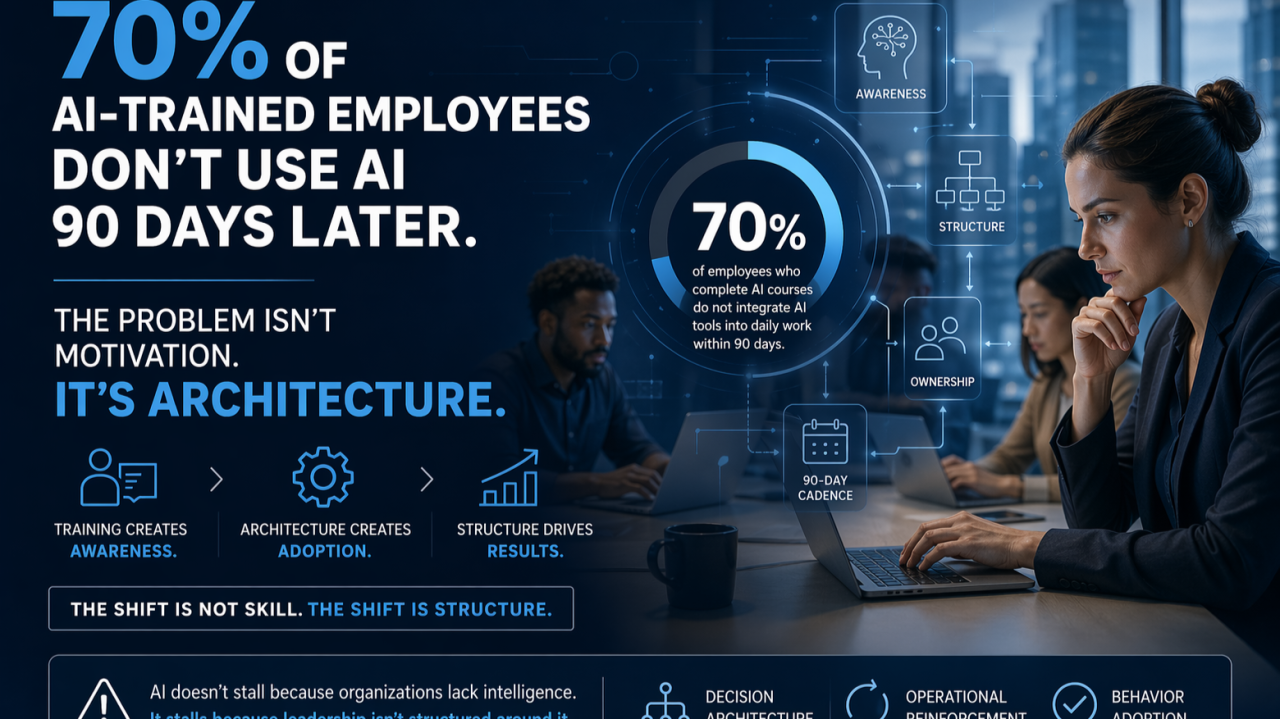
Here’s the stat that should end every debate about whether AI adoption is a training problem:

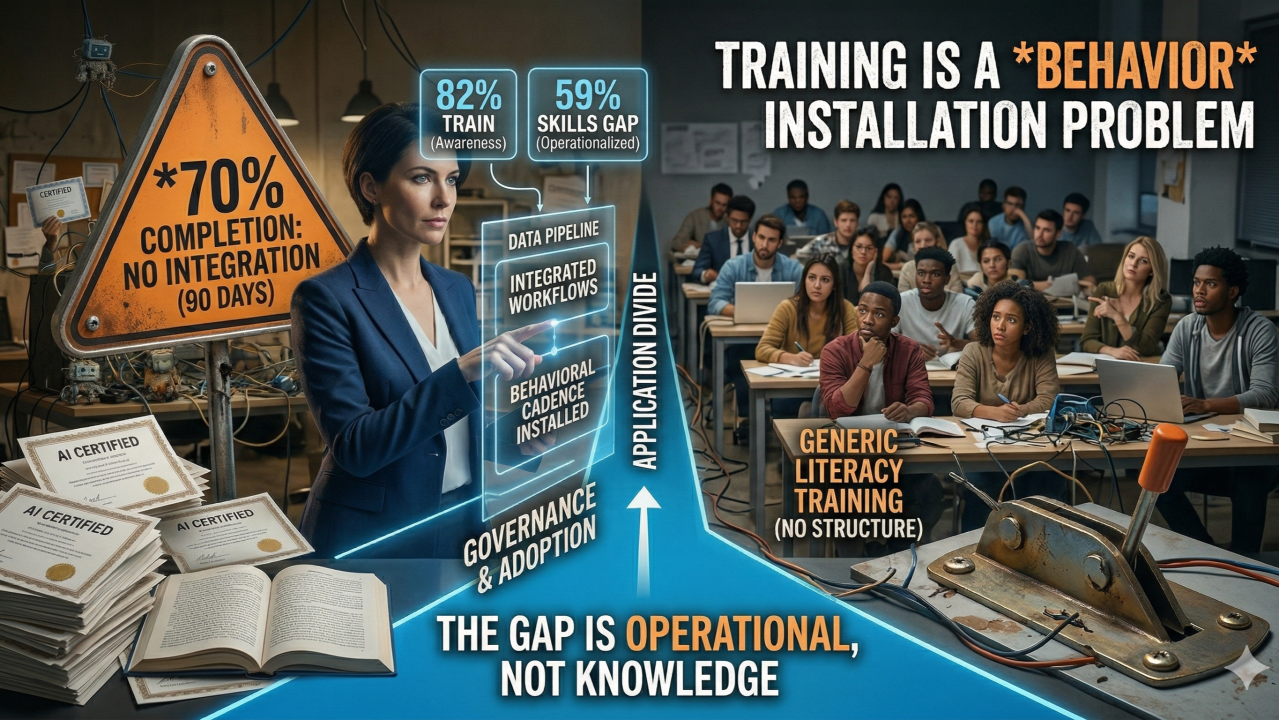
70% of employees who complete AI courses do not integrate AI tools into daily work within 90 days.

Not because they didn’t learn.

Not because they weren’t motivated.

Because there was no structured follow-up.

No operational reinforcement.

No system that turned awareness into behavior.

This is the same pattern at every level:

At the individual level: people learn AI but don’t use it.

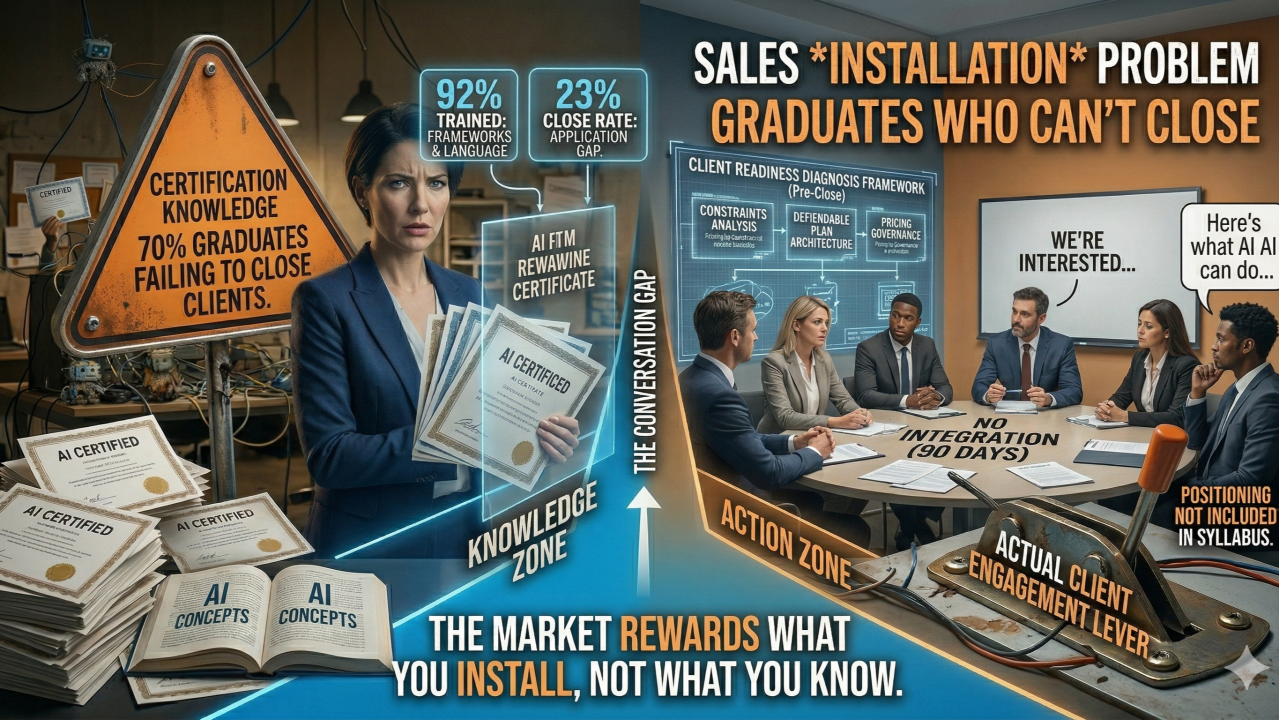
At the consultant level: people get certified but can’t close clients.

At the enterprise level: companies pilot AI agents but can’t get them to production.

The thread connecting all three?

The absence of operational architecture.

Training creates awareness.

Architecture creates adoption.

This distinction is the single most important idea in AI right now. And it’s the one almost nobody is building for.

Everyone is building more courses. More tools. More certifications. More agents.

Almost nobody is building the governance layer — the decision architecture, the ownership model, the 90-day cadence — that makes any of it stick.

That’s the gap.

And the people who fill it won’t be the most technically fluent AI professionals.

They’ll be the ones who understand something deeper:

AI doesn’t stall because organizations lack intelligence.

It stalls because leadership isn’t structured around it.

The shift is not skill.

The shift is structure.

I need to say something that most people in the AI certification space won’t.

The programs are doing their job. The graduates aren’t failing because the training was bad.

They’re failing because the training was never designed to prepare them for what actually happens in a client conversation.

Certification teaches you what AI can do.

It doesn’t teach you how to:

Qualify whether a client is actually ready.

Diagnose constraints before recommending solutions.

Create a plan a buyer can defend internally.

Lead delivery without improvising every step.

Price governance, not just projects.

I know this because I lived it.

I got certified. I had the language. I had the frameworks.

And the first time a prospect asked “So what do we do first?” — I realized the answer wasn’t in any module I’d completed.

That wasn’t a knowledge gap. It was an operating gap.

The certification gave me credibility.

It did not give me positioning.

And in this market — the one we’re in right now, in April 2026, with agentic AI accelerating and buyers getting more sophisticated — positioning is everything.

You can sound credible and still hear “this is interesting” instead of “let’s move forward.”

The question isn’t whether certifications are valuable. They are.

The question is: what’s missing between the certificate and the close?

Structure. Sequencing. A system that holds under pressure.

The market doesn’t reward what you know.

It rewards what you’ve installed.

DataCamp just published their 2026 AI workforce data.

Two numbers tell the whole story:

82% of enterprise leaders say their organization provides AI training.

59% still report an AI skills gap.

Read that again. The training is happening. The gap isn’t closing.

Why?

Because the gap isn’t about knowledge. It’s about application.

70% of employees who complete AI courses do not integrate AI tools into daily work within 90 days — without structured follow-up.

The research confirms what I’ve been saying for two years:

The problem isn’t that people don’t understand AI.

The problem is that no one has installed the operational structure that turns understanding into behavior.

Training teaches vocabulary.

Structure installs cadence.

One creates awareness. The other creates adoption.

This is why I stopped asking “How do I teach more people about AI?” and started asking “How do I build systems that make AI adoption inevitable?”

And it’s why, a few weeks ago, we partnered with Teri Moten as In-House AI Trainer at MyMobileLyfe.

What Installed Training Actually Looks Like

Teri doesn’t run generic AI literacy sessions.

Every training she leads is wired to a specific workflow, a specific team, and a specific outcome the business is trying to hit.

Before a session, we map what “installed” looks like for that group. What decision gets faster? What task gets offloaded? What behavior has to change? What’s the metric we’ll look at in 30 days to know whether the training actually landed?

After the session, we measure whether it actually got installed. Not whether people enjoyed it. Not whether they took good notes. Whether the behavior showed up in the work.

That’s the difference between training and installation.

One ends when the Zoom closes.

The other starts there.

I’m not sharing this to pitch a service. I’m sharing it because I refuse to add more noise to a market that already has too much of it.

If the 82/59 gap is going to close, it won’t be because somebody invented a better curriculum.

It’ll close because a small number of people decide to treat training as an installation problem — and build the structure around every session that makes the behavior stick.

That’s the work we’re doing.

And it’s the work I think a lot more of us should be doing.

The market doesn’t have a learning problem.

It has an installation problem.

Walk into most small businesses on a Monday morning and you’ll see the same worn ritual: a new hire sits at a desk with a stack of PDFs and a nervous manager delivering a two-hour lecture while their inbox fills. The new employee nods politely, but three days later they’re still unsure how to complete the basic tasks that keep the business running. Meanwhile, your best people spend hours babysitting checklists instead of doing the higher-value work you hired them for. That friction is expensive — and avoidable.

AI doesn’t replace human mentorship. But it can stop drowning new people and current staff in irrelevant information. When combined with microlearning, automated assessments, and workflow triggers, AI can deliver tiny, personalized learning bites exactly when someone needs them. The result is faster ramp-up, fewer interruptions, and a workforce that learns as it works.

How to build a practical, low-code AI-powered onboarding and continuous training system

  1. Map the competencies that matter
  • Start by listing the core tasks and decisions each role must handle. Think “ship an order,” “handle a refund,” “close a sales call,” not generic skills.
  • For each task, define the observable behaviors that determine proficiency. These become the testable learning outcomes for micro-modules.
  • Prioritize: pick 6–10 high-impact competencies for your first rollout.
  1. Create an accessible knowledge backbone
  • Inventory internal docs, SOPs, ticket threads, training slides, and product notes. These are the raw materials for learning.
  • Convert them to searchable formats (text, simple HTML or PDF with OCR). A low-code step: use a document ingestion tool or a managed vector store to index content so AI can retrieve relevant snippets.
  • Tag content with role, task, and recency so the system favors current procedures.
  1. Let AI curate and compose microlearning units
  • Use an LLM to generate short learning modules — 90-second explanations, 3-step checklists, and 2-question quizzes — drawing on your indexed content and public resources (product manuals, regulatory guidance).
  • Keep modules atomic: one concept, one action. This keeps busy people from feeling overwhelmed and supports just-in-time learning.
  • Have a human subject-matter expert (SME) review generated content for accuracy and tone. This human-in-the-loop step prevents errors and preserves institutional voice.
  1. Automate skill assessments and spaced repetition
  • Pair short quizzes with each micro-module. Automatic assessments identify gaps without long exams.
  • Implement a spaced-repetition scheduler that surfaces modules based on assessment results — weak areas reappear sooner; mastered topics are delayed.
  • Low-code tools can handle scheduling: integrate your LMS or content repository with automation platforms like Zapier or Make to trigger deliveries and reminders.
  1. Deliver learning where work happens
  • Integrate microlearning into existing tools: embed modules in the CRM, surface quick tips in the helpdesk, or push a two-minute refresher to Slack/Teams after a relevant ticket closes.
  • Use workflow triggers: after completing a task for the first time, the system suggests a follow-up micro-module; when an agent flags confusion on a ticket, a targeted micro-lesson pops up.
  • Just-in-time learning reduces context switching and anchors knowledge to the task at hand.
  1. Measure what matters
  • Track time-to-proficiency: how long until a hire can complete a target task independently.
  • Measure task completion rates and error rates before and after training interventions.
  • Monitor engagement metrics for microcontent: module completion, quiz scores, and time spent.
  • Use dashboards that join learning data with operational metrics (ticket resolution time, sales conversion) to associate training with business outcomes.

Common pitfalls and how to avoid them

  • Bias in training content: If your internal knowledge contains biased or outdated practices, AI can amplify those problems. Mitigation: audit source documents for bias, include diverse examples, and require SME sign-off on AI-generated content.
  • Privacy and employee trust: Performance data is sensitive. Be transparent about what is tracked, who can see it, and how it’s used. Store assessments and activity data with role-based access controls and comply with relevant regulations (e.g., GDPR, CCPA where applicable).
  • Over-automation: Don’t automate every touch. New hires still need human mentorship for culture, complex judgment, and relationship-building. Use AI to reduce repetitive coaching, not to replace it.
  • Information rot: Procedures change. Schedule periodic automated content checks so modules reference the latest docs; include versioning and “last reviewed” metadata.

A phased, low-cost rollout plan for SMBs

Phase 1 — Pilot (4–8 weeks)

  • Choose one role with frequent hires or high onboarding cost (e.g., customer support).
  • Map top 6 competencies, ingest existing SOPs, and generate 12–18 micro-modules with quizzes.
  • Run a pilot with 5–10 employees. Track baseline time-to-proficiency and support load for managers.

Phase 2 — Iterate and extend (8–12 weeks)

  • Review pilot analytics and SME feedback. Fix content gaps and bias issues.
  • Add spaced-repetition scheduling and integrate with one workflow (e.g., ticketing system).
  • Expand to adjacent roles with similar knowledge needs.

Phase 3 — Scale and automate (3–6 months)

  • Integrate analytics with HR and operations dashboards for business-level reporting.
  • Automate content ingestion and update checks. Add more workflow triggers (CRM, LMS, chat).
  • Standardize governance: data retention, access policies, content review cadence.

Where savings come from (and how to estimate them)

  • Manager time saved: fewer repetitive coaching sessions and fewer context-switching interruptions.
  • Faster revenue contribution: hires reach productive competence sooner.
  • Fewer errors and rework: targeted remediation reduces costly mistakes.
  • To estimate impact: measure current average onboarding time and manager hours per new hire as your baseline; run the pilot and compare the new values. Even without precise numbers up front, you’ll see directionally how many manager hours or lost sales hours are recovered after deploying microlearning.

Practical tool choices without heavy engineering

  • Use managed LLM APIs or fine-tuning services to avoid building models from scratch.
  • Store embeddings in a managed vector DB for quick retrieval of internal content.
  • Connect your LMS and chat tools with automation platforms (Zapier, Make) to keep the stack low-code.
  • Choose an LMS or content platform that supports micro-modules, quizzes, and analytics.

Final note: action over perfection

You don’t need a flawless AI system to reap benefits — you need a human-guided system that delivers the right tiny lesson at the right time, and measures whether that lesson changes behavior. Start small, validate quickly, protect privacy, and iterate.

If you need a partner that helps design and implement AI-driven onboarding and continuous training — mapping competencies, turning internal knowledge into microlearning, automating assessments and spaced repetition, and integrating everything into your workflows — MyMobileLyfe can help. Their team focuses on practical AI, automation, and data solutions tailored for small and mid-sized businesses to boost productivity and reduce costs: https://www.mymobilelyfe.com/artificial-intelligence-ai-services/.

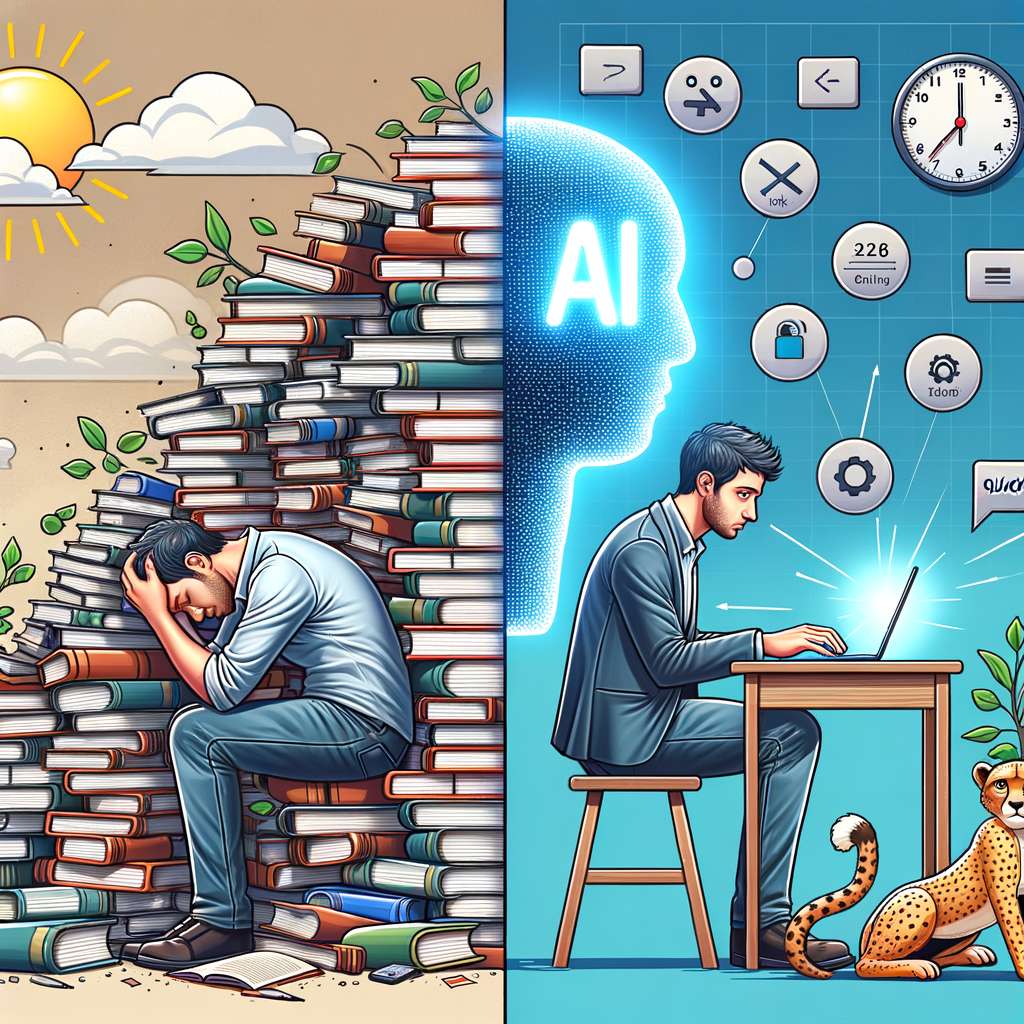
Imagine sitting through yet another mandatory training session, your mind wandering as the content flashes on the screen—material you already know or topics irrelevant to your daily tasks. The frustration builds when you realize that this one-size-fits-all approach to employee learning doesn’t just waste your time; it leaves you ill-prepared for real challenges and drains motivation. For employers, the pain is equally palpable: months and vast budgets invested in training programs that neither engage employees nor translate to meaningful skill growth. The traditional corporate training model is broken, failing to keep pace with the dizzying speed of workforce skill evolution.

This widespread dissatisfaction and inefficiency highlight a critical pain point in talent development that demands a revolutionary response. Enter AI-powered adaptive training—a new paradigm that transforms how employees learn by personalizing every aspect of the journey. It’s not just a technological upgrade; it’s a fundamental rethinking of learning itself, designed to meet each employee where they are and propel them precisely where they need to go.

The Crushing Burden of One-Size-Fits-All Training

Traditional training programs are often rigid, linear, and unable to adjust to the diverse needs of a workforce. These sessions are designed on the flawed assumption that all employees start at the same knowledge baseline and absorb information at the same pace. Some employees find themselves bored, revisiting familiar concepts, while others struggle to keep up and become disengaged.

This approach contributes to significant problems:

  • Low retention rates: Employees forget much of the material shortly after training, especially when it feels irrelevant or overwhelming.
  • Reduced productivity: Time spent in ineffective training means less time applying new skills on the job.
  • High training costs: Organizations pour resources into generic programs that deliver inconsistent results.
  • Employee dissatisfaction: When learning feels like a chore, employee motivation and engagement plummet, leading to higher turnover.

The result is a vicious cycle where learning initiatives drain resources but fail to unlock the potential of the workforce.

How AI-Powered Adaptive Training Breaks the Mold

Adaptive learning platforms, powered by artificial intelligence, harness data and sophisticated algorithms to revolutionize training by attuning content and delivery to each individual employee’s needs in real time. Instead of a static curriculum, the system continuously evaluates learner performance, adjusting difficulty, content sequencing, and assessment types dynamically.

This is how AI-powered adaptive training alleviates the pain:

  • Tailored Learning Paths: Machine learning algorithms analyze an employee’s prior knowledge, skill gaps, and learning preferences to craft a personalized training path. This ensures they spend time only on material that advances their proficiency, avoiding redundant content that wastes their time or causes boredom.
  • Optimized Pacing and Content Delivery: Recommendation engines modulate the pace based on ongoing learner responses and engagement signals, slowing down for difficult topics and accelerating through familiar ground.
  • Intelligent Assessments and Feedback: Natural language processing and predictive analytics deliver real-time feedback, clarify misunderstandings, and recommend remedial actions before gaps become critical.
  • Engaging and Interactive Experience: AI-driven chatbots and virtual tutors simulate human interaction, answering questions instantly and adapting explanations according to how the learner responds.

The result is a learning experience that feels intuitive, responsive, and focused—significantly boosting retention and skill acquisition speed.

The Core Technologies Behind Adaptive Learning

To understand the transformative power of AI-driven adaptive training, it’s important to recognize the key technologies fueling this momentum:

  1. Machine Learning (ML): ML models digest training data, employee performance metrics, and engagement levels to detect patterns and predict the most effective next steps in a learner’s journey.
  2. Recommendation Engines: These engines suggest customized content modules or exercises by drawing parallels between individual learning profiles and successful outcomes from similar learners.
  3. Natural Language Processing (NLP): NLP enables adaptive platforms to interpret and respond to learner inputs conversationally. This supports interactive Q&A, real-time clarification, and personalized feedback.
  4. Data Analytics: Continuous analytics track learner progress and satisfaction, empowering instructors and managers to intervene when necessary and optimize training strategies.

Together, these technologies create a feedback loop where learning adapts instantly to improve outcomes.

Real-World Impact and ROI of Adaptive Training

Organizations that have embraced AI-powered adaptive training have seen remarkable benefits:

  • Reduced training time: Employees reach proficiency faster because the system eliminates time spent on irrelevant or redundant material.
  • Higher knowledge retention: Personalized learning increases engagement and retention by delivering just the right challenge and support.
  • Improved employee satisfaction: Training feels less like an obligation and more like a growth opportunity, fueling motivation and loyalty.
  • Cost savings: Optimized learning paths mean less time off the job and fewer resources wasted on ineffective training.

For example, companies using adaptive learning platforms report up to 50% reductions in training duration along with measurable improvements in post-training performance. This translates to faster onboarding, accelerated skill development, and the agility to keep pace with evolving job requirements.

Implementing AI-Powered Adaptive Training: Best Practices

Transitioning to adaptive training isn’t just about installing a new software platform. To unlock its full potential, companies should approach implementation strategically:

  1. Conduct a thorough needs assessment: Understand existing training gaps, employee skill levels, and business priorities to select the right adaptive learning solution.
  2. Integrate with existing LMS: Choose platforms that seamlessly merge with your learning management system and HR tools to leverage current content and data.
  3. Develop modular, granular content: Break down training material into bite-sized, adaptable units that can be rearranged on demand to suit different learners.
  4. Train stakeholders: Equip trainers, HR, and managers to interpret AI-driven insights and support personalized learning journeys.
  5. Pilot and iterate: Start small with a pilot program, gather feedback, and refine the approach before scaling organization-wide.
  6. Measure impact rigorously: Track time-to-competency, retention, employee engagement, and business outcomes to continuously optimize.

Choosing the Right Tools

When selecting an AI-powered adaptive training platform, consider factors such as:

  • The system’s ability to personalize learning paths at scale.
  • User-friendly interface for both learners and administrators.
  • Advanced analytics and reporting capabilities.
  • Support for diverse content formats (video, text, simulations).
  • Strong integration with existing enterprise systems.
  • Proven track record with similar industries or business sizes.

Working with experienced technology partners can simplify this process and ensure the solution addresses your unique needs.

The Path Forward: Using AI to Empower Your Workforce

The disruption of traditional, generic training programs by AI-driven adaptive learning is no longer a futuristic concept; it’s happening now—and it’s reshaping employee development across industries. By embracing this technology, businesses not only solve the pain of ineffective training but unlock a powerful lever to future-proof their workforce and boost competitive advantage.

For companies seeking to transform their learning and development processes, MyMobileLyfe offers expert guidance and solutions that harness artificial intelligence, automation, and data-driven insights. Their AI services empower businesses to implement adaptive training solutions tailored to organizational needs, improving productivity while saving costs. By partnering with MyMobileLyfe, organizations can navigate the complex AI landscape with confidence, maximizing their investment and fostering a culture of continuous skill growth that keeps teams ready for what’s next.

In a world where skills evolve at a breakneck pace, settling for stale training methods is no longer an option. Adaptive training driven by AI holds the key to unlocking employee potential in ways that are personalized, engaging, efficient, and deeply impactful. The time to revolutionize your employee learning and development is now—and with the right tools and partners, your workforce will not just keep up but lead the charge into the future.

Leadership development is important for every business. It improves productivity, innovation, employee engagement, and customer retention and reduces employee turnover. A structured leadership development plan highlights how a company intends to train and help employees hone their leadership skills. 

In most cases, leadership development occurs in a formal classroom setting. However, individual leadership development plans, such as reflective journaling, coaching, and constructive feedback, are also effective. Implementing a leadership development plan helps businesses avoid the leadership gap that occurs following the unavoidable retirement or step down of current leadership. 

Below are a few tips for creating a leadership development plan. 

  1. Evaluate your business goals and needs

Identifying business needs and goals is crucial to creating a leadership development plan. This essentially involves identifying leadership qualities that can benefit your organization. Knowing what type of leader your company needs should be a priority. You should ask yourself the following questions:

  • How many leaders does your company need?
  • Are there notable gaps that need improvement?
  • Which strategies work well for your company?
  • How will the new leaders commit to organizational goals?
  1. Consult your employees

Employees play a key role in determining the success and productivity of the company. Therefore, you should ask for their perspective on leadership. Ask them what they want or looking for in a leader. They can help you identify leadership strategies that are working or not working in your organization. Taking their input can help you design an effective leadership development plan. 

  1. Define the type of leaders your company needs 

You should also define the type of leaders your company requires. For this, consider reviewing key business objectives and how they can be achieved. Below are a few tips to consider:

  • Create a detailed list of the skills you expect to see in leaders that fit your company profile. 
  • If one of the departments requires better leadership, create a different profile for the department.
  • Assess your current level of leadership. Use emails, anonymous tips, and feedback from your employees. 
  • Create a list of employees who are talented enough and interested in management roles.
  1. Identify the best method of development 

As mentioned, leadership development was traditionally hinged on formal programs. While they are effective, you should consider other leadership training methods, such as mentorship programs, working groups, and task forces. You should also choose between conducting in-house training or hiring a third-party company. 

Conclusion

Around 77% of companies struggle with leadership gaps. This explains why 89% of company executives agree that strengthening leadership development should be a priority for most companies. Having a leadership training plan can help your company mold successful future managers.