Archive for the
‘Artificial Intelligence’ Category

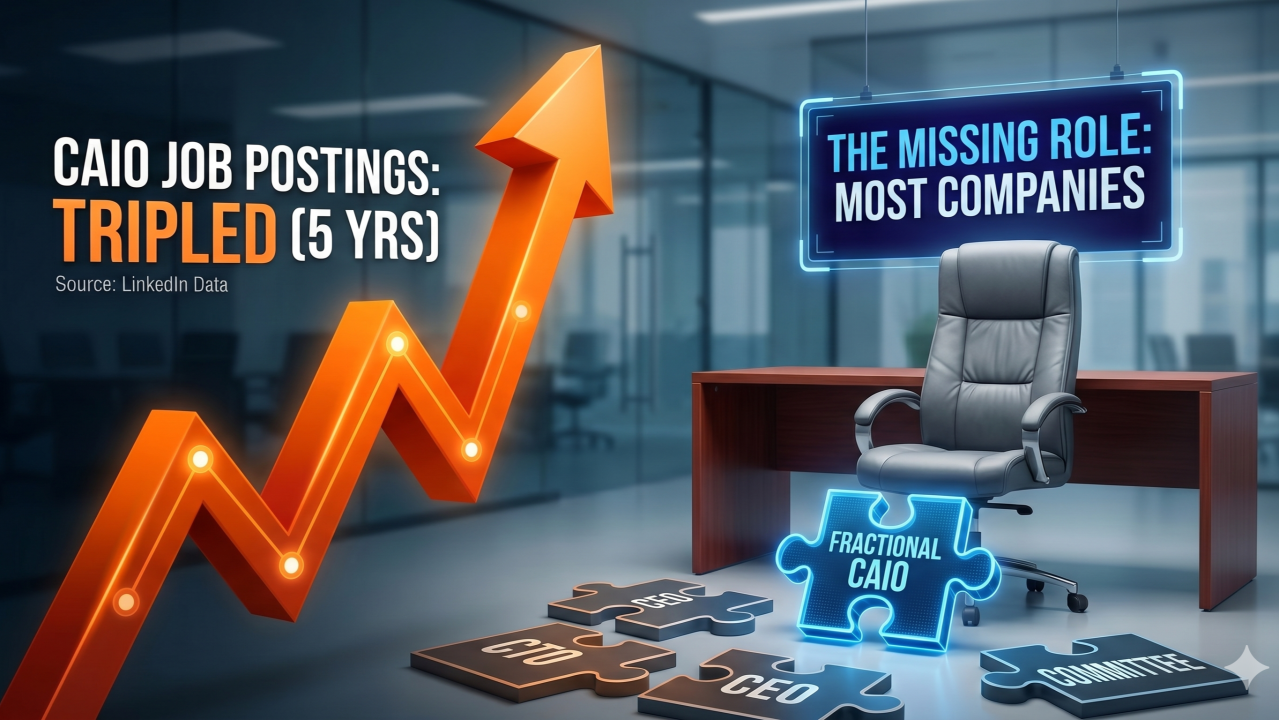
LinkedIn just reported that Chief AI Officer job postings have tripled over the last five years.

It’s now officially one of technology’s fastest-growing executive roles.

But here’s what the headline misses:

Most companies still don’t have one.

Not because they don’t need AI leadership. Because the role, as typically defined, assumes a full-time executive with a dedicated budget and organizational authority.

Most mid-market companies — the ones actually struggling with AI adoption — can’t afford that.

So what happens?

AI ownership defaults to the CEO. Or the CTO. Or a committee.

And when something belongs to everyone, it belongs to no one.

This is exactly where the fractional model changes the game.

A Fractional CAIO isn’t a consultant who advises on AI.

It’s an installed leadership function that governs AI decisions, establishes cadence, and creates accountability — on a retainer, not a project.

The demand signal is clear.

The hiring data says companies want AI leadership.

The market reality says most can’t hire it full-time.

The opportunity for AI professionals who can install governance — not just deliver advice — has never been larger.

But it requires a structural shift.

From: “I help companies with AI.”

To: “I install the decision architecture that makes AI work.”

Those are different identities. Different revenue models. Different outcomes.

Do you see the fractional CAIO model gaining traction in your network? Or is it still mostly consultant-as-title?

I need to say something that most people in the AI certification space won’t.

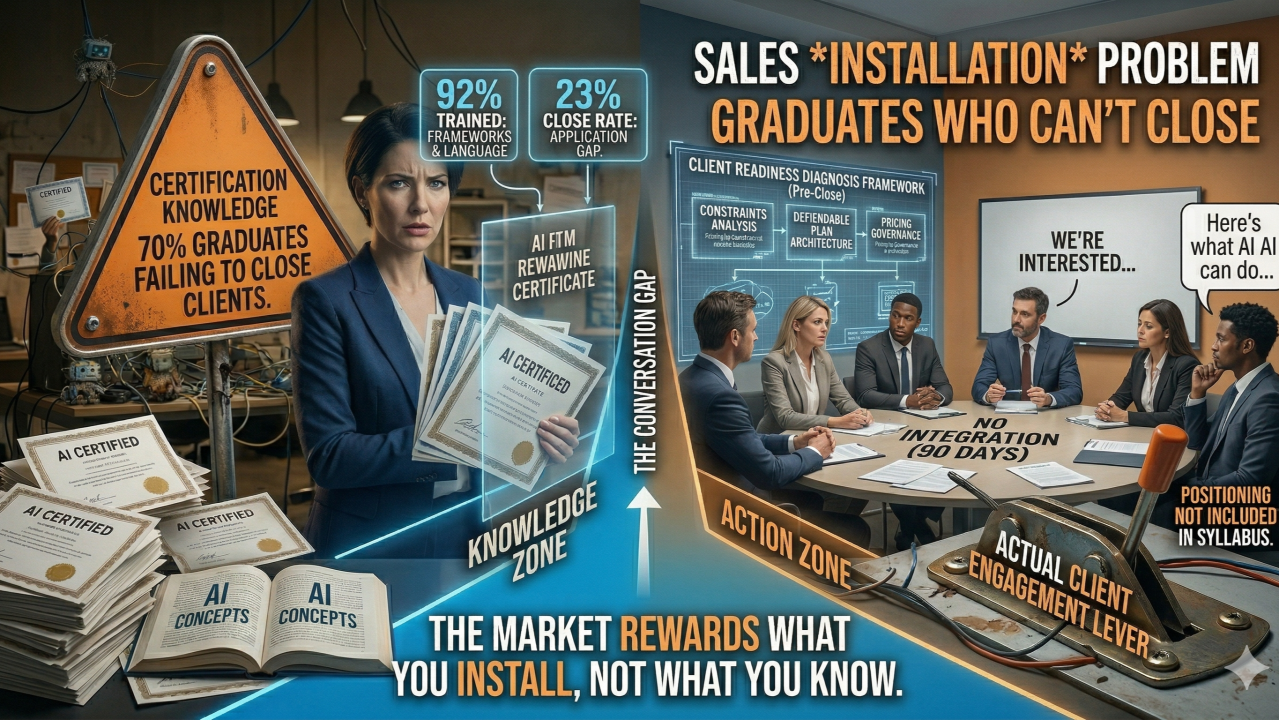
The programs are doing their job. The graduates aren’t failing because the training was bad.

They’re failing because the training was never designed to prepare them for what actually happens in a client conversation.

Certification teaches you what AI can do.

It doesn’t teach you how to:

Qualify whether a client is actually ready.

Diagnose constraints before recommending solutions.

Create a plan a buyer can defend internally.

Lead delivery without improvising every step.

Price governance, not just projects.

I know this because I lived it.

I got certified. I had the language. I had the frameworks.

And the first time a prospect asked “So what do we do first?” — I realized the answer wasn’t in any module I’d completed.

That wasn’t a knowledge gap. It was an operating gap.

The certification gave me credibility.

It did not give me positioning.

And in this market — the one we’re in right now, in April 2026, with agentic AI accelerating and buyers getting more sophisticated — positioning is everything.

You can sound credible and still hear “this is interesting” instead of “let’s move forward.”

The question isn’t whether certifications are valuable. They are.

The question is: what’s missing between the certificate and the close?

Structure. Sequencing. A system that holds under pressure.

The market doesn’t reward what you know.

It rewards what you’ve installed.

DataCamp just published their 2026 AI workforce data.

Two numbers tell the whole story:

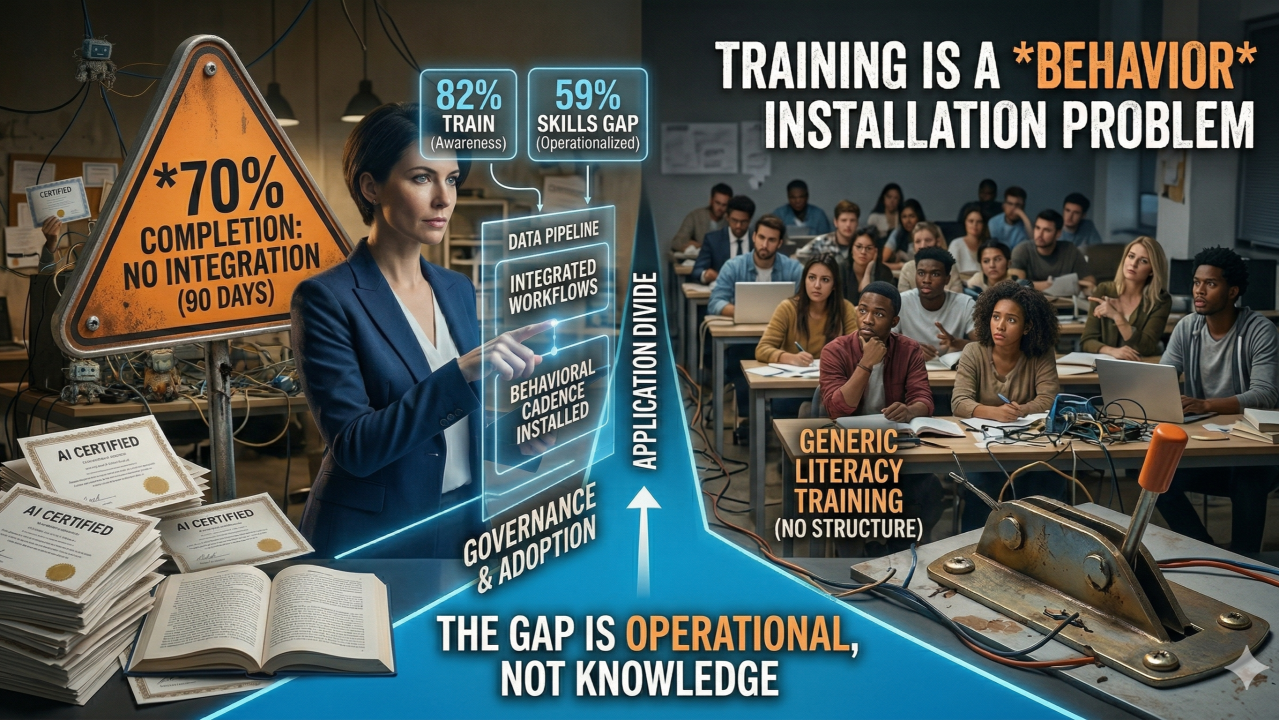
82% of enterprise leaders say their organization provides AI training.

59% still report an AI skills gap.

Read that again. The training is happening. The gap isn’t closing.

Why?

Because the gap isn’t about knowledge. It’s about application.

70% of employees who complete AI courses do not integrate AI tools into daily work within 90 days — without structured follow-up.

The research confirms what I’ve been saying for two years:

The problem isn’t that people don’t understand AI.

The problem is that no one has installed the operational structure that turns understanding into behavior.

Training teaches vocabulary.

Structure installs cadence.

One creates awareness. The other creates adoption.

This is why I stopped asking “How do I teach more people about AI?” and started asking “How do I build systems that make AI adoption inevitable?”

And it’s why, a few weeks ago, we partnered with Teri Moten as In-House AI Trainer at MyMobileLyfe.

What Installed Training Actually Looks Like

Teri doesn’t run generic AI literacy sessions.

Every training she leads is wired to a specific workflow, a specific team, and a specific outcome the business is trying to hit.

Before a session, we map what “installed” looks like for that group. What decision gets faster? What task gets offloaded? What behavior has to change? What’s the metric we’ll look at in 30 days to know whether the training actually landed?

After the session, we measure whether it actually got installed. Not whether people enjoyed it. Not whether they took good notes. Whether the behavior showed up in the work.

That’s the difference between training and installation.

One ends when the Zoom closes.

The other starts there.

I’m not sharing this to pitch a service. I’m sharing it because I refuse to add more noise to a market that already has too much of it.

If the 82/59 gap is going to close, it won’t be because somebody invented a better curriculum.

It’ll close because a small number of people decide to treat training as an installation problem — and build the structure around every session that makes the behavior stick.

That’s the work we’re doing.

And it’s the work I think a lot more of us should be doing.

The market doesn’t have a learning problem.

It has an installation problem.

Here’s the number everyone in AI should be paying attention to right now:

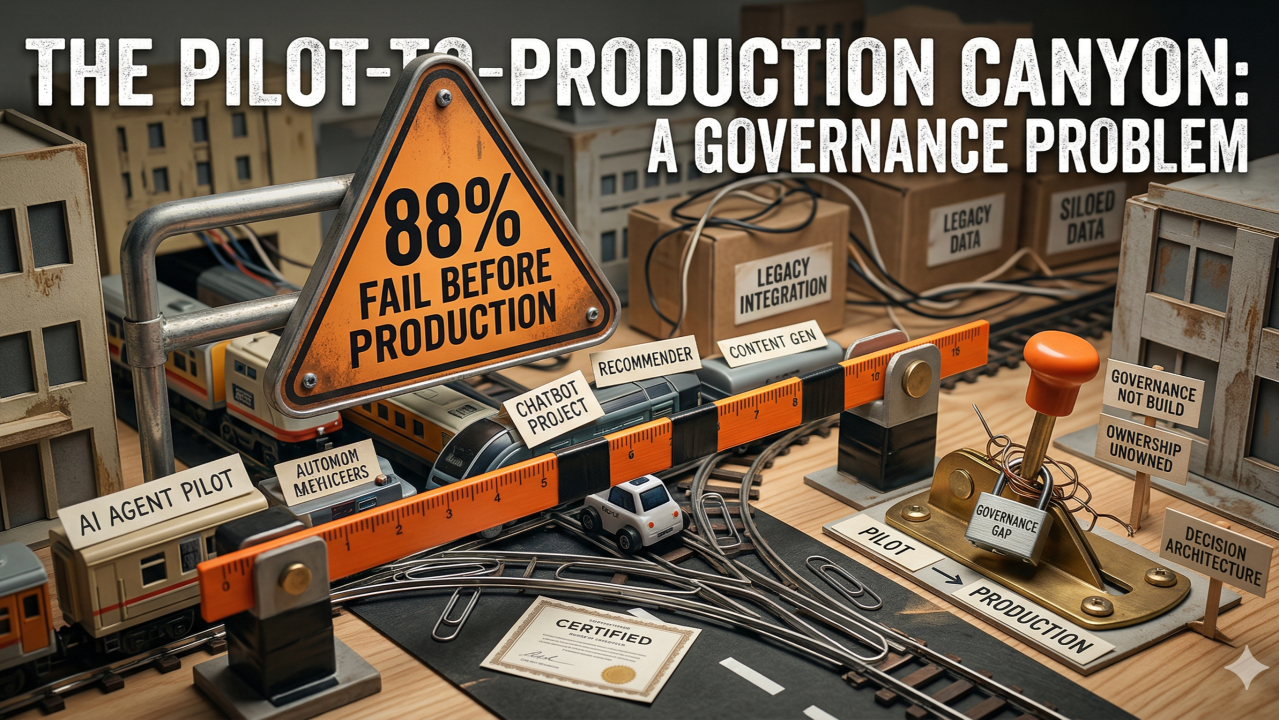
88% of AI agent projects fail to reach production.

Not because the technology doesn’t work.

Not because the models aren’t good enough.

Because — according to the research — “teams build agents before they build controls.”

Let that sink in.

The Deployment Backlog Nobody’s Talking About

78% of enterprises now have AI agent pilots running.

Only 14% have successfully scaled to production.

That’s not a gap. That’s a canyon.

And it gets worse. A March 2026 survey of 650 enterprise technology leaders found that even when pilots show meaningful results — and 67% of them do — only 10% ever make it across the finish line.

This is the largest deployment backlog in enterprise technology history. Double the failure rate of traditional IT projects.

The agents work in the lab. They work in the demo. They impress the steering committee.

And then they stall.

Five Root Causes — And Only One Is Technical

New research has identified the five root causes that account for 89% of scaling failures:

Integration complexity with legacy systems.

Inconsistent output quality at volume.

Absence of monitoring tooling.

Unclear organizational ownership.

Insufficient domain training data.

Look at that list carefully.

Only one — integration complexity — is a technology problem.

The rest? Ownership. Monitoring. Quality control. Governance.

These are leadership problems wearing technical disguises.

And they’re interrelated in a way that makes them compound. Ownership gaps leave monitoring gaps unfilled. Monitoring gaps make quality problems invisible. Invisible quality problems erode executive trust. Eroded trust kills budget.

It’s a chain reaction. And it starts — every time — with the same missing variable:

Nobody owns this.

Agent Sprawl: The Term You’ll Be Hearing Everywhere

There’s a new concept emerging in enterprise AI that perfectly captures what’s happening:

Agent sprawl.

It’s the uncontrolled proliferation of siloed, ungoverned AI agents across an enterprise. It happens when business units move fast to solve immediate problems with AI — without a unifying strategy, shared data infrastructure, or centralized oversight.

Sound familiar?

It should. It’s the same pattern I’ve been naming for two years. I called it “Duct-Tape Adoption” — sticking AI onto broken processes and hoping it creates magic.

The only difference now? The stakes are higher.

When it was chatbots and automation workflows, duct-tape adoption wasted time and budget.

When it’s autonomous agents making decisions, accessing databases, and operating across departments — duct-tape adoption creates organizational risk.

The security data backs this up. 88% of organizations reported confirmed or suspected AI agent security incidents in the last year. 80% documented risky agent behaviors including unauthorized system access and data exposure. And 64% of companies with revenue above $1 billion reported losses exceeding $1 million tied to AI system failures.

These aren’t hypothetical risks. They’re happening right now, in production environments, at scale.

The Readiness Gap in Four Numbers

Research now quantifies exactly how unprepared most organizations are to govern agentic AI. Four readiness categories tell the story:

Infrastructure readiness: 43%.

Data management readiness: 40%.

Governance readiness: 30%.

Talent readiness: 20%.

That last number should stop every AI consultant and advisor in their tracks.

Only 20% of organizations are talent-ready for agentic AI.

And governance — the single most critical variable for moving agents from pilot to production — sits at 30%.

This is why Gartner is now warning that 40%+ of agentic AI projects may be cancelled by 2027.

Not for lack of capability.

For lack of structure.

What This Means If You’re an AI Consultant

This data is both a warning and an opportunity.

The warning: implementation advice alone won’t save a stalled agent deployment. If you’re still leading with tool recommendations and feature demos, you’re solving a problem the market has already moved past.

The opportunity: the organizations that need you most right now aren’t asking “what tool should we use?”

They’re asking something harder:

“How do we govern what we’ve already built?”

“Who owns the decision about what this agent is allowed to do?”

“What happens when it breaks — and who’s accountable?”

Those aren’t consulting questions. They’re governance questions. And they require a fundamentally different operating model than most AI consultants are running.

The consultants who step into that gap — who can install decision architecture, define ownership, and build the 90-day oversight cadence — will own the most valuable real estate in the AI market for the next three years.

The ones who keep leading with tools will wonder why their pipeline dried up.

The Bottom Line

The agentic AI wave isn’t failing because the technology is immature.

It’s failing because organizations are building agents the same way they adopted every other AI tool:

Fast. Excited. Unstructured.

And for the first time, the consequences of that approach aren’t just wasted budget.

They’re security incidents. Unauthorized access. Million-dollar losses.

The market doesn’t need more agents.

It needs more architecture.

Source data:

– 88% failure rate, 78% piloting / 14% production (Apify enterprise research, Digital Applied March 2026 survey)

– 67% of pilots show meaningful results, only 10% scale (Digital Applied)

– 5 root causes account for 89% of failures (ZBrain, HarrisonAIX)

– Agent sprawl and security incidents: 88% confirmed/suspected incidents, 80% risky behaviors (Gravitee State of AI Agent Security 2026)

– 64% of $1B+ companies report $1M+ AI losses (Accelirate)

– Readiness gaps: Governance 30%, Talent 20% (Decidr US AI Readiness Index 2026)

– Gartner: 40%+ agentic AI project cancellation risk by 2027

– Only 22% treat agents as independent identities (Security Boulevard)

The digital evolution isn’t waiting for anyone.

For businesses today, the question is no longer if they should use AI: it’s who is orchestrating it. And more importantly, how.


A Personal Journey That Became a Platform

In mid-2024, I started exploring AI with one simple goal: find additional services I could offer through our digital marketing agency, MyMobileLyfe.

I wasn’t coming in as a technologist. I was a business strategist trying to figure out where AI fit into our clients’ worlds. And honestly? I didn’t know much.

I had never heard the title Chief AI Officer. I certainly didn’t understand what the role actually demanded — the governance responsibilities, the ethical frameworks, the strategic depth required to move a company from “we’re experimenting with AI” to measurable, scalable results.

But I started digging.

The deeper I went — including studying the work coming out of organizations like ChiefAIOfficer — the clearer it became: businesses desperately need structured AI leadership, and most of them don’t know where to find it.

That realization didn’t just lead me to write a book. It became the entire foundation for One-Click AI.ai — a platform built specifically for aspiring AI consultants and CAIOs who want to deliver real strategic value to their clients.


Announcing the Second Edition

I’m thrilled to announce the release of the second edition of The Invisible Chief AI Officer: Leading in the Age of Autonomy.

This isn’t a book about AI tools. It’s a field guide for the people responsible for making AI work inside real organizations — business leaders, fractional partners, and especially non-technical certified AI consultants who are navigating clients through one of the most complex transitions in business history.

The second edition goes deeper on the core responsibilities this emerging role demands:

  • Strategic Mandates — Building a long-term AI vision that aligns with a company’s actual mission, not just its budget
  • The Silicon Workforce — Managing hybrid teams where humans and autonomous agentic systems work side by side
  • Governance & Ethics — Conducting bias audits, protecting data privacy, and building transparency into every deployment
  • Operational Models — Helping clients choose between Full-Time, Fractional, or On-Demand CAIO structures based on their specific needs and readiness

Why This Is Your Moment as an AI Consultant

Here’s what I want every non-technical certified AI consultant to understand: your value isn’t in knowing how to build models. It’s in knowing how to lead through them.

Your clients aren’t failing because they don’t have enough AI tools. They’re failing because they don’t have a coherent strategy. They’re stuck in pilot purgatory, burning budget on disconnected solutions that never add up to competitive advantage.

That’s the gap you fill.

You don’t need a hundred-million-dollar R&D budget to compete with industry giants anymore. Through models like the On-Demand CAIO, even small businesses can access the kind of strategic intelligence that was once reserved for the Fortune 500.

Whether you’re serving as a fractional partner or leveraging a platform like OneClickAI.ai to scale your practice, you are the architect of your clients’ AI future.


The Invisible Leader Is the Most Powerful One

We are operating in an era where work is increasingly autonomous — and the leaders who matter most aren’t the loudest ones in the room. They’re the ones quietly building the infrastructure, the governance, and the strategy that makes everything else possible.

That’s who this book is for.

I invite you to pick up the second edition of The Invisible Chief AI Officer and join me in bridging the gap between AI potential and profitable, sustainable business outcomes. I’ve dropped a link in the comments and you can download a Free digital copy.

The future belongs to those who act with intention.

Let’s get started.

There’s a moment many AI consultants experience but rarely talk about.

You’re certified. Capable. Confident in your knowledge.

Clients are interested.

The market is growing.

And yet…

Revenue still feels fragile.


The Instability No One Posts About

Not because you lack skill.

Not because there isn’t demand.

But because every engagement resets your position.

Each new client requires:

• Re-explaining your value • Re-justifying your pricing • Re-defining scope • Re-earning authority

That repetition creates something subtle:

Instability.


Competent — But Not Installed

You can be competent and still not be positioned.

Consultants are brought in.

They advise. They recommend. They deliver.

Then they exit.

And when they exit, so does their authority.

That cycle becomes exhausting.

Not physically.

Structurally.


The Psychological Tension

Here’s the part most won’t say publicly:

There’s a quiet anxiety in knowing your income depends on the next project closing.

Even if you’re good.

Even if you’re respected.

Even if your work delivers results.

When your position resets each time, security becomes temporary.

That’s not a capability problem.

That’s a structural one.


The Realization

I remember recognizing it.

Not dramatically.

Not all at once.

Just gradually understanding:

I wasn’t unstable because I lacked skill.

I was unstable because I was operating inside an execution model.

Projects must be resold.

Authority must be installed.

That distinction changed how I approached AI advisory work.


The Shift

The solution wasn’t more certifications.

It wasn’t lowering price.

It wasn’t expanding services.

It was redesigning the operating model.

From:

External expert To installed governance.

From:

Project revenue To executive cadence.

From:

Rotating advisory To structured oversight.


Closing

Most AI consultants are more capable than their positioning allows.

But capability does not protect you from structural fragility.

Governance does.

The shift is not skill.

The shift is structure.

— Rick Hancock, Architect of Fractional CAIO Governance Systems

Many AI professionals believe the shift from consultant to Fractional CAIO is a pricing upgrade.

It isn’t.

It’s an identity shift.

And most avoid it because it requires structural change, not just confidence.


The Misunderstanding

An AI consultant improves skill.

A Fractional CAIO improves position.

Those are not the same progression.

Consultants ask:

“How do I deliver more value?”

Fractional CAIOs ask:

“How do I install authority?”

The first question expands capability.

The second redesigns structure.


Skillset vs Position

You can:

• Earn certifications • Master frameworks • Understand AI strategy deeply • Deliver strong advisory insights

And still be positioned as an external expert.

External experts are valuable.

But they are not embedded leadership.

Consultants are brought in.

CAIOs are installed.

That is a positional difference — not a technical one.


Execution vs Governance

Consultants operate in execution cycles.

Assess. Recommend. Implement. Exit.

Fractional CAIOs operate in governance cycles.

Evaluate. Prioritize. Oversee. Report. Renew.

Execution is episodic.

Governance is continuous.

If your revenue depends on project flow, you are operating inside an execution identity.

No matter what title you use.


The Resistance

The identity shift is uncomfortable because it requires:

• Defining decision authority • Establishing governance cadence • Creating a 90-day oversight model • Embedding reporting structure • Designing renewal logic

Consulting can feel fluid.

Governance must be structured.

Many professionals prefer fluidity.

Executives require structure.


The Psychological Barrier

Consultants prove value repeatedly.

Fractional CAIOs design systems that make value visible automatically.

That requires confidence in architecture, not just expertise.

It also requires relinquishing the comfort of “expert for hire.”

Because once installed as governance, you are no longer optional support.

You are structural leadership.


The Real Shift

The shift is not:

More AI knowledge. More tools. More certifications.

The shift is:

From execution To governance.

From influence To oversight.

From service provider To installed operating model.


Closing

Many professionals are capable of operating as Fractional CAIOs.

Few redesign their position to do so.

Because the shift is not skill.

The shift is structure.

— Rick Hancock, Architect of Fractional CAIO Governance Systems

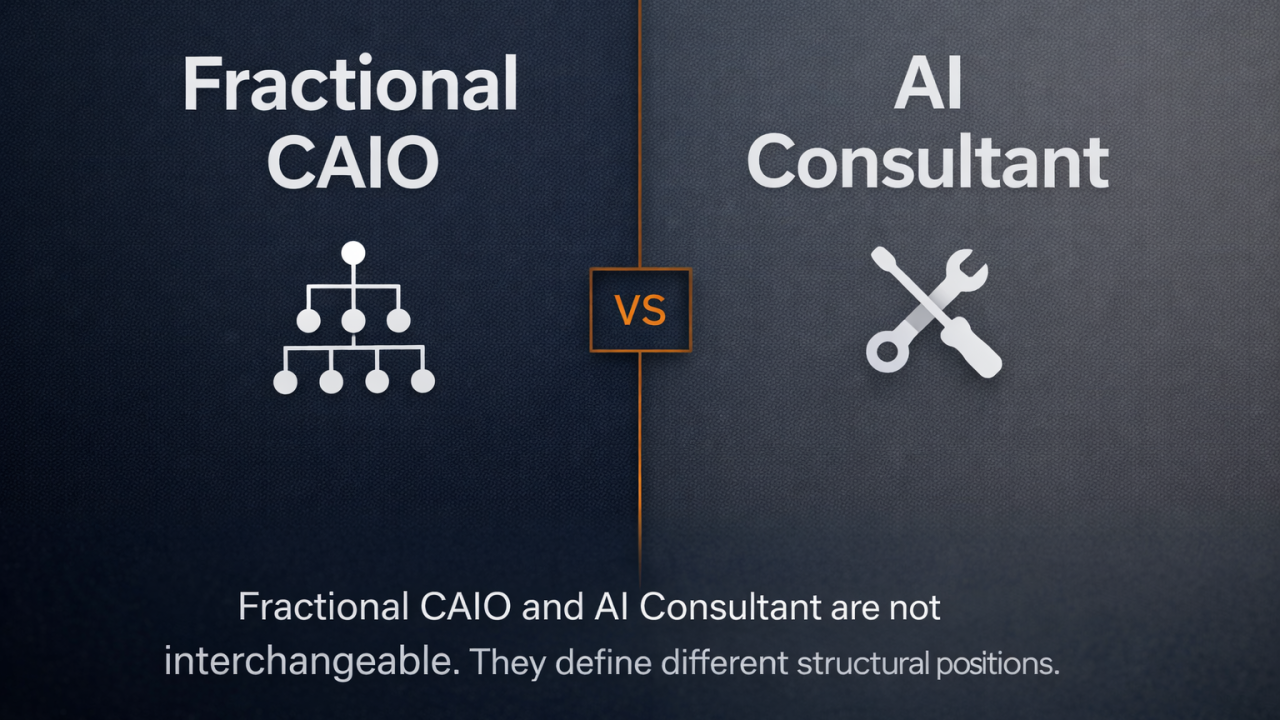
The terms are being used interchangeably.

They should not be.

“AI Consultant” and “Fractional CAIO” describe two different operating positions in the market.

The confusion is understandable.

The distinction is structural.


1️⃣ The AI Consultant

An AI consultant is brought in to:

• Advise on AI initiatives • Evaluate tools and vendors • Design implementation plans • Support execution • Deliver defined outcomes

Compensation Model: Project-based, milestone-based, or scoped advisory retainers.

Authority Level: Influence without ownership.

Identity: External expert.

The consultant’s role is directional.

They recommend.

They guide.

They deliver.

But they do not own governance.


2️⃣ The Fractional CAIO

A Fractional CAIO is installed to:

• Oversee AI governance • Define decision architecture • Establish executive cadence • Align AI initiatives with business objectives • Manage risk and prioritization • Report at leadership level

Compensation Model: Retainer-based executive function.

Authority Level: Oversight and structured decision influence.

Identity: Installed leadership role.

The Fractional CAIO does not simply recommend AI initiatives.

They design how AI decisions get made.

That distinction changes everything.


3️⃣ Influence vs Governance

Consultants answer:

“What should we do?”

Fractional CAIOs answer:

“How will AI decisions be structured, evaluated, and overseen over time?”

One solves problems.

The other installs systems.

One delivers insight.

The other defines operating rhythm.


4️⃣ Execution Model vs Governance Model

AI Consultant: Revenue tied to projects.

Fractional CAIO: Revenue tied to executive oversight.

Projects end.

Governance continues.

Projects must be resold.

Governance renews.


5️⃣ The Title Problem

Many professionals adopt the title “Fractional CAIO.”

Few install a governance model.

Title adoption without structural installation creates confusion in the market.

Fractional CAIO is not a branding upgrade.

It is an operating model.

Without:

• Defined governance cadence • Reporting structure • 90-day oversight rhythm • Budget prioritization logic • Risk management framework

You are operating as a consultant.

Not as a CAIO.


6️⃣ Why This Definition Matters

The AI market is expanding.

But advisory revenue volatility remains high.

The reason is not lack of demand.

It is structural misalignment.

When you operate as a consultant while attempting to earn as a governance executive, friction appears.

Clarity resolves friction.


Closing Definition

AI Consultant: Delivers AI expertise.

Fractional CAIO: Installs AI governance.

Both roles are valid.

They are not the same.

The shift is not skill.

The shift is structure.

Atlanta, GA — December 30, 2025 — As demand for AI consulting accelerates, a growing number of AI consultants are running into the same problem: clients want strategic guidance, but delivering it consistently often requires building tools, assessments, and deliverables that many consultants never intended to become responsible for.

Digital consultancy MyMobileLyfe launched One-Click AI (oneclickai.ai), a platform designed specifically for AI consultants, fractional AI leaders, and advisory-focused professionals who want to deliver structured AI strategy without turning into product developers or full-time technologists.

Nicknamed “OC”, the platform functions as a One-Click Chief AI Officer, providing consultants with AI readiness assessments, structured strategy workflows, and reusable client-facing outputs in a single system.

“Most AI consultants didn’t get into this field to build tools—they got into it to advise,” said Rick Hancock, CEO of MyMobileLyfe and creator of One-Click AI. “What we kept seeing was smart consultants spending more time duct-taping solutions together than actually leading clients. One-Click was built to remove that friction.”

Addressing a Quiet Bottleneck in the AI Consulting Boom

While the global AI consulting market continues to grow rapidly, adoption among small and mid-sized businesses remains uneven. Industry analysts point to a shortage not of tools, but of AI leadership capacity—the ability to assess readiness, define priorities, and translate AI into business decisions.

One-Click AI positions itself at that intersection, offering consultants a way to standardize assessments, strategy conversations, and recommendations without requiring custom builds for each client.

The platform includes:

  • Voice-based AI readiness assessments that generate shareable scorecards
  • A strategy console trained on AI leadership, governance, and roadmap design
  • A prompt and deliverables library aligned to consulting workflows
  • Persistent memory for ongoing client strategy work

“We designed the platform around how consultants actually work—not how AI vendors wish they worked,” said Michael Grillo, lead developer of One-Click AI. “The technical challenge wasn’t adding more features; it was making the experience feel natural, structured, and repeatable.”

Early Use Highlights Consultant-Focused Design

Early users say the platform fills a gap between theory-heavy AI education and tool-centric automation platforms.

“I’ve been consulting businesses in the AI space for over a year, and I’ve tried a lot of tools,” said Rory Woodfaulk, Associate Vice President at Exit Factor – Atlanta South Metro. “What stands out about One-Click AI is the intuitiveness. The way it’s structured makes it easier for me to connect with clients—and when I show them what’s happening behind the scenes, they can actually see themselves operating in the world of AI.”

Woodfaulk added that the platform has helped bridge conversations with clients who are curious about AI but unsure where to start.

“It’s rare to find a tool that works equally well for people at very different levels of expertise. So far, it’s been a strong partner in that process.”

Built From Consulting Practice, Not Product Theory

Hancock, a longtime digital transformation consultant and author of The Invisible Chief AI Officer, says One-Click AI emerged from years of firsthand consulting work rather than venture-backed product development.

“This wasn’t built in a lab,” Hancock said. “It was built from real consulting engagements—real confusion, real resistance, real business constraints. The goal wasn’t to replace consultants, but to give them a system that supports how they already operate.”

One-Click AI is now available via subscription at oneclickai.ai, with early access programs targeted at independent consultants and fractional AI leaders. A marketplace for deployable AI applications is planned for 2026.


About MyMobileLyfe

MyMobileLyfe is a digital transformation and AI consultancy focused on strategy, implementation, and advisory services for businesses navigating emerging technologies.

About One-Click AI

One-Click AI is a consultant-first AI leadership platform designed to help AI advisors deliver structured assessments, strategy, and roadmaps without building custom tools or hiring full-time AI executives.

You know the feeling: it’s Friday, the inbox is a mess, and a routine data-cleaning pass turns up a line item with the wrong account code. Someone has to stop the batch, untangle the correction, and re-run reports. The team groans. Weeks of customer trust, supplier terms, or regulatory peace of mind hinge on catching mistakes like this before they ripple outward. Manual checks feel like paddling upstream—exhausting, slow, and prone to human error.

That exhaustion is a symptom. The root problem is process design: too many routine tasks depend on people spotting tiny inconsistencies across text, numbers, images, or transactions. AI-powered quality control replaces the brittle, repetitive human work with systems that catch what humans miss, auto-correct what can be fixed safely, and surface only genuine exceptions for attention. Below is a practical path for operations managers, process-improvement leads, IT teams, and SME owners to move from dread to control—fast and without grand reinventing.

What AI techniques actually help

  • Natural Language Processing (NLP) for text validation: Beyond spellcheck. NLP can validate addresses, product descriptions, contract clauses, or free-form notes by extracting entities, matching them against master records, and flagging semantic inconsistencies (e.g., “wire transfer” listed but bank details missing).
  • Anomaly detection for numeric and transactional data: Unsupervised or semi-supervised models can learn “normal” behavior—typical purchase sizes, invoice totals, or daily transaction patterns—and instantly flag outliers that warrant human review.
  • Computer vision for visual inspections: From product photos to scanned forms, vision models spot scratches, missing labels, misaligned barcodes, or unreadable fields using object detection and OCR.
  • Rule-augmented machine learning: Combine deterministic business rules (mandatory fields, ranges, format checks) with probabilistic models. Rules catch straightforward breaks; ML handles fuzzy, contextual mistakes.

A lightweight pilot you can run in weeks

You don’t need a multi-month enterprise AI overhaul. Use this step-by-step pilot plan to demonstrate value quickly:

  1. Define measurable quality rules and success metrics
    • Pick a high-impact, error-prone process (e.g., invoice entry, product listing uploads, or customer onboarding forms).
    • Define clear rules: required fields, valid formats, allowable ranges, and known exceptions.
    • Choose metrics to prove improvement: error rate, average handling time per item, number of escalations, and time-to-resolution.
  2. Select off-the-shelf models and low-code tools
    • Start with pre-trained models or cloud APIs for NLP and vision to avoid building from scratch. Many providers offer models that can be fine-tuned with small datasets.
    • Use low-code orchestration tools or integration platforms to chain validations into existing systems—so you don’t rebuild workflows.
    • Choose tools that export logs and metrics for easy monitoring.
  3. Integrate into existing workflows
    • Insert validation steps where they cause the least friction: at the point of capture (forms, uploads) or immediately after ingestion (data pipelines).
    • Set triage rules: auto-correct trivial errors (formatting, standardizing dates), hold and notify for medium-confidence issues, and escalate high-risk exceptions to humans.
    • Ensure every automated action is auditable—log what was changed, why, and who approved overrides.
  4. Train and validate on real business data
    • Label a small, focused dataset reflecting common errors and edge cases. Even a few hundred examples can dramatically improve model relevance.
    • Run shadow-mode testing: let the AI flag issues without blocking processes, compare its findings to human reviews, and tune thresholds to balance false positives and negatives.
    • Use a blind holdout set to estimate real-world performance.
  5. Monitor performance and bias over time
    • Track precision/recall and operational KPIs weekly during rollout, then monthly.
    • Watch for drift—changes in upstream inputs (new product types, vendor formats) will reduce model accuracy over time.
    • Periodically review model decisions with frontline staff to spot systematic biases and update rules or retrain models.

Change-management: get humans on board

  • Start with frontline workers, not executives. When people see AI decreasing grunt work and surfacing real problems, adoption accelerates.
  • Provide a simple feedback loop so reviewers can label AI mistakes. This turns users into model trainers and reduces resistance.
  • Make the system transparent: show the model’s confidence and the rule rationale for any flagged item so reviewers can understand and trust decisions.
  • Train staff to handle exceptions, not to “babysit” routine fixes. Reallocate saved time into higher-value tasks.

Data privacy and governance essentials

  • Minimize data exposure: only send essential fields to third-party models or cloud services. Mask or tokenize personally identifiable information (PII) when possible.
  • Choose deployment modes aligned with risk—on-premise or private VPC options exist for sensitive data if cloud services aren’t acceptable.
  • Maintain an auditable trail: store inputs, model outputs, and decisions for compliance and for model debugging.
  • Align with legal rules (GDPR, CCPA, sector-specific regulations) and get legal/infosec signoff early.

Calculating ROI so leaders sign off

A clear ROI case reduces the “badge-driven” pilot risk. Use a simple four-part calculation:

  • Baseline cost per error = average labor cost to detect and fix one error (include rework, follow-up, and escalations).
  • Error frequency = number of errors per period in the target process.
  • Expected reduction = conservative percentage improvement you can demonstrate in pilot (often start with 30–50% as a measurable pilot goal).
  • Automation costs = one-time integration and model-tuning plus recurring cloud/compute and maintenance.

Monthly savings = Baseline cost per error × Error frequency × Expected reduction − Monthly automation costs.
Then compute payback period = One-time costs ÷ Monthly savings.

A pilot with modest assumptions that reduces errors and handling time usually pays back in months, not years—especially when regulatory fines or customer churn risks are involved.

Practical guardrails to avoid common traps

  • Don’t aim for zero errors. Aim to reduce routine noise and surface high-impact exceptions.
  • Avoid “black-box” deployments. Rule-augmented systems are easier to justify and easier to debug.
  • Keep humans in the loop where ethical, regulatory, or reputational risks are high.

Where to go next

You can build a small, effective AI quality-control capability without a massive budget or a data science team. A well-designed pilot proves technical feasibility and builds trust among people who will use the system daily. From there, scale by adding new rule sets, retraining models with more data, and expanding to other error-prone processes.

If your team needs help planning and executing a pilot—defining measurable rules, selecting the right off-the-shelf models and low-code tools, integrating with your systems, and setting up monitoring and governance—MyMobileLyfe can assist. They specialize in helping businesses use AI, automation, and data to improve productivity and save money: https://www.mymobilelyfe.com/artificial-intelligence-ai-services/