
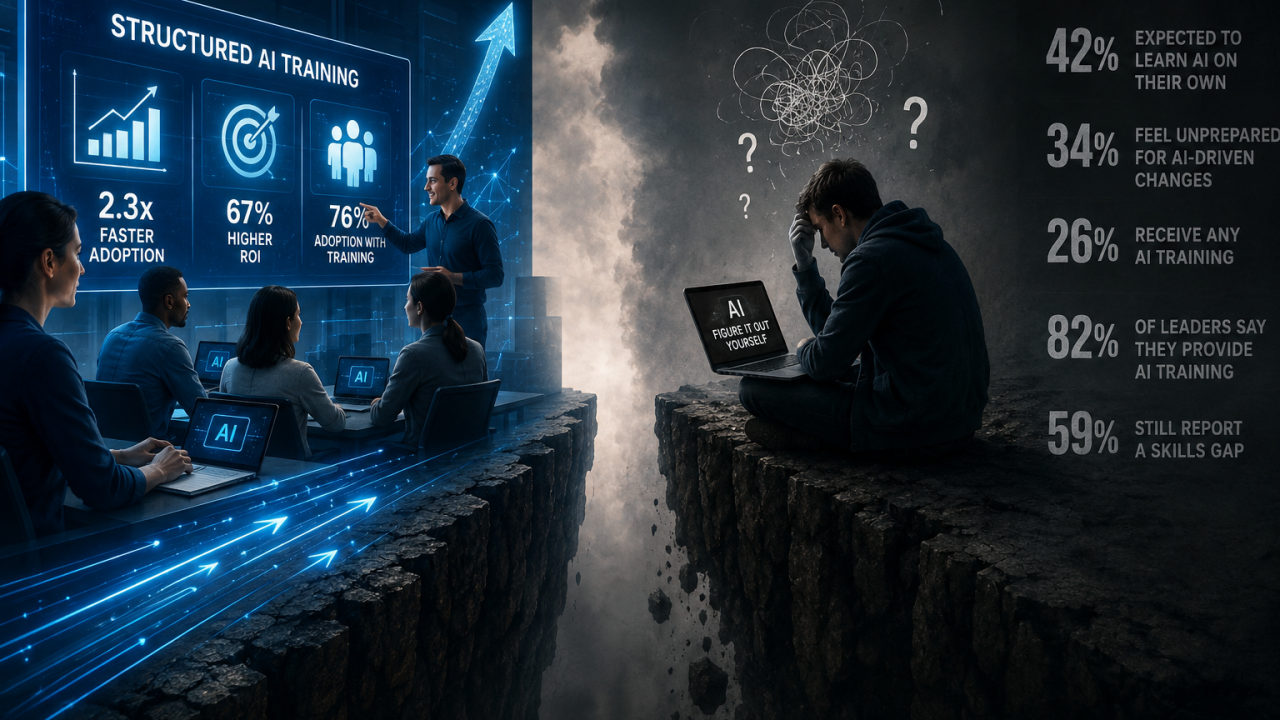
The data on structured AI training is unambiguous:
Organizations with formal AI training programs achieve 2.3x faster adoption and 67% higher AI ROI compared to those without structured programs.
When employers provide AI training, adoption jumps to 76%.
Without it? 25%.
That’s a 3x difference based on one variable: whether someone built the structure.
The Paradox
So if structured training produces dramatically better outcomes, you’d expect every organization to be investing in it.
Here’s what’s actually happening:
42% of employees say their employer expects them to learn AI on their own.
34% feel unprepared for AI-driven changes in their role.
Only 26% report receiving any training on how to collaborate with AI.
And the stat that should stop every executive in their tracks: 82% of enterprise leaders say their organization provides AI training — but 59% still report a skills gap.
We’ve seen this number before. It’s the same paradox. Training is happening. Capability isn’t.
Why the Gap Persists
The answer is the same one I’ve been naming for months.
Most AI training is designed to create awareness. Awareness doesn’t change behavior.
What changes behavior is structured follow-through. A specific workflow tied to a specific outcome. A 30-day measurement of whether the behavior showed up. An operational cadence that reinforces the learning after the session ends.
Without that structure, training is a check-the-box exercise. And the 82/59 gap — 82% training, 59% skills gap — is the proof.
The $5.5 Trillion Cost of Getting This Wrong
IDC projects that AI skills shortages could cost the global economy $5.5 trillion by the end of this decade.
That’s not lost revenue from bad technology. It’s lost revenue from unprepared people.
Over 90% of global enterprises are projected to face critical skills shortages by 2026. Not because AI talent doesn’t exist — but because organizations haven’t built the infrastructure to develop it internally.
The organizations closing the gap share three common investments:
Structured training wired to specific business outcomes — not generic AI literacy.
Measurement after the session — adoption metrics, not satisfaction surveys.
Internal AI champions who own follow-through — not just an L&D team that schedules the workshop.
What This Means for CAIOs and AI Consultants
This is the workforce development consulting market hiding inside every AI strategy engagement.
Every company that hires you to advise on AI adoption also has a workforce readiness problem. Most of them don’t know it yet. The ones that do don’t know how to solve it.
If you can build the structured training infrastructure — the assessment, the pathway, the measurement cadence — you’re not just an AI consultant anymore.
You’re a workforce architect.
And that’s a much bigger market.
Is your organization measuring AI training by completion rates or by behavior change? What’s the difference in outcomes?
