Posts Tagged
‘Consulting’

Home / Consulting

Here’s a number that should concern every hiring manager, career counselor, and workforce development leader in the country:

Junior tech job postings have declined 67% since 2022.

Not a slowdown. A collapse.

And it’s not just tech. LinkedIn’s hiring rate for entry-level workers dropped 6% between December 2025 and February 2026. Middle-management hiring declined 10% over the same window.

The mechanism is straightforward. Many of the tasks that used to fill entry-level roles — research, drafting, analysis, coordination — can now be accelerated or partially automated by generative AI tools. Companies under cost pressure responded by eliminating the roles that performed those tasks.

But here’s what nobody’s talking about:

We’re building a career ladder with no first rung.

Employers say they want mid-career professionals with five to ten years of experience. But the roles that used to produce those five to ten years are disappearing.

The Paradox Nobody’s Solving

Job postings now routinely demand two to three years of experience for what used to be entry-level positions. You need the job to get the experience. You need the experience to get the job.

Employment for 22-to-25-year-olds in AI-exposed occupations has dropped 13% since late 2022. For software developers in that age range, it’s down 20%.

This isn’t just a Gen Z problem. It’s a pipeline problem.

If you’re an employer cutting entry-level roles today, ask yourself: where does your mid-career talent come from in 2030?

If you’re a workforce development leader, ask yourself: what are you building for the people who can’t get on the ladder at all?

What the Adaptive Workers Are Doing

The workers who are navigating this aren’t waiting for the ladder to come back. They’re building their own.

They’re stacking credentials — not just degrees, but certificates, portfolio projects, and documented AI-augmented work samples.

They’re treating continuous learning as a job requirement, not an extracurricular.

They’re gaining experience through freelance projects, open-source contributions, and apprenticeship-style arrangements before they ever land a full-time role.

It’s not the path anyone drew up. But it’s the path that’s working.

The question for the rest of us — employers, educators, consultants, policymakers — is whether we’re going to keep pretending the old ladder still exists.

Or start building a new one.

If you’re hiring right now — are you still requiring experience that entry-level candidates have no way to get? What would it take to rethink that?

Here’s the stat that should end every debate about whether AI adoption is a training problem:

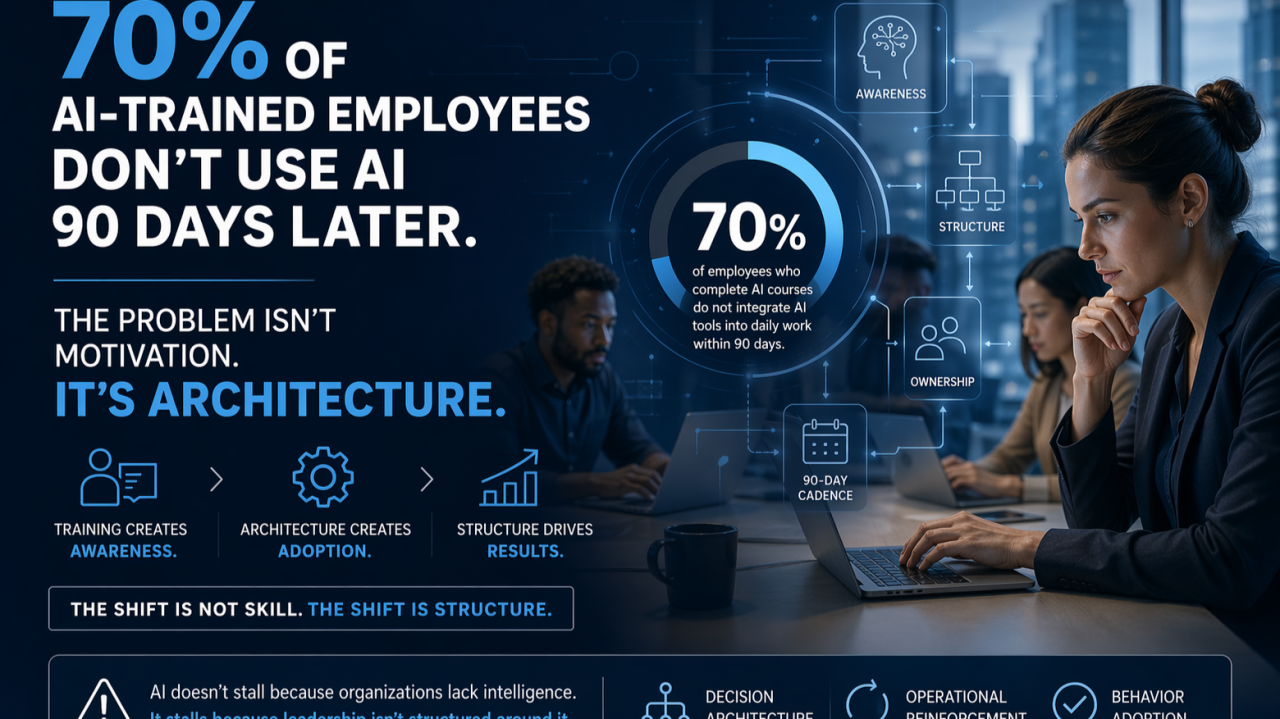
70% of employees who complete AI courses do not integrate AI tools into daily work within 90 days.

Not because they didn’t learn.

Not because they weren’t motivated.

Because there was no structured follow-up.

No operational reinforcement.

No system that turned awareness into behavior.

This is the same pattern at every level:

At the individual level: people learn AI but don’t use it.

At the consultant level: people get certified but can’t close clients.

At the enterprise level: companies pilot AI agents but can’t get them to production.

The thread connecting all three?

The absence of operational architecture.

Training creates awareness.

Architecture creates adoption.

This distinction is the single most important idea in AI right now. And it’s the one almost nobody is building for.

Everyone is building more courses. More tools. More certifications. More agents.

Almost nobody is building the governance layer — the decision architecture, the ownership model, the 90-day cadence — that makes any of it stick.

That’s the gap.

And the people who fill it won’t be the most technically fluent AI professionals.

They’ll be the ones who understand something deeper:

AI doesn’t stall because organizations lack intelligence.

It stalls because leadership isn’t structured around it.

The shift is not skill.

The shift is structure.

The AI consulting market is projected to hit $14 billion this year.

By 2035, it’s expected to reach $116 billion.

But here’s what the growth headlines don’t tell you:

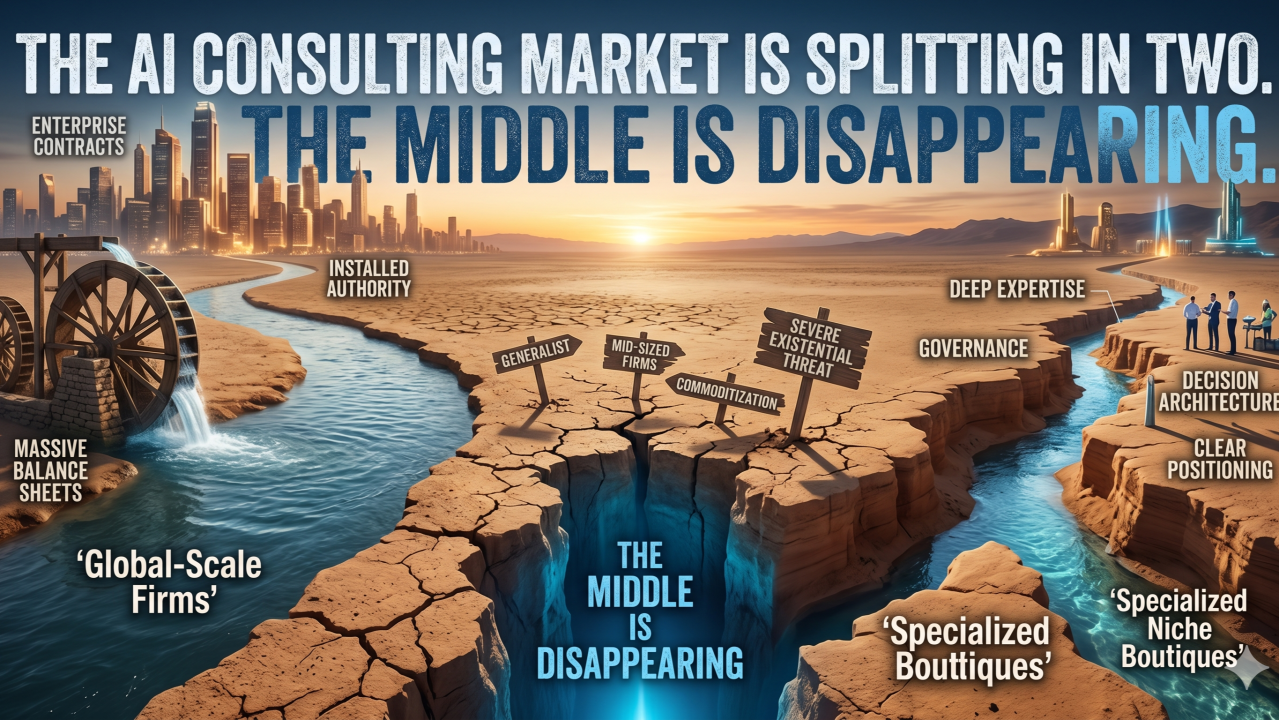
The market isn’t growing evenly.

It’s splitting.

Industry research is showing a clear bifurcation:

On one side: global-scale firms (Deloitte, Accenture, McKinsey) with massive balance sheets and enterprise contracts.

On the other: specialized niche boutiques with deep expertise and clear positioning.

The middle? It’s disappearing.

Mid-sized firms without either the scale to compete for enterprise work or the specialization to compete on depth are facing what researchers are calling “a severe existential threat.”

This isn’t a prediction. It’s already happening.

And it maps directly to what I’m seeing with individual AI consultants:

The generalist — “I help companies with AI” — is being commoditized.

Basic AI implementation tasks are increasingly handled by automated systems or standardized frameworks.

What’s not commoditizable?

Governance. Decision architecture. Industry-specific readiness assessment. Structured certification pathways.

The consultants who are thriving aren’t trying to be everything.

They’re choosing a lane and going deep.

Then they’re building ecosystems with partners who own the lanes they don’t.

The market rewards specificity. It rewards installed authority.

It does not reward being “pretty good at everything.”

If you’re an AI consultant reading this: the question isn’t whether the market is growing.

It’s whether you’re positioned in the part of the market that’s growing — or the part that’s collapsing.

Where do you see yourself in this split — scaling toward enterprise, or deepening into a niche?

Six months ago, I was trying to be the smartest AI person in the room.

Today, I’m building an ecosystem with people who are smarter than me in areas I’ll never own.

That shift changed everything.

Here’s what I’ve come to believe:

The solo AI consultant — the one who knows the tools, runs the assessments, builds the roadmaps, leads the implementation, and tries to be everything to every client — is a dying model.

Not because they’re not good.

Because the market has gotten too complex for one person to credibly cover.

Agentic AI. Governance. Training. Certification. Industry-specific implementation. Security. Data architecture.

No single consultant can hold all of that.

The consultants I see winning right now aren’t the ones with the deepest expertise.

They’re the ones building partnerships.

Embedding their methodology into existing certification programs.

Co-creating training with people who own the classroom.

Layering platforms over partner ecosystems instead of selling one seat at a time.

In the last 90 days, we’ve moved from “here’s our tool” to:

“Let’s embed this into your existing curriculum.”

“Let’s co-create a certification tier together.”

“Let’s build infrastructure that scales through your network, not mine.”

That’s not a product pivot.

That’s an identity shift.

From: I am the expert.

To: I architect the system that makes experts operational.

The solo consultant model worked when AI was new and clients just needed someone to explain it.

We’re past that now.

The question isn’t “who knows the most?”

It’s “who has built something that holds without them in the room?”

Are you still trying to be the single expert? Or have you started building partnerships that extend your reach?

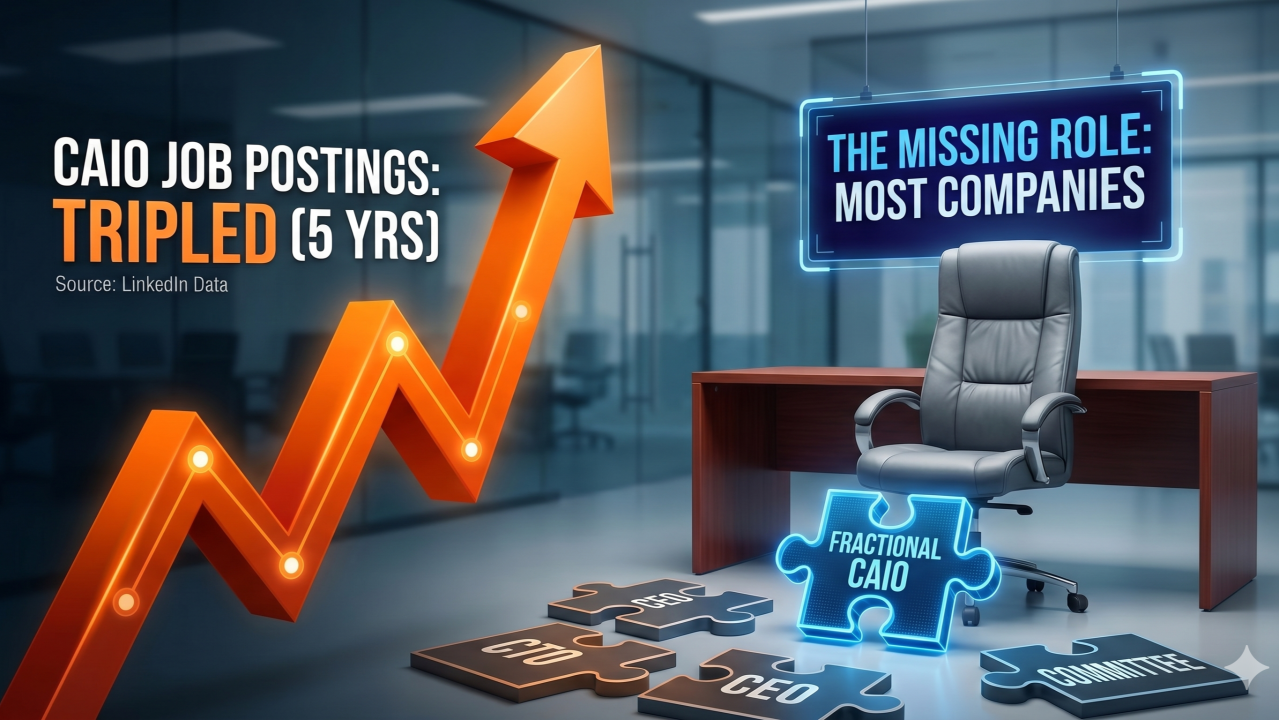
LinkedIn just reported that Chief AI Officer job postings have tripled over the last five years.

It’s now officially one of technology’s fastest-growing executive roles.

But here’s what the headline misses:

Most companies still don’t have one.

Not because they don’t need AI leadership. Because the role, as typically defined, assumes a full-time executive with a dedicated budget and organizational authority.

Most mid-market companies — the ones actually struggling with AI adoption — can’t afford that.

So what happens?

AI ownership defaults to the CEO. Or the CTO. Or a committee.

And when something belongs to everyone, it belongs to no one.

This is exactly where the fractional model changes the game.

A Fractional CAIO isn’t a consultant who advises on AI.

It’s an installed leadership function that governs AI decisions, establishes cadence, and creates accountability — on a retainer, not a project.

The demand signal is clear.

The hiring data says companies want AI leadership.

The market reality says most can’t hire it full-time.

The opportunity for AI professionals who can install governance — not just deliver advice — has never been larger.

But it requires a structural shift.

From: “I help companies with AI.”

To: “I install the decision architecture that makes AI work.”

Those are different identities. Different revenue models. Different outcomes.

Do you see the fractional CAIO model gaining traction in your network? Or is it still mostly consultant-as-title?

Here’s the number everyone in AI should be paying attention to right now:

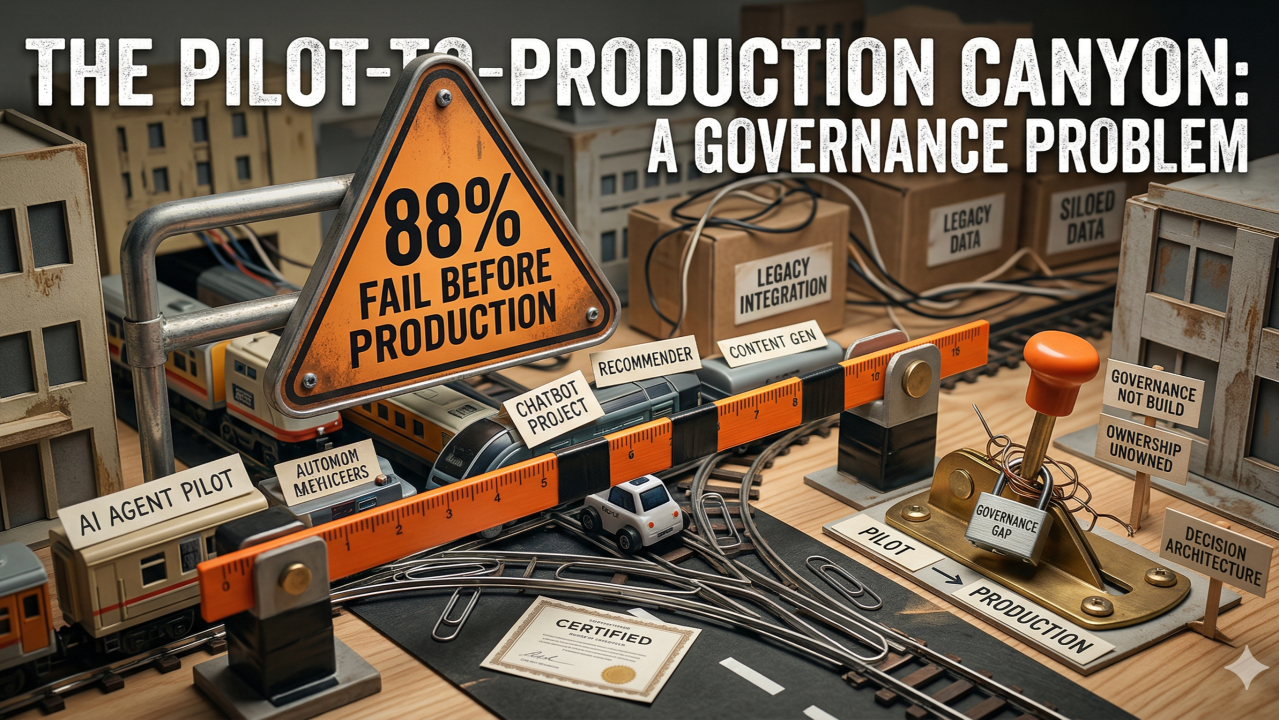
88% of AI agent projects fail to reach production.

Not because the technology doesn’t work.

Not because the models aren’t good enough.

Because — according to the research — “teams build agents before they build controls.”

Let that sink in.

The Deployment Backlog Nobody’s Talking About

78% of enterprises now have AI agent pilots running.

Only 14% have successfully scaled to production.

That’s not a gap. That’s a canyon.

And it gets worse. A March 2026 survey of 650 enterprise technology leaders found that even when pilots show meaningful results — and 67% of them do — only 10% ever make it across the finish line.

This is the largest deployment backlog in enterprise technology history. Double the failure rate of traditional IT projects.

The agents work in the lab. They work in the demo. They impress the steering committee.

And then they stall.

Five Root Causes — And Only One Is Technical

New research has identified the five root causes that account for 89% of scaling failures:

Integration complexity with legacy systems.

Inconsistent output quality at volume.

Absence of monitoring tooling.

Unclear organizational ownership.

Insufficient domain training data.

Look at that list carefully.

Only one — integration complexity — is a technology problem.

The rest? Ownership. Monitoring. Quality control. Governance.

These are leadership problems wearing technical disguises.

And they’re interrelated in a way that makes them compound. Ownership gaps leave monitoring gaps unfilled. Monitoring gaps make quality problems invisible. Invisible quality problems erode executive trust. Eroded trust kills budget.

It’s a chain reaction. And it starts — every time — with the same missing variable:

Nobody owns this.

Agent Sprawl: The Term You’ll Be Hearing Everywhere

There’s a new concept emerging in enterprise AI that perfectly captures what’s happening:

Agent sprawl.

It’s the uncontrolled proliferation of siloed, ungoverned AI agents across an enterprise. It happens when business units move fast to solve immediate problems with AI — without a unifying strategy, shared data infrastructure, or centralized oversight.

Sound familiar?

It should. It’s the same pattern I’ve been naming for two years. I called it “Duct-Tape Adoption” — sticking AI onto broken processes and hoping it creates magic.

The only difference now? The stakes are higher.

When it was chatbots and automation workflows, duct-tape adoption wasted time and budget.

When it’s autonomous agents making decisions, accessing databases, and operating across departments — duct-tape adoption creates organizational risk.

The security data backs this up. 88% of organizations reported confirmed or suspected AI agent security incidents in the last year. 80% documented risky agent behaviors including unauthorized system access and data exposure. And 64% of companies with revenue above $1 billion reported losses exceeding $1 million tied to AI system failures.

These aren’t hypothetical risks. They’re happening right now, in production environments, at scale.

The Readiness Gap in Four Numbers

Research now quantifies exactly how unprepared most organizations are to govern agentic AI. Four readiness categories tell the story:

Infrastructure readiness: 43%.

Data management readiness: 40%.

Governance readiness: 30%.

Talent readiness: 20%.

That last number should stop every AI consultant and advisor in their tracks.

Only 20% of organizations are talent-ready for agentic AI.

And governance — the single most critical variable for moving agents from pilot to production — sits at 30%.

This is why Gartner is now warning that 40%+ of agentic AI projects may be cancelled by 2027.

Not for lack of capability.

For lack of structure.

What This Means If You’re an AI Consultant

This data is both a warning and an opportunity.

The warning: implementation advice alone won’t save a stalled agent deployment. If you’re still leading with tool recommendations and feature demos, you’re solving a problem the market has already moved past.

The opportunity: the organizations that need you most right now aren’t asking “what tool should we use?”

They’re asking something harder:

“How do we govern what we’ve already built?”

“Who owns the decision about what this agent is allowed to do?”

“What happens when it breaks — and who’s accountable?”

Those aren’t consulting questions. They’re governance questions. And they require a fundamentally different operating model than most AI consultants are running.

The consultants who step into that gap — who can install decision architecture, define ownership, and build the 90-day oversight cadence — will own the most valuable real estate in the AI market for the next three years.

The ones who keep leading with tools will wonder why their pipeline dried up.

The Bottom Line

The agentic AI wave isn’t failing because the technology is immature.

It’s failing because organizations are building agents the same way they adopted every other AI tool:

Fast. Excited. Unstructured.

And for the first time, the consequences of that approach aren’t just wasted budget.

They’re security incidents. Unauthorized access. Million-dollar losses.

The market doesn’t need more agents.

It needs more architecture.

Source data:

– 88% failure rate, 78% piloting / 14% production (Apify enterprise research, Digital Applied March 2026 survey)

– 67% of pilots show meaningful results, only 10% scale (Digital Applied)

– 5 root causes account for 89% of failures (ZBrain, HarrisonAIX)

– Agent sprawl and security incidents: 88% confirmed/suspected incidents, 80% risky behaviors (Gravitee State of AI Agent Security 2026)

– 64% of $1B+ companies report $1M+ AI losses (Accelirate)

– Readiness gaps: Governance 30%, Talent 20% (Decidr US AI Readiness Index 2026)

– Gartner: 40%+ agentic AI project cancellation risk by 2027

– Only 22% treat agents as independent identities (Security Boulevard)

The digital evolution isn’t waiting for anyone.

For businesses today, the question is no longer if they should use AI: it’s who is orchestrating it. And more importantly, how.


A Personal Journey That Became a Platform

In mid-2024, I started exploring AI with one simple goal: find additional services I could offer through our digital marketing agency, MyMobileLyfe.

I wasn’t coming in as a technologist. I was a business strategist trying to figure out where AI fit into our clients’ worlds. And honestly? I didn’t know much.

I had never heard the title Chief AI Officer. I certainly didn’t understand what the role actually demanded — the governance responsibilities, the ethical frameworks, the strategic depth required to move a company from “we’re experimenting with AI” to measurable, scalable results.

But I started digging.

The deeper I went — including studying the work coming out of organizations like ChiefAIOfficer — the clearer it became: businesses desperately need structured AI leadership, and most of them don’t know where to find it.

That realization didn’t just lead me to write a book. It became the entire foundation for One-Click AI.ai — a platform built specifically for aspiring AI consultants and CAIOs who want to deliver real strategic value to their clients.


Announcing the Second Edition

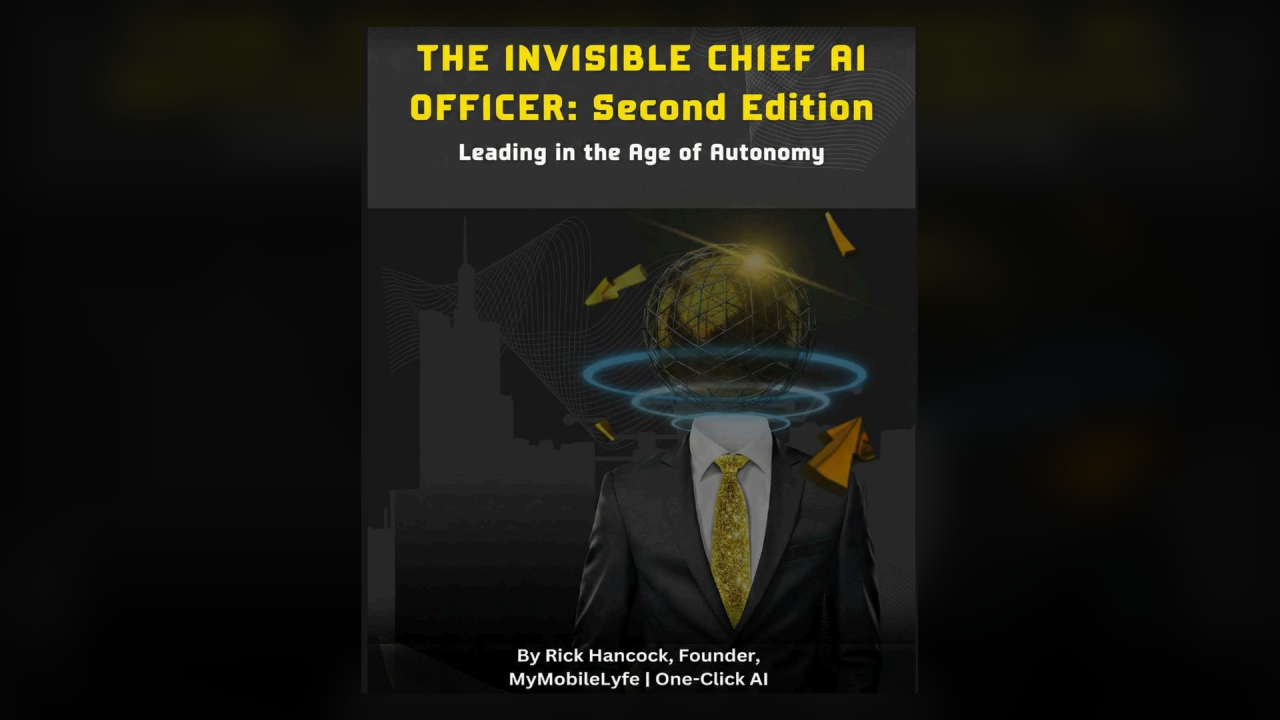
I’m thrilled to announce the release of the second edition of The Invisible Chief AI Officer: Leading in the Age of Autonomy.

This isn’t a book about AI tools. It’s a field guide for the people responsible for making AI work inside real organizations — business leaders, fractional partners, and especially non-technical certified AI consultants who are navigating clients through one of the most complex transitions in business history.

The second edition goes deeper on the core responsibilities this emerging role demands:

  • Strategic Mandates — Building a long-term AI vision that aligns with a company’s actual mission, not just its budget
  • The Silicon Workforce — Managing hybrid teams where humans and autonomous agentic systems work side by side
  • Governance & Ethics — Conducting bias audits, protecting data privacy, and building transparency into every deployment
  • Operational Models — Helping clients choose between Full-Time, Fractional, or On-Demand CAIO structures based on their specific needs and readiness

Why This Is Your Moment as an AI Consultant

Here’s what I want every non-technical certified AI consultant to understand: your value isn’t in knowing how to build models. It’s in knowing how to lead through them.

Your clients aren’t failing because they don’t have enough AI tools. They’re failing because they don’t have a coherent strategy. They’re stuck in pilot purgatory, burning budget on disconnected solutions that never add up to competitive advantage.

That’s the gap you fill.

You don’t need a hundred-million-dollar R&D budget to compete with industry giants anymore. Through models like the On-Demand CAIO, even small businesses can access the kind of strategic intelligence that was once reserved for the Fortune 500.

Whether you’re serving as a fractional partner or leveraging a platform like OneClickAI.ai to scale your practice, you are the architect of your clients’ AI future.


The Invisible Leader Is the Most Powerful One

We are operating in an era where work is increasingly autonomous — and the leaders who matter most aren’t the loudest ones in the room. They’re the ones quietly building the infrastructure, the governance, and the strategy that makes everything else possible.

That’s who this book is for.

I invite you to pick up the second edition of The Invisible Chief AI Officer and join me in bridging the gap between AI potential and profitable, sustainable business outcomes. I’ve dropped a link in the comments and you can download a Free digital copy.

The future belongs to those who act with intention.

Let’s get started.

There’s a moment many AI consultants experience but rarely talk about.

You’re certified. Capable. Confident in your knowledge.

Clients are interested.

The market is growing.

And yet…

Revenue still feels fragile.


The Instability No One Posts About

Not because you lack skill.

Not because there isn’t demand.

But because every engagement resets your position.

Each new client requires:

• Re-explaining your value • Re-justifying your pricing • Re-defining scope • Re-earning authority

That repetition creates something subtle:

Instability.


Competent — But Not Installed

You can be competent and still not be positioned.

Consultants are brought in.

They advise. They recommend. They deliver.

Then they exit.

And when they exit, so does their authority.

That cycle becomes exhausting.

Not physically.

Structurally.


The Psychological Tension

Here’s the part most won’t say publicly:

There’s a quiet anxiety in knowing your income depends on the next project closing.

Even if you’re good.

Even if you’re respected.

Even if your work delivers results.

When your position resets each time, security becomes temporary.

That’s not a capability problem.

That’s a structural one.


The Realization

I remember recognizing it.

Not dramatically.

Not all at once.

Just gradually understanding:

I wasn’t unstable because I lacked skill.

I was unstable because I was operating inside an execution model.

Projects must be resold.

Authority must be installed.

That distinction changed how I approached AI advisory work.


The Shift

The solution wasn’t more certifications.

It wasn’t lowering price.

It wasn’t expanding services.

It was redesigning the operating model.

From:

External expert To installed governance.

From:

Project revenue To executive cadence.

From:

Rotating advisory To structured oversight.


Closing

Most AI consultants are more capable than their positioning allows.

But capability does not protect you from structural fragility.

Governance does.

The shift is not skill.

The shift is structure.

— Rick Hancock, Architect of Fractional CAIO Governance Systems

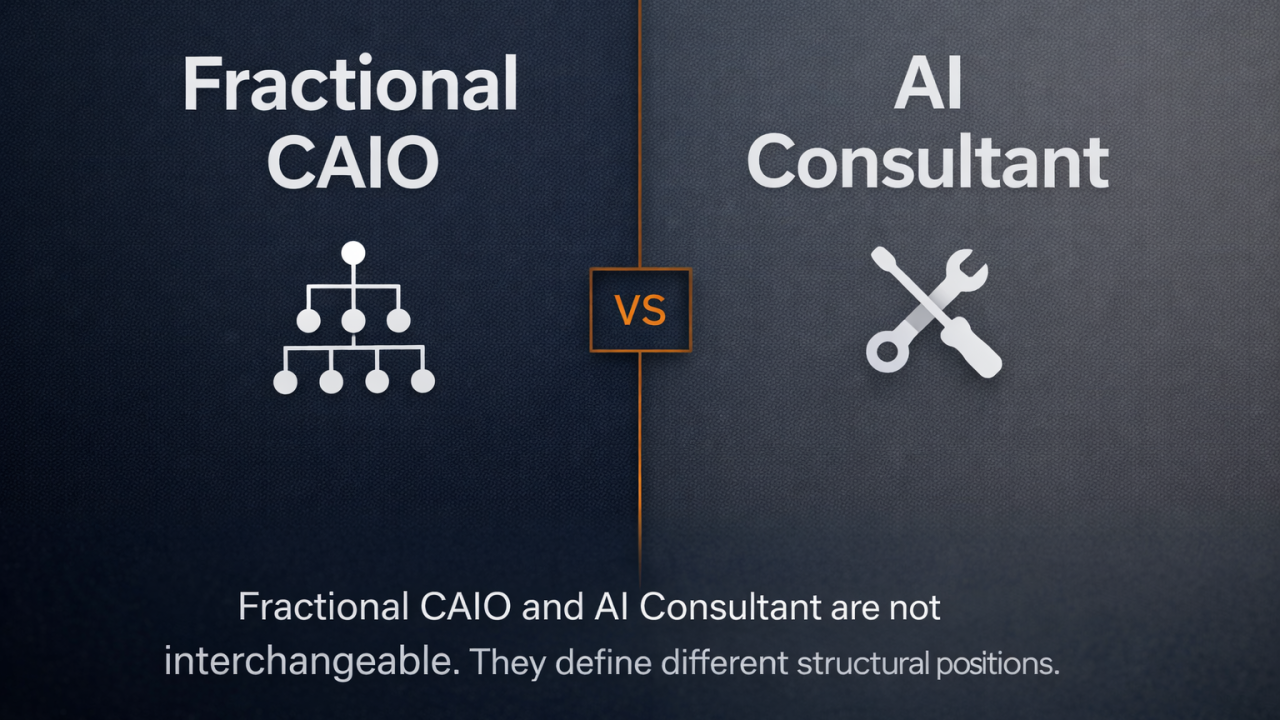
The terms are being used interchangeably.

They should not be.

“AI Consultant” and “Fractional CAIO” describe two different operating positions in the market.

The confusion is understandable.

The distinction is structural.


1️⃣ The AI Consultant

An AI consultant is brought in to:

• Advise on AI initiatives • Evaluate tools and vendors • Design implementation plans • Support execution • Deliver defined outcomes

Compensation Model: Project-based, milestone-based, or scoped advisory retainers.

Authority Level: Influence without ownership.

Identity: External expert.

The consultant’s role is directional.

They recommend.

They guide.

They deliver.

But they do not own governance.


2️⃣ The Fractional CAIO

A Fractional CAIO is installed to:

• Oversee AI governance • Define decision architecture • Establish executive cadence • Align AI initiatives with business objectives • Manage risk and prioritization • Report at leadership level

Compensation Model: Retainer-based executive function.

Authority Level: Oversight and structured decision influence.

Identity: Installed leadership role.

The Fractional CAIO does not simply recommend AI initiatives.

They design how AI decisions get made.

That distinction changes everything.


3️⃣ Influence vs Governance

Consultants answer:

“What should we do?”

Fractional CAIOs answer:

“How will AI decisions be structured, evaluated, and overseen over time?”

One solves problems.

The other installs systems.

One delivers insight.

The other defines operating rhythm.


4️⃣ Execution Model vs Governance Model

AI Consultant: Revenue tied to projects.

Fractional CAIO: Revenue tied to executive oversight.

Projects end.

Governance continues.

Projects must be resold.

Governance renews.


5️⃣ The Title Problem

Many professionals adopt the title “Fractional CAIO.”

Few install a governance model.

Title adoption without structural installation creates confusion in the market.

Fractional CAIO is not a branding upgrade.

It is an operating model.

Without:

• Defined governance cadence • Reporting structure • 90-day oversight rhythm • Budget prioritization logic • Risk management framework

You are operating as a consultant.

Not as a CAIO.


6️⃣ Why This Definition Matters

The AI market is expanding.

But advisory revenue volatility remains high.

The reason is not lack of demand.

It is structural misalignment.

When you operate as a consultant while attempting to earn as a governance executive, friction appears.

Clarity resolves friction.


Closing Definition

AI Consultant: Delivers AI expertise.

Fractional CAIO: Installs AI governance.

Both roles are valid.

They are not the same.

The shift is not skill.

The shift is structure.