Posts Tagged
‘Hiring’

Home / Hiring

The data on structured AI training is unambiguous:

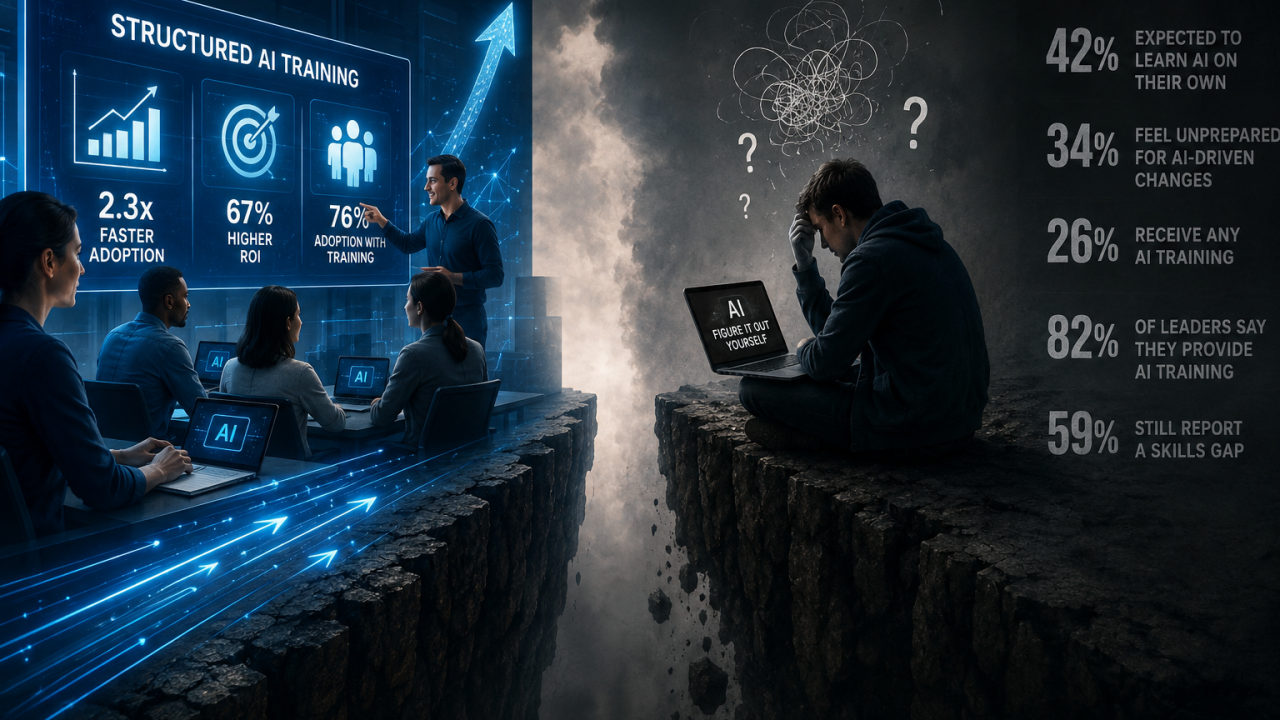
Organizations with formal AI training programs achieve 2.3x faster adoption and 67% higher AI ROI compared to those without structured programs.

When employers provide AI training, adoption jumps to 76%.

Without it? 25%.

That’s a 3x difference based on one variable: whether someone built the structure.

The Paradox

So if structured training produces dramatically better outcomes, you’d expect every organization to be investing in it.

Here’s what’s actually happening:

42% of employees say their employer expects them to learn AI on their own.

34% feel unprepared for AI-driven changes in their role.

Only 26% report receiving any training on how to collaborate with AI.

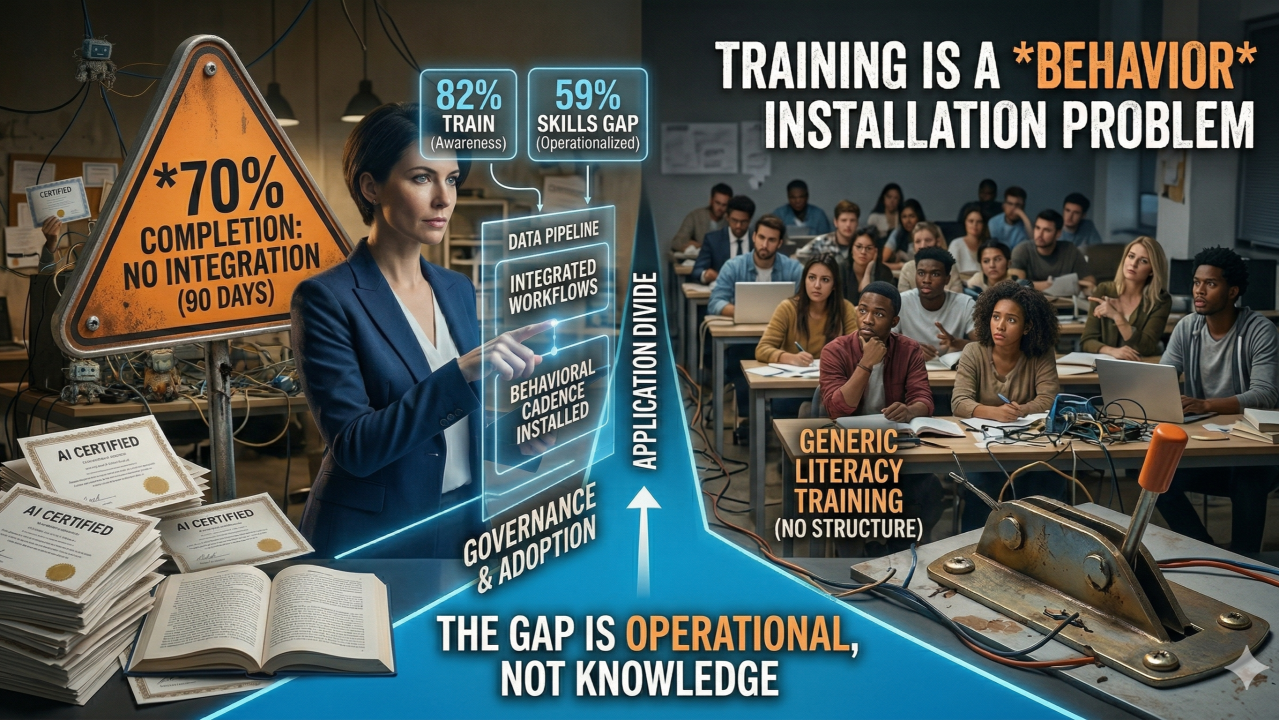
And the stat that should stop every executive in their tracks: 82% of enterprise leaders say their organization provides AI training — but 59% still report a skills gap.

We’ve seen this number before. It’s the same paradox. Training is happening. Capability isn’t.

Why the Gap Persists

The answer is the same one I’ve been naming for months.

Most AI training is designed to create awareness. Awareness doesn’t change behavior.

What changes behavior is structured follow-through. A specific workflow tied to a specific outcome. A 30-day measurement of whether the behavior showed up. An operational cadence that reinforces the learning after the session ends.

Without that structure, training is a check-the-box exercise. And the 82/59 gap — 82% training, 59% skills gap — is the proof.

The $5.5 Trillion Cost of Getting This Wrong

IDC projects that AI skills shortages could cost the global economy $5.5 trillion by the end of this decade.

That’s not lost revenue from bad technology. It’s lost revenue from unprepared people.

Over 90% of global enterprises are projected to face critical skills shortages by 2026. Not because AI talent doesn’t exist — but because organizations haven’t built the infrastructure to develop it internally.

The organizations closing the gap share three common investments:

Structured training wired to specific business outcomes — not generic AI literacy.

Measurement after the session — adoption metrics, not satisfaction surveys.

Internal AI champions who own follow-through — not just an L&D team that schedules the workshop.

What This Means for CAIOs and AI Consultants

This is the workforce development consulting market hiding inside every AI strategy engagement.

Every company that hires you to advise on AI adoption also has a workforce readiness problem. Most of them don’t know it yet. The ones that do don’t know how to solve it.

If you can build the structured training infrastructure — the assessment, the pathway, the measurement cadence — you’re not just an AI consultant anymore.

You’re a workforce architect.

And that’s a much bigger market.

Is your organization measuring AI training by completion rates or by behavior change? What’s the difference in outcomes?

This is the hiring trend that’s moving faster than most job seekers realize:

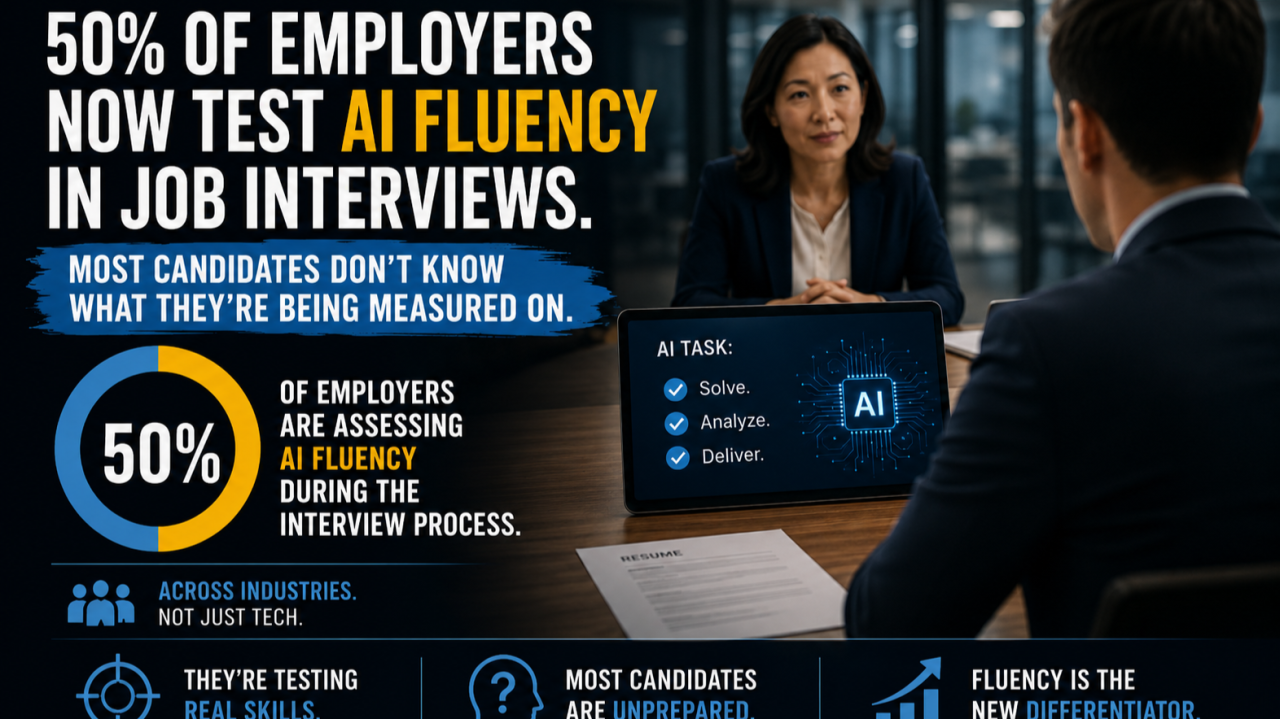
Half of all employers are now assessing AI fluency during the interview process.

Not in engineering roles. Across industries.

And what they’re measuring isn’t what most people think.

What Employers Actually Test

According to WGU’s 2026 Workforce Decoded report:

52% are using technical skills-based assessments or on-the-project evaluations. Not multiple choice. Not “tell me about a time you used AI.” Actual tasks. Actual output.

39% are evaluating real-world experience with tools like ChatGPT, Copilot, and Python libraries. They want to see what you’ve built, not what you’ve studied.

32% are looking for certifications — but not as standalone proof. As one signal among many in a broader readiness portfolio.

The shift is from “do you know what AI is?” to “can you use AI to produce something measurable?”

The Fluency Gap

Here’s where it gets uncomfortable.

Most AI training — corporate, academic, or self-directed — still focuses on awareness. What AI is. What it can do. How to write a prompt.

But employers aren’t hiring for awareness anymore. They’re hiring for fluency.

Fluency means you’ve integrated AI into your actual workflow. It means you can identify which tasks benefit from AI augmentation and which don’t. It means you can evaluate AI output critically — not just accept whatever the model gives you.

That gap — between awareness and fluency — is where most candidates are falling short. Not because they’re not smart. Because nobody taught them the difference.

Why This Matters for AI Consultants

If you’re advising organizations on AI adoption, this is the workforce side of the same governance problem.

Companies are testing for fluency in hiring but not building fluency in their existing teams. They’re assessing candidates on skills they haven’t structured internal training to develop.

That disconnect is a consulting opportunity hiding in plain sight.

The organizations that solve it won’t just hire better. They’ll retain better, adopt faster, and build the internal capability that makes AI investments actually pay off.

The ones that keep testing for fluency without building it? They’ll keep wondering why their AI initiatives stall.

If you’ve interviewed recently — did you get tested on AI fluency? What did they ask? And did it match what you actually know how to do?

Here’s the number that should keep every university president up at night:

Only 37% of employers believe higher education is adequately preparing graduates for the workforce.

That’s not a fringe opinion. That’s from a survey of 3,147 U.S. employers.

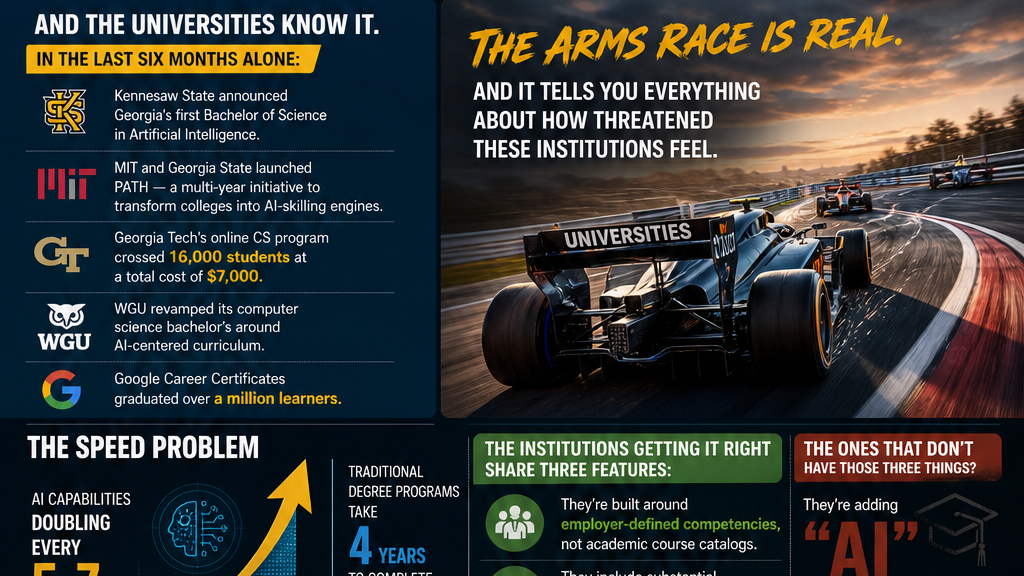
And the universities know it.

In the last six months alone:

Kennesaw State announced Georgia’s first Bachelor of Science in Artificial Intelligence.

MIT and Georgia State launched PATH — a multi-year initiative to transform colleges into AI-skilling engines.

Georgia Tech’s online CS program crossed 16,000 students at a total cost of $7,000.

WGU revamped its computer science bachelor’s around AI-centered curriculum.

Google Career Certificates graduated over a million learners.

The arms race is real. And it tells you everything about how threatened these institutions feel.

But here’s my concern:

Most of them are building faster versions of the same model that produced the 37% number in the first place.

The Speed Problem

AI capabilities are doubling roughly every five to seven months. Traditional degree programs take four years to complete and two to three years to design.

By the time a curriculum committee approves a new AI course, the tools it teaches may already be obsolete.

The institutions getting it right share three features:

They’re built around employer-defined competencies, not academic course catalogs.

They include substantial applied project work — not just theory.

They have public outcomes data that employers can actually verify.

The ones that don’t have those three things? They’re adding “AI” to their marketing copy and hoping nobody notices the syllabus hasn’t changed.

The Real Question

The question isn’t whether higher education will adapt. It will. Institutions that don’t will simply become irrelevant.

The question is whether they’ll adapt fast enough to matter for the workers who need reskilling right now — not in 2030.

Because here’s what the 37% number really means:

Employers have already started building their own pipelines. Internal training programs. Certificate partnerships. Skills-based hiring that bypasses degrees entirely.

The longer universities take to close the gap, the less the market will need them to.

That’s not a prediction.

That’s the math.

If you’re in higher education — what’s the single biggest barrier to moving faster? If you’re an employer — have you given up waiting for universities to catch up?

Two numbers from Western Governors University’s 2026 Workforce Decoded report tell you everything about where hiring is headed:

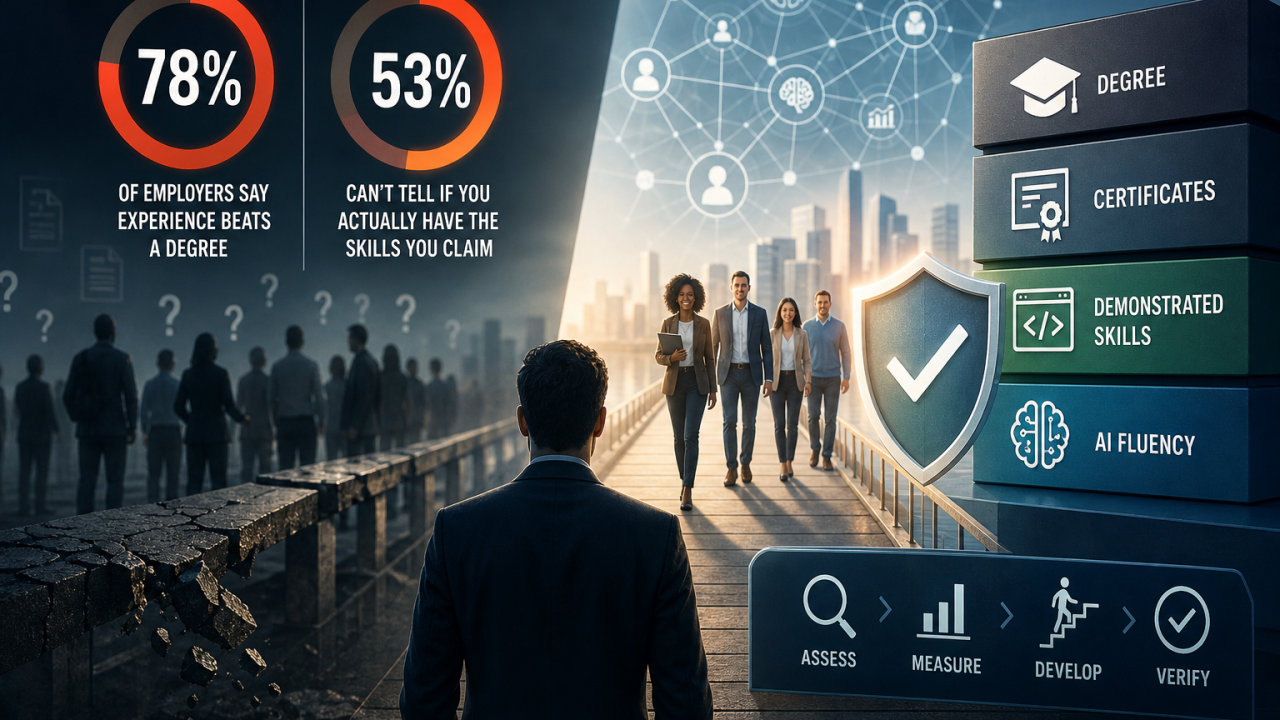
78% of employers now say work experience is equal to or more valuable than a college degree.

53% say their biggest hiring challenge is validating whether candidates actually possess the skills they claim.

Read those together.

Employers have already decided that degrees alone aren’t enough. But they haven’t figured out how to verify what replaced them.

The Readiness Portfolio

What’s emerging is something researchers are calling a “readiness portfolio” — a stacked combination of degree, certificate, demonstrated skill, and provable AI fluency that hiring managers are now evaluating together.

This isn’t the “degrees are dead” narrative. The data doesn’t support that. 68% of employers still say degrees are important. 86% say certificates are valuable.

But neither one is sufficient on its own anymore.

The skills employers rank as most critical aren’t narrowly technical. Critical thinking and problem solving: 60%. Time management: 41%. Adaptability: 40%. Emotional intelligence: 37%.

These are precisely the competencies that AI cannot replicate — and that working professionals develop through years of experience, not classroom instruction.

Which brings us back to the validation problem.

The Verification Gap

If the readiness portfolio is the new standard, then someone needs to build the verification infrastructure.

Right now, 52% of employers are using technical skills-based assessments or on-the-project evaluations to measure AI competency. 39% are evaluating real-world experience with tools like ChatGPT, Copilot, and Python libraries. 32% are looking at certifications from AWS, Microsoft Azure AI, and WGU.

But most of this is ad hoc. There’s no standard. There’s no shared framework. Every employer is inventing their own readiness rubric.

This is a massive opportunity — and it’s one that most AI consultants are completely ignoring.

Where AI Consultants and CAIOs Fit

If you’re an AI consultant or a Fractional CAIO, this is the part that should get your attention.

The organizations struggling hardest with the readiness portfolio aren’t asking for another tool recommendation. They’re asking:

“How do we assess whether our existing workforce is actually AI-ready?”

“What does a structured upskilling pathway look like — not a course catalog, but a measured progression?”

“How do we verify that training translated into capability?”

Those are consulting questions. They’re governance questions. And they’re workforce architecture questions.

The consultants who build frameworks for answering them — repeatable, installable, measurable — will own the workforce development conversation for the next three years.

Everyone else will still be selling tool demos.

CTA: How is your organization verifying AI readiness — structured assessments, or gut instinct? What’s working and what isn’t?

Here’s a number that should concern every hiring manager, career counselor, and workforce development leader in the country:

Junior tech job postings have declined 67% since 2022.

Not a slowdown. A collapse.

And it’s not just tech. LinkedIn’s hiring rate for entry-level workers dropped 6% between December 2025 and February 2026. Middle-management hiring declined 10% over the same window.

The mechanism is straightforward. Many of the tasks that used to fill entry-level roles — research, drafting, analysis, coordination — can now be accelerated or partially automated by generative AI tools. Companies under cost pressure responded by eliminating the roles that performed those tasks.

But here’s what nobody’s talking about:

We’re building a career ladder with no first rung.

Employers say they want mid-career professionals with five to ten years of experience. But the roles that used to produce those five to ten years are disappearing.

The Paradox Nobody’s Solving

Job postings now routinely demand two to three years of experience for what used to be entry-level positions. You need the job to get the experience. You need the experience to get the job.

Employment for 22-to-25-year-olds in AI-exposed occupations has dropped 13% since late 2022. For software developers in that age range, it’s down 20%.

This isn’t just a Gen Z problem. It’s a pipeline problem.

If you’re an employer cutting entry-level roles today, ask yourself: where does your mid-career talent come from in 2030?

If you’re a workforce development leader, ask yourself: what are you building for the people who can’t get on the ladder at all?

What the Adaptive Workers Are Doing

The workers who are navigating this aren’t waiting for the ladder to come back. They’re building their own.

They’re stacking credentials — not just degrees, but certificates, portfolio projects, and documented AI-augmented work samples.

They’re treating continuous learning as a job requirement, not an extracurricular.

They’re gaining experience through freelance projects, open-source contributions, and apprenticeship-style arrangements before they ever land a full-time role.

It’s not the path anyone drew up. But it’s the path that’s working.

The question for the rest of us — employers, educators, consultants, policymakers — is whether we’re going to keep pretending the old ladder still exists.

Or start building a new one.

If you’re hiring right now — are you still requiring experience that entry-level candidates have no way to get? What would it take to rethink that?

Everyone’s still debating whether AI will take their job.

That debate is already over.

Not because AI replaced anyone. Because it changed what employers are looking for — and 76% of them already made the switch.

That’s the number from Western Governors University’s 2026 Workforce Decoded report. Seventy-six percent of employers say AI has already shifted the types of candidates they’re hiring.

Not “plan to shift.” Already shifted.

And here’s what the shift actually looks like:

More than 40% of employers now say mid-career professionals — five to ten years of experience — are their most in-demand hires.

38% are actively reducing entry-level hiring because of AI.

78% say work experience is now equal to or more valuable than a degree.

This isn’t a technology story. It’s a labor market story.

The people losing ground right now aren’t the ones who refuse to learn AI. They’re the ones who learned AI — the vocabulary, the certifications, the LinkedIn posts about prompt engineering — but never installed it into their actual work.

Employers aren’t asking “do you know what AI is?”

They’re asking “have you used it to produce something we can measure?”

That’s a different question entirely. And most people aren’t ready for it.

The threat was never replacement.

The threat was repositioning.

And if you didn’t notice the job description changed, you’re already behind.

When did you first notice the hiring criteria in your industry had shifted? Was it gradual — or did it hit all at once?

DataCamp just published their 2026 AI workforce data.

Two numbers tell the whole story:

82% of enterprise leaders say their organization provides AI training.

59% still report an AI skills gap.

Read that again. The training is happening. The gap isn’t closing.

Why?

Because the gap isn’t about knowledge. It’s about application.

70% of employees who complete AI courses do not integrate AI tools into daily work within 90 days — without structured follow-up.

The research confirms what I’ve been saying for two years:

The problem isn’t that people don’t understand AI.

The problem is that no one has installed the operational structure that turns understanding into behavior.

Training teaches vocabulary.

Structure installs cadence.

One creates awareness. The other creates adoption.

This is why I stopped asking “How do I teach more people about AI?” and started asking “How do I build systems that make AI adoption inevitable?”

And it’s why, a few weeks ago, we partnered with Teri Moten as In-House AI Trainer at MyMobileLyfe.

What Installed Training Actually Looks Like

Teri doesn’t run generic AI literacy sessions.

Every training she leads is wired to a specific workflow, a specific team, and a specific outcome the business is trying to hit.

Before a session, we map what “installed” looks like for that group. What decision gets faster? What task gets offloaded? What behavior has to change? What’s the metric we’ll look at in 30 days to know whether the training actually landed?

After the session, we measure whether it actually got installed. Not whether people enjoyed it. Not whether they took good notes. Whether the behavior showed up in the work.

That’s the difference between training and installation.

One ends when the Zoom closes.

The other starts there.

I’m not sharing this to pitch a service. I’m sharing it because I refuse to add more noise to a market that already has too much of it.

If the 82/59 gap is going to close, it won’t be because somebody invented a better curriculum.

It’ll close because a small number of people decide to treat training as an installation problem — and build the structure around every session that makes the behavior stick.

That’s the work we’re doing.

And it’s the work I think a lot more of us should be doing.

The market doesn’t have a learning problem.

It has an installation problem.

Artificial intelligence (AI) is no longer a futuristic fantasy; it’s a present-day reality, rapidly transforming industries and reshaping the way businesses operate. From streamlining workflows to enhancing customer experiences, AI promises unprecedented efficiency and innovation. However, beneath the shiny surface of technological marvel lies a potentially treacherous problem: bias. AI systems, though seemingly objective, can unintentionally perpetuate and even amplify existing societal biases, leading to significant ethical and business risks. For business leaders, AI strategists, and compliance officers, understanding and mitigating these biases is not just a matter of ethical responsibility, but also a crucial step towards ensuring sustainable growth and long-term success.

The promise of AI lies in its ability to analyze vast datasets and identify patterns that would be impossible for humans to detect. However, the very foundation of an AI system – the data it is trained on – is often a source of bias. This is because the data we collect and use to train AI reflects the existing biases within our society. If historical data is skewed, the AI system will inevitably learn and perpetuate those skews.

Consider, for example, a hiring algorithm trained on a dataset of past employee performance. If that dataset predominantly features male employees in leadership positions, the algorithm may learn to favor male candidates, effectively perpetuating gender inequality. Similarly, a loan application system trained on historical data reflecting discriminatory lending practices could unfairly deny loans to individuals from marginalized communities.

These biases are not always conscious or malicious. In many cases, they are embedded within the data, often stemming from unintentional errors, historical prejudices, or simply a lack of diverse representation. This is precisely what makes them so insidious – they can creep into AI systems unnoticed, leading to unfair and discriminatory outcomes without anyone realizing the system is flawed.

Sources of AI Bias: Unveiling the Culprits

To effectively combat AI bias, it’s crucial to understand its root causes. Here are some of the most common sources:

  • Data Bias: This is perhaps the most prevalent source of AI bias. As mentioned earlier, if the training data is not representative of the population it is meant to serve, the AI system will learn biased patterns. This can manifest in various ways:
    • Historical Bias: Data reflects past inequalities and prejudices.
    • Representation Bias: Certain groups are underrepresented or overrepresented in the data.
    • Measurement Bias: The way data is collected or measured systematically favors certain groups.
  • Algorithm Bias: Even with unbiased data, the algorithm itself can introduce bias. This can occur through:
    • Feature Selection: The choice of which features to include in the model can inadvertently favor certain groups.
    • Model Design: The mathematical models used in AI systems can amplify existing biases in the data.
    • Optimization Criteria: The objective function used to train the AI system can prioritize certain outcomes that disproportionately benefit certain groups.
  • Human Bias: Human decisions throughout the AI development lifecycle, from data collection and labeling to algorithm design and evaluation, can inject bias into the system. This can be due to:
    • Confirmation Bias: Humans tend to seek out information that confirms their existing beliefs, leading them to inadvertently bias the data or the algorithm.
    • Availability Heuristic: Humans tend to rely on readily available information, which may not be representative of the entire population.
    • Unconscious Bias: Subconscious stereotypes and prejudices can influence decision-making, even when individuals are unaware of them.

Ethical and Business Risks: The Price of Ignoring AI Bias

The consequences of ignoring AI bias are far-reaching, impacting both ethical considerations and business outcomes.

  • Ethical Risks: The most obvious risk is the perpetuation of discrimination and inequality. Biased AI systems can deny individuals access to essential services, such as loans, employment, or healthcare, simply because of their race, gender, or other protected characteristics. This not only harms individuals but also undermines the principles of fairness and justice.
  • Legal Risks: Biased AI systems can violate anti-discrimination laws and regulations, leading to costly lawsuits and reputational damage. Companies that fail to address AI bias are increasingly likely to face legal challenges from regulatory bodies and individuals who have been harmed by biased AI systems.
  • Reputational Risks: Negative publicity surrounding biased AI systems can severely damage a company’s reputation and erode customer trust. In today’s highly connected world, news of biased AI systems can spread rapidly through social media, leading to public outcry and boycotts.
  • Financial Risks: Biased AI systems can lead to poor business decisions, resulting in financial losses. For example, a biased marketing campaign that targets the wrong audience can waste resources and damage brand perception. A biased risk assessment system can lead to poor investment decisions.
  • Operational Risks: Biased AI systems can create operational inefficiencies and hinder innovation. If AI systems are not accurately reflecting the needs of all customers, they may not be effective in solving real-world problems. This can lead to wasted resources and missed opportunities.

Mitigating and Preventing AI Bias: A Proactive Approach

Addressing AI bias requires a proactive and multifaceted approach that spans the entire AI development lifecycle. Here are some key strategies:

  • Data Auditing and Cleansing: Regularly audit training data for potential biases and cleanse it to ensure it is representative and accurate. This may involve collecting more diverse data, correcting errors, and removing irrelevant features.
  • Algorithm Awareness: Be aware of the potential biases inherent in different algorithms and choose algorithms that are less susceptible to bias. Consider using fairness-aware algorithms that are specifically designed to mitigate bias.
  • Fairness Metrics: Implement fairness metrics to measure the performance of AI systems across different demographic groups. This will help you identify and address biases that may not be apparent through traditional performance metrics.
  • Bias Detection Tools: Utilize bias detection tools to automatically identify potential biases in data and algorithms. These tools can help you uncover hidden biases that you may not be aware of.
  • Transparency and Explainability: Design AI systems that are transparent and explainable, allowing users to understand how decisions are being made. This will help you identify and address biases that may be hidden within the system.
  • Human Oversight: Maintain human oversight of AI systems to ensure they are not perpetuating bias. This may involve setting up review boards to evaluate the performance of AI systems and making adjustments as needed.
  • Diverse Teams: Build diverse teams of data scientists, engineers, and ethicists to develop and deploy AI systems. This will help you ensure that different perspectives are considered and that potential biases are identified early on.
  • Ethical Guidelines and Training: Establish clear ethical guidelines for AI development and deployment and provide training to employees on how to identify and mitigate AI bias. This will help create a culture of ethical AI development within your organization.

By taking a proactive and comprehensive approach to addressing AI bias, business leaders can mitigate the ethical and business risks associated with this pervasive problem. Investing in bias mitigation strategies is not just a matter of social responsibility; it is also a strategic imperative for ensuring the long-term success and sustainability of your organization.

The Future of AI is Fair:

The future of AI hinges on our ability to build fair and equitable systems. By acknowledging and addressing the hidden biases within AI, we can unlock its full potential to improve lives and drive innovation. This requires a concerted effort from business leaders, AI strategists, and compliance officers to prioritize ethical considerations and implement robust bias mitigation strategies. The journey towards fair AI is a continuous one, demanding ongoing vigilance and adaptation.

Ready to take the next step towards responsible AI adoption? Learn more about how MyMobileLyfe’s AI services can help you recognize, mitigate, and prevent AI bias in your workflows. Visit us at https://www.mymobilelyfe.com/artificial-intelligence-ai-services/ to discover how we can help you build a more ethical and sustainable AI strategy.

The talent acquisition landscape is undergoing a seismic shift, fueled by the rapid advancement and increasing accessibility of Artificial Intelligence (AI). Promises of streamlined processes, reduced costs, and more efficient matching of candidates to roles have captivated HR executives and recruiters alike. From automated resume screening and chatbots fielding initial inquiries to predictive analytics identifying top performers, AI is poised to revolutionize how organizations find, attract, and retain talent. However, this technological transformation isn’t without its pitfalls. The question looming large over the future of AI in HR is this: will it lead to smarter hiring, or simply amplify existing biases in the workforce?

For years, HR professionals have grappled with inefficiencies in traditional recruitment methods. Sifting through mountains of resumes, conducting repetitive initial screenings, and scheduling countless interviews are time-consuming tasks, often prone to human error and subjective judgments. This is where AI shines. AI-powered tools can automate these processes, freeing up recruiters to focus on more strategic activities like building relationships with candidates and developing employer branding initiatives.

The Allure of Efficiency: How AI is Transforming Talent Acquisition

One of the most impactful applications of AI in HR is in resume screening. AI algorithms can analyze thousands of applications in a fraction of the time it would take a human recruiter, identifying candidates whose skills and experience best match the job requirements. This drastically reduces the initial screening workload and helps ensure that qualified applicants are not overlooked. Furthermore, AI can be trained to identify keywords and phrases indicative of success in specific roles, further refining the selection process.

Chatbots are another popular AI application, providing instant answers to candidate questions about job openings, company culture, and benefits packages. This improves the candidate experience by providing immediate support and reduces the burden on HR staff to handle routine inquiries. By providing 24/7 availability and consistent information, chatbots can significantly enhance employer branding and attract top talent.

Beyond streamlining initial processes, AI can also be used to predict candidate success. Predictive analytics tools can analyze historical data on employee performance, identifying patterns and characteristics that correlate with high performance. This information can then be used to assess new candidates and predict their potential for success within the organization. By identifying candidates who are more likely to thrive in specific roles, AI can help reduce employee turnover and improve overall organizational performance.

Finally, AI-powered platforms are even being used to conduct video interviews, analyzing facial expressions, tone of voice, and word choices to assess a candidate’s personality and communication skills. This can provide valuable insights into a candidate’s suitability for a role beyond what can be gleaned from a traditional resume or phone screening.

The Dark Side of Algorithms: The Peril of Unintentional Bias

While the potential benefits of AI in HR are undeniable, the risk of perpetuating and even amplifying existing biases is a significant concern. AI algorithms are trained on data, and if that data reflects historical biases, the AI will inevitably learn and perpetuate those biases. This can lead to discriminatory hiring practices that disadvantage underrepresented groups.

For example, if an AI system is trained on data from a company that has historically hired predominantly male engineers, it may learn to associate certain keywords and qualifications with male candidates, leading it to automatically filter out qualified female applicants. Similarly, if the data reflects biases against certain racial or ethnic groups, the AI may inadvertently discriminate against candidates from those groups.

The insidious nature of this bias lies in its objectivity. Because the AI is making decisions based on data, it can be difficult to detect and challenge the underlying biases. This can lead to a false sense of security, with HR professionals believing they are making unbiased decisions when, in reality, the AI is perpetuating systemic inequalities.

Navigating the Ethical Minefield: Considerations for HR Leaders

So, how can HR leaders harness the power of AI in HR while mitigating the risk of bias? The answer lies in a proactive and ethical approach that prioritizes transparency, fairness, and accountability.

  • Data Auditing and Mitigation: The first step is to carefully audit the data used to train AI algorithms. Identify any potential biases and take steps to mitigate them. This may involve removing biased data, re-weighting certain features, or using techniques like adversarial training to make the AI more robust to bias.
  • Transparency and Explainability: It’s crucial to understand how AI algorithms are making decisions. Choose AI tools that provide transparency and explainability, allowing HR professionals to understand the reasoning behind the AI’s recommendations. This enables them to identify potential biases and challenge decisions that appear unfair.
  • Human Oversight: AI should not be used as a replacement for human judgment. Recruiters should always review the AI’s recommendations and make the final hiring decisions. This ensures that the AI’s biases are not inadvertently perpetuated and that candidates are assessed based on their individual merits.
  • Diverse Teams and Perspectives: Ensure that the teams developing and implementing AI tools are diverse and representative of the workforce. This will help to identify potential biases and ensure that the AI is designed and used in a fair and equitable manner.
  • Continuous Monitoring and Evaluation: AI systems should be continuously monitored and evaluated to ensure they are performing as expected and are not perpetuating bias. Regularly assess the impact of AI on diversity and inclusion metrics and make adjustments as needed.
  • Legal Compliance: Stay informed about relevant legal and regulatory requirements regarding AI and employment. Ensure that AI tools comply with all applicable laws and regulations.

The future of AI in HR and recruiting is not predetermined. It is up to HR leaders to shape its trajectory and ensure that it is used to create a more diverse, equitable, and inclusive workforce. By embracing a proactive and ethical approach, organizations can harness the power of AI to improve efficiency, reduce costs, and make smarter hiring decisions, without sacrificing fairness and equality. The key is to remember that AI is a tool, and like any tool, it can be used for good or for ill. It is our responsibility to ensure that it is used responsibly and ethically.

The potential of AI to transform HR is vast, but realizing that potential requires careful planning, ethical considerations, and a commitment to continuous improvement. As you navigate this evolving landscape, remember that the ultimate goal is to build a workforce that is diverse, talented, and reflective of the communities you serve.


Ready to unlock the power of AI for your HR and recruiting processes while staying ahead of potential pitfalls? We invite you to learn more about MyMobileLyfe’s AI services and how we can help you achieve smarter hiring practices that are both efficient and equitable. Visit us today at https://www.mymobilelyfe.com/artificial-intelligence-ai-services/ to explore our AI solutions and discover how we can partner with you to build the future of talent acquisition.

Does your company struggle to retain employees, leading to constant hiring cycles? If so, your operation is losing out on valuable skills and tribal knowledge – and it’s also costing you money! According to Gallup studies, replacing a lost employee can cost anywhere between 50% to 200% of that employee’s salary. Proactive employee retention policies are almost always cheaper than rehiring.

MyMobileLyfe specializes in recruitment marketing services that enable long-lasting employee relationships. We know how to find – and keep – the best workers!

Offer more internal advancement opportunities. 

63% of workers leave their job because they feel they cannot advance their careers, and look to other businesses to move up the career ladder. In particular, refusing to promote an employee who’s “too good” at their current job is likely to drive them away.

Boost managers’ empathy and listening skills. 

“Bad bosses” are a perennial issue leading to resignations. This can typically be fixed simply by encouraging managers to help workers feel listened-to and valued in the workplace.

Offer flexible hours and/or WFH. 

According to Forbes, 98% of office workers would prefer to work from home at least partially – and 57% would consider quitting if WFH isn’t an option. Modern telecommunications make WFH a workable option for most sit-down office jobs.

Encourage feedback with clear communication channels. 

In our experience, employees want to help improve their workplace, but often lack clear channels for offering constructive feedback and “on the ground” suggestions for improvement. Let your employees contribute, and everybody wins.

Shut down office toxicity. 

Today’s workers have very little tolerance for toxicity in the workplace, with over 50% citing poor office culture as a reason for quitting. Take harassment complaints seriously, and make it clear your workers should feel safe at work.

Have clear and fairly-enforced rules. 

Few issues will tank internal morale faster than unclear or unevenly enforced rules. If workers get the feeling there’s a “two tier” enforcement system, those on the lower tier will look for other employers who will give them fair treatment.

Implement better family policies. 

In a Pew study, 48% of employees mentioned family/child-care problems as a reason for switching jobs. Help support your workers with families, and offer options that allow them to achieve a stable work/life balance which doesn’t require neglecting their family.

Choose a recruitment marketing partner.

Long-term employees begin as great new hires! MyMobileLyfe recruitment marketing strategies can find, attract, and engage prime talent before they even apply, granting you access to the best workers available. Contact us to learn more.