Posts Tagged
‘Job Search’

Home / Job Search

The data on structured AI training is unambiguous:

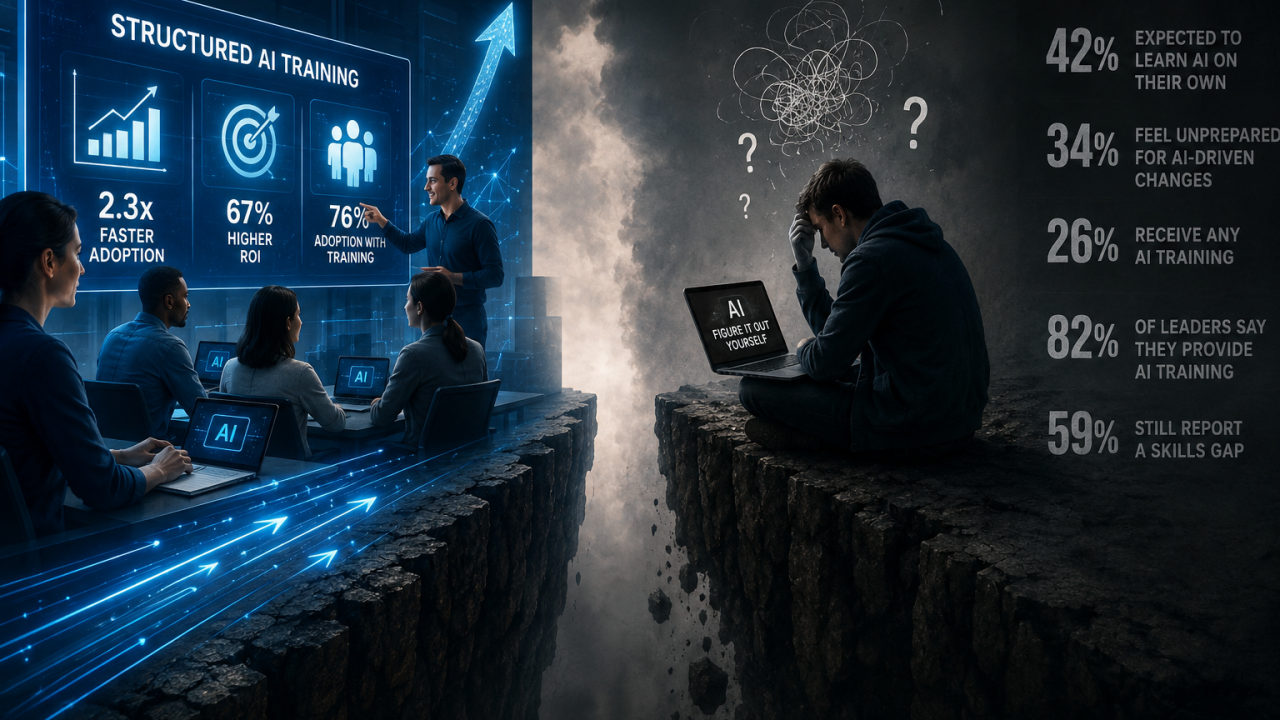
Organizations with formal AI training programs achieve 2.3x faster adoption and 67% higher AI ROI compared to those without structured programs.

When employers provide AI training, adoption jumps to 76%.

Without it? 25%.

That’s a 3x difference based on one variable: whether someone built the structure.

The Paradox

So if structured training produces dramatically better outcomes, you’d expect every organization to be investing in it.

Here’s what’s actually happening:

42% of employees say their employer expects them to learn AI on their own.

34% feel unprepared for AI-driven changes in their role.

Only 26% report receiving any training on how to collaborate with AI.

And the stat that should stop every executive in their tracks: 82% of enterprise leaders say their organization provides AI training — but 59% still report a skills gap.

We’ve seen this number before. It’s the same paradox. Training is happening. Capability isn’t.

Why the Gap Persists

The answer is the same one I’ve been naming for months.

Most AI training is designed to create awareness. Awareness doesn’t change behavior.

What changes behavior is structured follow-through. A specific workflow tied to a specific outcome. A 30-day measurement of whether the behavior showed up. An operational cadence that reinforces the learning after the session ends.

Without that structure, training is a check-the-box exercise. And the 82/59 gap — 82% training, 59% skills gap — is the proof.

The $5.5 Trillion Cost of Getting This Wrong

IDC projects that AI skills shortages could cost the global economy $5.5 trillion by the end of this decade.

That’s not lost revenue from bad technology. It’s lost revenue from unprepared people.

Over 90% of global enterprises are projected to face critical skills shortages by 2026. Not because AI talent doesn’t exist — but because organizations haven’t built the infrastructure to develop it internally.

The organizations closing the gap share three common investments:

Structured training wired to specific business outcomes — not generic AI literacy.

Measurement after the session — adoption metrics, not satisfaction surveys.

Internal AI champions who own follow-through — not just an L&D team that schedules the workshop.

What This Means for CAIOs and AI Consultants

This is the workforce development consulting market hiding inside every AI strategy engagement.

Every company that hires you to advise on AI adoption also has a workforce readiness problem. Most of them don’t know it yet. The ones that do don’t know how to solve it.

If you can build the structured training infrastructure — the assessment, the pathway, the measurement cadence — you’re not just an AI consultant anymore.

You’re a workforce architect.

And that’s a much bigger market.

Is your organization measuring AI training by completion rates or by behavior change? What’s the difference in outcomes?

This is the hiring trend that’s moving faster than most job seekers realize:

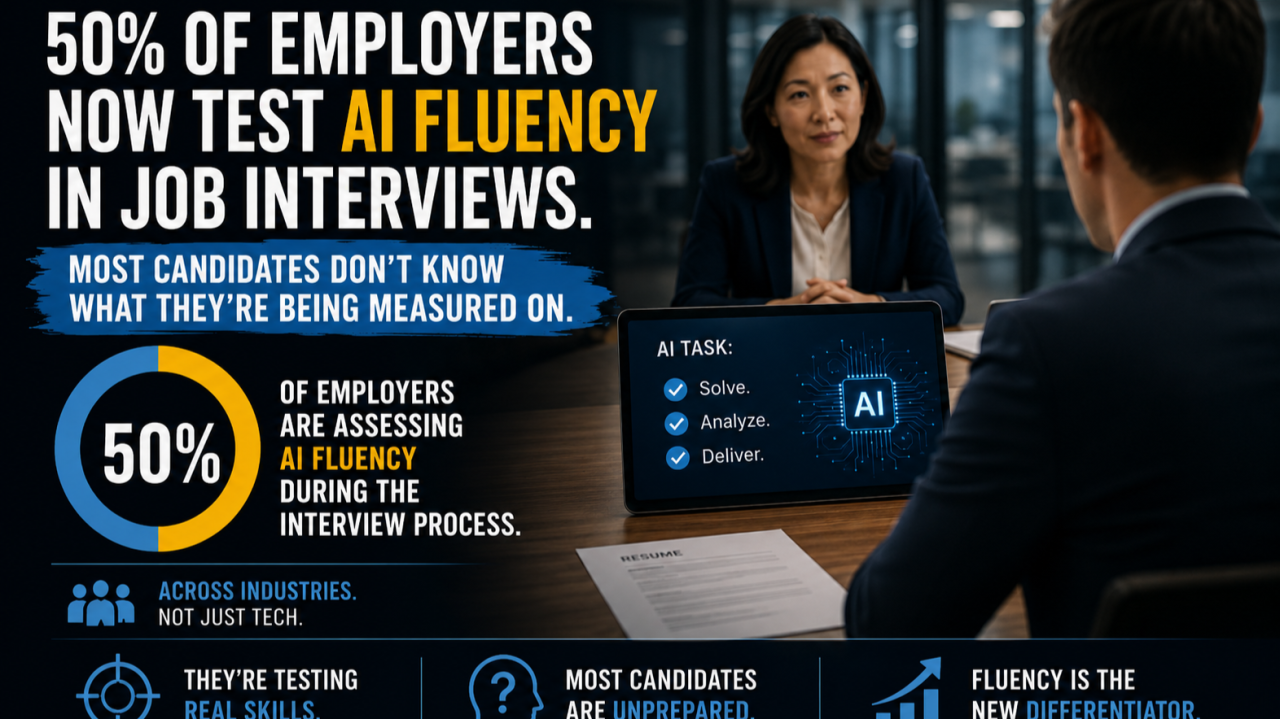
Half of all employers are now assessing AI fluency during the interview process.

Not in engineering roles. Across industries.

And what they’re measuring isn’t what most people think.

What Employers Actually Test

According to WGU’s 2026 Workforce Decoded report:

52% are using technical skills-based assessments or on-the-project evaluations. Not multiple choice. Not “tell me about a time you used AI.” Actual tasks. Actual output.

39% are evaluating real-world experience with tools like ChatGPT, Copilot, and Python libraries. They want to see what you’ve built, not what you’ve studied.

32% are looking for certifications — but not as standalone proof. As one signal among many in a broader readiness portfolio.

The shift is from “do you know what AI is?” to “can you use AI to produce something measurable?”

The Fluency Gap

Here’s where it gets uncomfortable.

Most AI training — corporate, academic, or self-directed — still focuses on awareness. What AI is. What it can do. How to write a prompt.

But employers aren’t hiring for awareness anymore. They’re hiring for fluency.

Fluency means you’ve integrated AI into your actual workflow. It means you can identify which tasks benefit from AI augmentation and which don’t. It means you can evaluate AI output critically — not just accept whatever the model gives you.

That gap — between awareness and fluency — is where most candidates are falling short. Not because they’re not smart. Because nobody taught them the difference.

Why This Matters for AI Consultants

If you’re advising organizations on AI adoption, this is the workforce side of the same governance problem.

Companies are testing for fluency in hiring but not building fluency in their existing teams. They’re assessing candidates on skills they haven’t structured internal training to develop.

That disconnect is a consulting opportunity hiding in plain sight.

The organizations that solve it won’t just hire better. They’ll retain better, adopt faster, and build the internal capability that makes AI investments actually pay off.

The ones that keep testing for fluency without building it? They’ll keep wondering why their AI initiatives stall.

If you’ve interviewed recently — did you get tested on AI fluency? What did they ask? And did it match what you actually know how to do?

Here’s the number that should keep every university president up at night:

Only 37% of employers believe higher education is adequately preparing graduates for the workforce.

That’s not a fringe opinion. That’s from a survey of 3,147 U.S. employers.

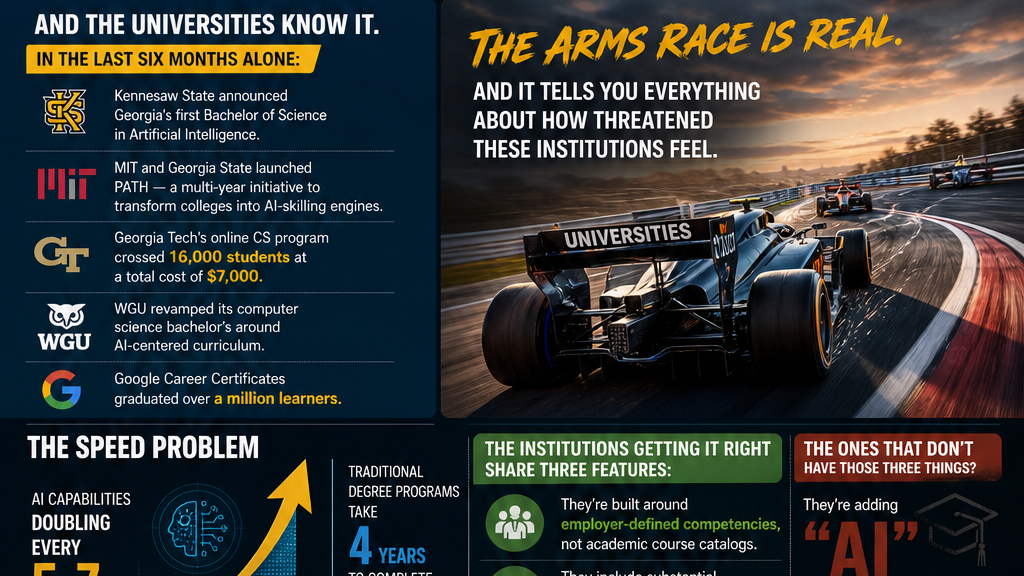
And the universities know it.

In the last six months alone:

Kennesaw State announced Georgia’s first Bachelor of Science in Artificial Intelligence.

MIT and Georgia State launched PATH — a multi-year initiative to transform colleges into AI-skilling engines.

Georgia Tech’s online CS program crossed 16,000 students at a total cost of $7,000.

WGU revamped its computer science bachelor’s around AI-centered curriculum.

Google Career Certificates graduated over a million learners.

The arms race is real. And it tells you everything about how threatened these institutions feel.

But here’s my concern:

Most of them are building faster versions of the same model that produced the 37% number in the first place.

The Speed Problem

AI capabilities are doubling roughly every five to seven months. Traditional degree programs take four years to complete and two to three years to design.

By the time a curriculum committee approves a new AI course, the tools it teaches may already be obsolete.

The institutions getting it right share three features:

They’re built around employer-defined competencies, not academic course catalogs.

They include substantial applied project work — not just theory.

They have public outcomes data that employers can actually verify.

The ones that don’t have those three things? They’re adding “AI” to their marketing copy and hoping nobody notices the syllabus hasn’t changed.

The Real Question

The question isn’t whether higher education will adapt. It will. Institutions that don’t will simply become irrelevant.

The question is whether they’ll adapt fast enough to matter for the workers who need reskilling right now — not in 2030.

Because here’s what the 37% number really means:

Employers have already started building their own pipelines. Internal training programs. Certificate partnerships. Skills-based hiring that bypasses degrees entirely.

The longer universities take to close the gap, the less the market will need them to.

That’s not a prediction.

That’s the math.

If you’re in higher education — what’s the single biggest barrier to moving faster? If you’re an employer — have you given up waiting for universities to catch up?

Two numbers from Western Governors University’s 2026 Workforce Decoded report tell you everything about where hiring is headed:

78% of employers now say work experience is equal to or more valuable than a college degree.

53% say their biggest hiring challenge is validating whether candidates actually possess the skills they claim.

Read those together.

Employers have already decided that degrees alone aren’t enough. But they haven’t figured out how to verify what replaced them.

The Readiness Portfolio

What’s emerging is something researchers are calling a “readiness portfolio” — a stacked combination of degree, certificate, demonstrated skill, and provable AI fluency that hiring managers are now evaluating together.

This isn’t the “degrees are dead” narrative. The data doesn’t support that. 68% of employers still say degrees are important. 86% say certificates are valuable.

But neither one is sufficient on its own anymore.

The skills employers rank as most critical aren’t narrowly technical. Critical thinking and problem solving: 60%. Time management: 41%. Adaptability: 40%. Emotional intelligence: 37%.

These are precisely the competencies that AI cannot replicate — and that working professionals develop through years of experience, not classroom instruction.

Which brings us back to the validation problem.

The Verification Gap

If the readiness portfolio is the new standard, then someone needs to build the verification infrastructure.

Right now, 52% of employers are using technical skills-based assessments or on-the-project evaluations to measure AI competency. 39% are evaluating real-world experience with tools like ChatGPT, Copilot, and Python libraries. 32% are looking at certifications from AWS, Microsoft Azure AI, and WGU.

But most of this is ad hoc. There’s no standard. There’s no shared framework. Every employer is inventing their own readiness rubric.

This is a massive opportunity — and it’s one that most AI consultants are completely ignoring.

Where AI Consultants and CAIOs Fit

If you’re an AI consultant or a Fractional CAIO, this is the part that should get your attention.

The organizations struggling hardest with the readiness portfolio aren’t asking for another tool recommendation. They’re asking:

“How do we assess whether our existing workforce is actually AI-ready?”

“What does a structured upskilling pathway look like — not a course catalog, but a measured progression?”

“How do we verify that training translated into capability?”

Those are consulting questions. They’re governance questions. And they’re workforce architecture questions.

The consultants who build frameworks for answering them — repeatable, installable, measurable — will own the workforce development conversation for the next three years.

Everyone else will still be selling tool demos.

CTA: How is your organization verifying AI readiness — structured assessments, or gut instinct? What’s working and what isn’t?

Everyone’s still debating whether AI will take their job.

That debate is already over.

Not because AI replaced anyone. Because it changed what employers are looking for — and 76% of them already made the switch.

That’s the number from Western Governors University’s 2026 Workforce Decoded report. Seventy-six percent of employers say AI has already shifted the types of candidates they’re hiring.

Not “plan to shift.” Already shifted.

And here’s what the shift actually looks like:

More than 40% of employers now say mid-career professionals — five to ten years of experience — are their most in-demand hires.

38% are actively reducing entry-level hiring because of AI.

78% say work experience is now equal to or more valuable than a degree.

This isn’t a technology story. It’s a labor market story.

The people losing ground right now aren’t the ones who refuse to learn AI. They’re the ones who learned AI — the vocabulary, the certifications, the LinkedIn posts about prompt engineering — but never installed it into their actual work.

Employers aren’t asking “do you know what AI is?”

They’re asking “have you used it to produce something we can measure?”

That’s a different question entirely. And most people aren’t ready for it.

The threat was never replacement.

The threat was repositioning.

And if you didn’t notice the job description changed, you’re already behind.

When did you first notice the hiring criteria in your industry had shifted? Was it gradual — or did it hit all at once?

There are indications that tech jobs have resumed the positive trajectory after slamming into reverse during the pandemic. Figures from the Bureau of Labor Statistics estimate that over 12,900 tech opportunities were created as of last year September. Interestingly, the number of job seekers remains at an all-time high, making the job market competitive. As such, succeeding in your next tech interview requires that you stand out from other applicants. Below are a few tips.

1. Understand your CV

While it seems obvious, many people don’t understand their CVs deeply, especially after applying for hundreds of positions. Besides tailoring your CV to suit the advertised position, memorize the version of CV you sent before the interview. This reduces the chances of going blank during the interview. Below are a few things to do with your CV:

  • Read the job description carefully – highlight transferable skills if your skills don’t match those required.
  • Have proof of success stories, key results, and challenges you mentioned in your CV.

2. Learn about your Employer

Researching your employer before the interview is also crucial. Check their website, social media, and featured stories in local and national media. For established tech companies, know the basics, such as their share prices, senior leaders, and company deliverables to customers, before sitting for the interview.

3. Show you are Always Learning

Tech is always evolving. Therefore, you shouldn’t stop learning after mastering a skill. If your specialty involves software, processes, and algorithms, show what you’ve been doing to keep up to date. If you recently completed a project that can help your employer, bring it up.

4. Prepare for Common Tech Interview Questions

Employers often use the interview process to learn more about applicants and their technical skills. Therefore, you should prepare extensively and expect tough questions. Simple questions, such as “why do you want to join this company? What are you looking for in this career move, and what qualities do you bring to this role” help potential employers gauge your suitability for the role.

You should also expect specific questions about your applied role. For instance, what experience do you have with specific technologies, or which problems have you solved using a specific technology? Depending on the vacant role, questions in the last stage become more complex. For instance, developers may be asked how to maintain a code base. Most employers also give candidates technical tasks to complete during the interview.

Conclusion

As you prepare for the interview, remember that new opportunities often come through professional connections and referrals. 30% of job candidates find opportunities from their networks. Therefore, you should keep expanding your network with professional peers and others.