Posts Tagged
‘AI Training’

Home / AI Training

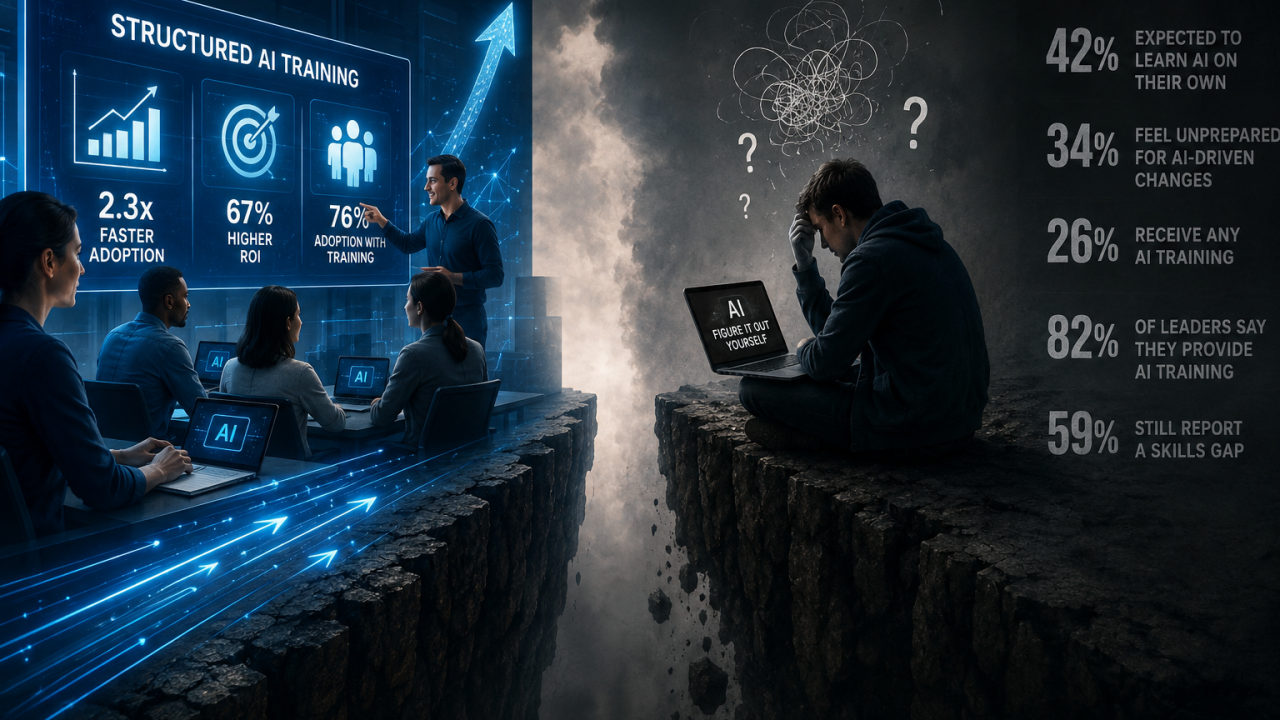
The data on structured AI training is unambiguous:

Organizations with formal AI training programs achieve 2.3x faster adoption and 67% higher AI ROI compared to those without structured programs.

When employers provide AI training, adoption jumps to 76%.

Without it? 25%.

That’s a 3x difference based on one variable: whether someone built the structure.

The Paradox

So if structured training produces dramatically better outcomes, you’d expect every organization to be investing in it.

Here’s what’s actually happening:

42% of employees say their employer expects them to learn AI on their own.

34% feel unprepared for AI-driven changes in their role.

Only 26% report receiving any training on how to collaborate with AI.

And the stat that should stop every executive in their tracks: 82% of enterprise leaders say their organization provides AI training — but 59% still report a skills gap.

We’ve seen this number before. It’s the same paradox. Training is happening. Capability isn’t.

Why the Gap Persists

The answer is the same one I’ve been naming for months.

Most AI training is designed to create awareness. Awareness doesn’t change behavior.

What changes behavior is structured follow-through. A specific workflow tied to a specific outcome. A 30-day measurement of whether the behavior showed up. An operational cadence that reinforces the learning after the session ends.

Without that structure, training is a check-the-box exercise. And the 82/59 gap — 82% training, 59% skills gap — is the proof.

The $5.5 Trillion Cost of Getting This Wrong

IDC projects that AI skills shortages could cost the global economy $5.5 trillion by the end of this decade.

That’s not lost revenue from bad technology. It’s lost revenue from unprepared people.

Over 90% of global enterprises are projected to face critical skills shortages by 2026. Not because AI talent doesn’t exist — but because organizations haven’t built the infrastructure to develop it internally.

The organizations closing the gap share three common investments:

Structured training wired to specific business outcomes — not generic AI literacy.

Measurement after the session — adoption metrics, not satisfaction surveys.

Internal AI champions who own follow-through — not just an L&D team that schedules the workshop.

What This Means for CAIOs and AI Consultants

This is the workforce development consulting market hiding inside every AI strategy engagement.

Every company that hires you to advise on AI adoption also has a workforce readiness problem. Most of them don’t know it yet. The ones that do don’t know how to solve it.

If you can build the structured training infrastructure — the assessment, the pathway, the measurement cadence — you’re not just an AI consultant anymore.

You’re a workforce architect.

And that’s a much bigger market.

Is your organization measuring AI training by completion rates or by behavior change? What’s the difference in outcomes?

This is the hiring trend that’s moving faster than most job seekers realize:

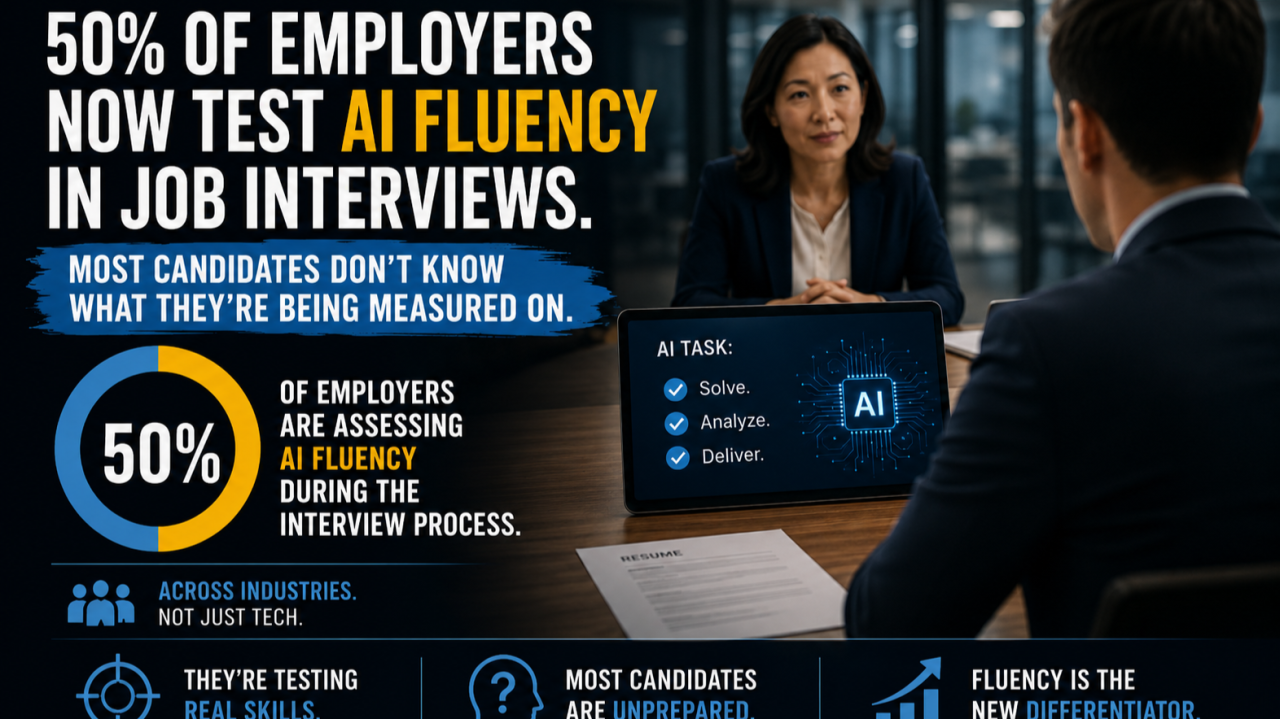
Half of all employers are now assessing AI fluency during the interview process.

Not in engineering roles. Across industries.

And what they’re measuring isn’t what most people think.

What Employers Actually Test

According to WGU’s 2026 Workforce Decoded report:

52% are using technical skills-based assessments or on-the-project evaluations. Not multiple choice. Not “tell me about a time you used AI.” Actual tasks. Actual output.

39% are evaluating real-world experience with tools like ChatGPT, Copilot, and Python libraries. They want to see what you’ve built, not what you’ve studied.

32% are looking for certifications — but not as standalone proof. As one signal among many in a broader readiness portfolio.

The shift is from “do you know what AI is?” to “can you use AI to produce something measurable?”

The Fluency Gap

Here’s where it gets uncomfortable.

Most AI training — corporate, academic, or self-directed — still focuses on awareness. What AI is. What it can do. How to write a prompt.

But employers aren’t hiring for awareness anymore. They’re hiring for fluency.

Fluency means you’ve integrated AI into your actual workflow. It means you can identify which tasks benefit from AI augmentation and which don’t. It means you can evaluate AI output critically — not just accept whatever the model gives you.

That gap — between awareness and fluency — is where most candidates are falling short. Not because they’re not smart. Because nobody taught them the difference.

Why This Matters for AI Consultants

If you’re advising organizations on AI adoption, this is the workforce side of the same governance problem.

Companies are testing for fluency in hiring but not building fluency in their existing teams. They’re assessing candidates on skills they haven’t structured internal training to develop.

That disconnect is a consulting opportunity hiding in plain sight.

The organizations that solve it won’t just hire better. They’ll retain better, adopt faster, and build the internal capability that makes AI investments actually pay off.

The ones that keep testing for fluency without building it? They’ll keep wondering why their AI initiatives stall.

If you’ve interviewed recently — did you get tested on AI fluency? What did they ask? And did it match what you actually know how to do?

Everyone’s still debating whether AI will take their job.

That debate is already over.

Not because AI replaced anyone. Because it changed what employers are looking for — and 76% of them already made the switch.

That’s the number from Western Governors University’s 2026 Workforce Decoded report. Seventy-six percent of employers say AI has already shifted the types of candidates they’re hiring.

Not “plan to shift.” Already shifted.

And here’s what the shift actually looks like:

More than 40% of employers now say mid-career professionals — five to ten years of experience — are their most in-demand hires.

38% are actively reducing entry-level hiring because of AI.

78% say work experience is now equal to or more valuable than a degree.

This isn’t a technology story. It’s a labor market story.

The people losing ground right now aren’t the ones who refuse to learn AI. They’re the ones who learned AI — the vocabulary, the certifications, the LinkedIn posts about prompt engineering — but never installed it into their actual work.

Employers aren’t asking “do you know what AI is?”

They’re asking “have you used it to produce something we can measure?”

That’s a different question entirely. And most people aren’t ready for it.

The threat was never replacement.

The threat was repositioning.

And if you didn’t notice the job description changed, you’re already behind.

When did you first notice the hiring criteria in your industry had shifted? Was it gradual — or did it hit all at once?

Here’s the stat that should end every debate about whether AI adoption is a training problem:

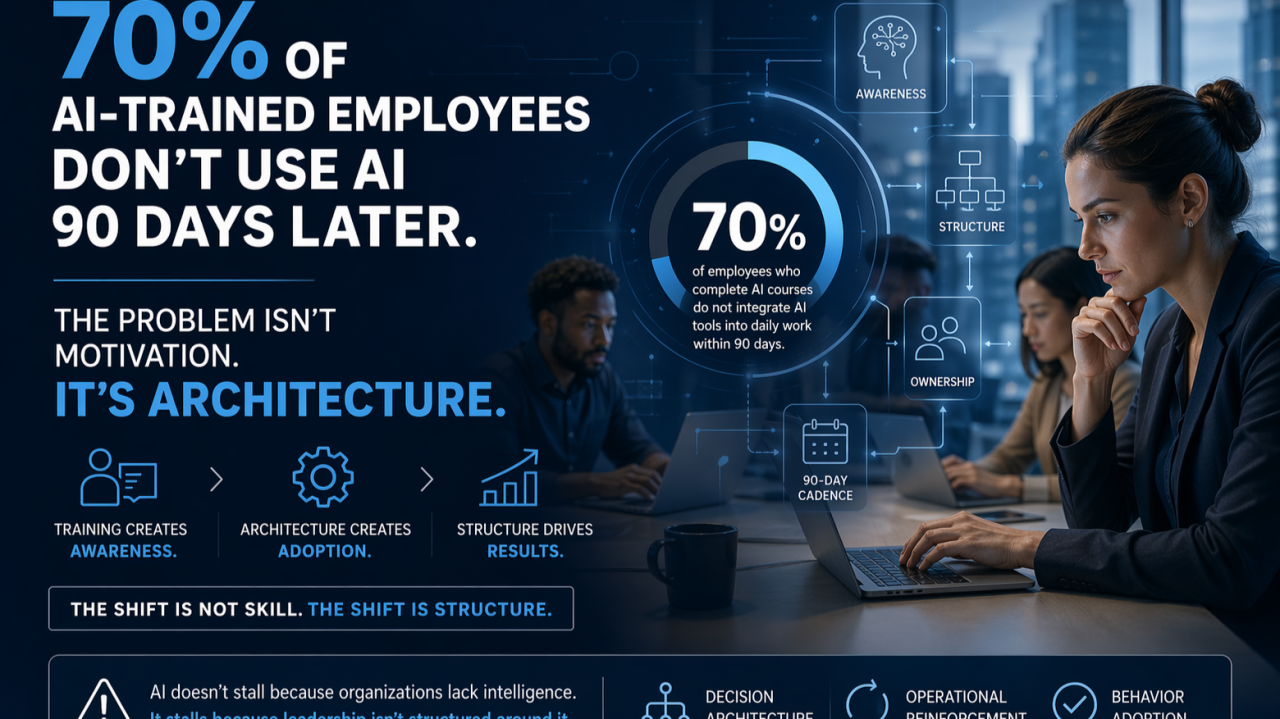
70% of employees who complete AI courses do not integrate AI tools into daily work within 90 days.

Not because they didn’t learn.

Not because they weren’t motivated.

Because there was no structured follow-up.

No operational reinforcement.

No system that turned awareness into behavior.

This is the same pattern at every level:

At the individual level: people learn AI but don’t use it.

At the consultant level: people get certified but can’t close clients.

At the enterprise level: companies pilot AI agents but can’t get them to production.

The thread connecting all three?

The absence of operational architecture.

Training creates awareness.

Architecture creates adoption.

This distinction is the single most important idea in AI right now. And it’s the one almost nobody is building for.

Everyone is building more courses. More tools. More certifications. More agents.

Almost nobody is building the governance layer — the decision architecture, the ownership model, the 90-day cadence — that makes any of it stick.

That’s the gap.

And the people who fill it won’t be the most technically fluent AI professionals.

They’ll be the ones who understand something deeper:

AI doesn’t stall because organizations lack intelligence.

It stalls because leadership isn’t structured around it.

The shift is not skill.

The shift is structure.