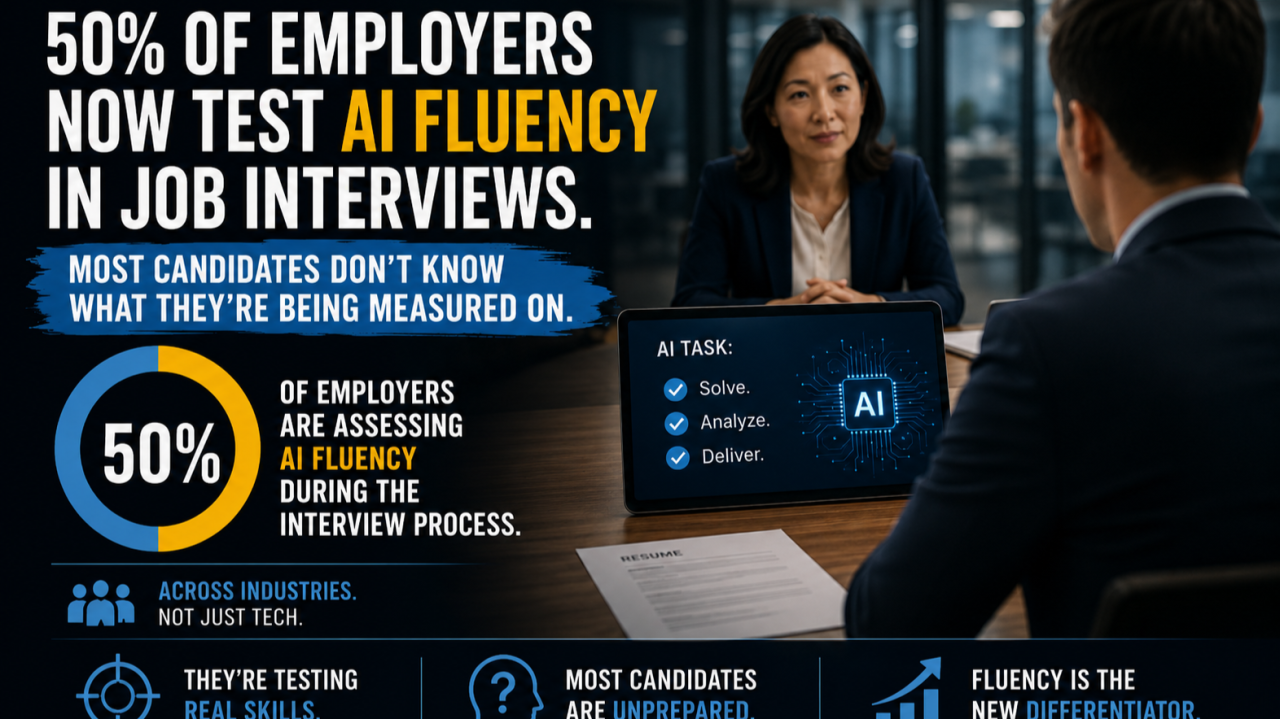
This is the hiring trend that’s moving faster than most job seekers realize:

Half of all employers are now assessing AI fluency during the interview process.

Not in engineering roles. Across industries.

And what they’re measuring isn’t what most people think.

What Employers Actually Test

According to WGU’s 2026 Workforce Decoded report:

52% are using technical skills-based assessments or on-the-project evaluations. Not multiple choice. Not “tell me about a time you used AI.” Actual tasks. Actual output.

39% are evaluating real-world experience with tools like ChatGPT, Copilot, and Python libraries. They want to see what you’ve built, not what you’ve studied.

32% are looking for certifications — but not as standalone proof. As one signal among many in a broader readiness portfolio.

The shift is from “do you know what AI is?” to “can you use AI to produce something measurable?”

The Fluency Gap

Here’s where it gets uncomfortable.

Most AI training — corporate, academic, or self-directed — still focuses on awareness. What AI is. What it can do. How to write a prompt.

But employers aren’t hiring for awareness anymore. They’re hiring for fluency.

Fluency means you’ve integrated AI into your actual workflow. It means you can identify which tasks benefit from AI augmentation and which don’t. It means you can evaluate AI output critically — not just accept whatever the model gives you.

That gap — between awareness and fluency — is where most candidates are falling short. Not because they’re not smart. Because nobody taught them the difference.

Why This Matters for AI Consultants

If you’re advising organizations on AI adoption, this is the workforce side of the same governance problem.

Companies are testing for fluency in hiring but not building fluency in their existing teams. They’re assessing candidates on skills they haven’t structured internal training to develop.

That disconnect is a consulting opportunity hiding in plain sight.

The organizations that solve it won’t just hire better. They’ll retain better, adopt faster, and build the internal capability that makes AI investments actually pay off.

The ones that keep testing for fluency without building it? They’ll keep wondering why their AI initiatives stall.

If you’ve interviewed recently — did you get tested on AI fluency? What did they ask? And did it match what you actually know how to do?