Posts Tagged
‘AI Learning’

Home / AI Learning

Gartner just issued a warning that should reshape how every AI professional thinks about the next 18 months:

More than 40% of agentic AI projects are at risk of cancellation by 2027.

Not because the agents don’t work.

Because of what researchers are calling “agent sprawl” — the uncontrolled proliferation of siloed, ungoverned AI agents across an enterprise.

It happens when business units move fast to solve immediate problems with AI, without:

A unifying strategy.

Shared data infrastructure.

Centralized oversight.

Sound familiar?

This is the same pattern I’ve been naming for two years — just at a larger scale.

When I said “most businesses adopt AI backwards — tools first, strategy never” — that was about chatbots and automation workflows.

Now multiply that by autonomous agents that make decisions, take actions, and operate across departments.

Without governance, it’s not just inefficiency.

It’s organizational risk.

The research is clear: the organizations that succeed with agentic AI won’t be the ones with the best agents.

They’ll be the ones with the clearest decision architecture.

Who approves what the agent does?

Who monitors outcomes?

Who escalates when something breaks?

Who owns the 90-day review?

Those aren’t technical questions.

They’re leadership questions.

And they require a governance operating model — not another pilot.

CTA: Is your organization building controls before it builds agents? Or the other way around?

DataCamp just published their 2026 AI workforce data.

Two numbers tell the whole story:

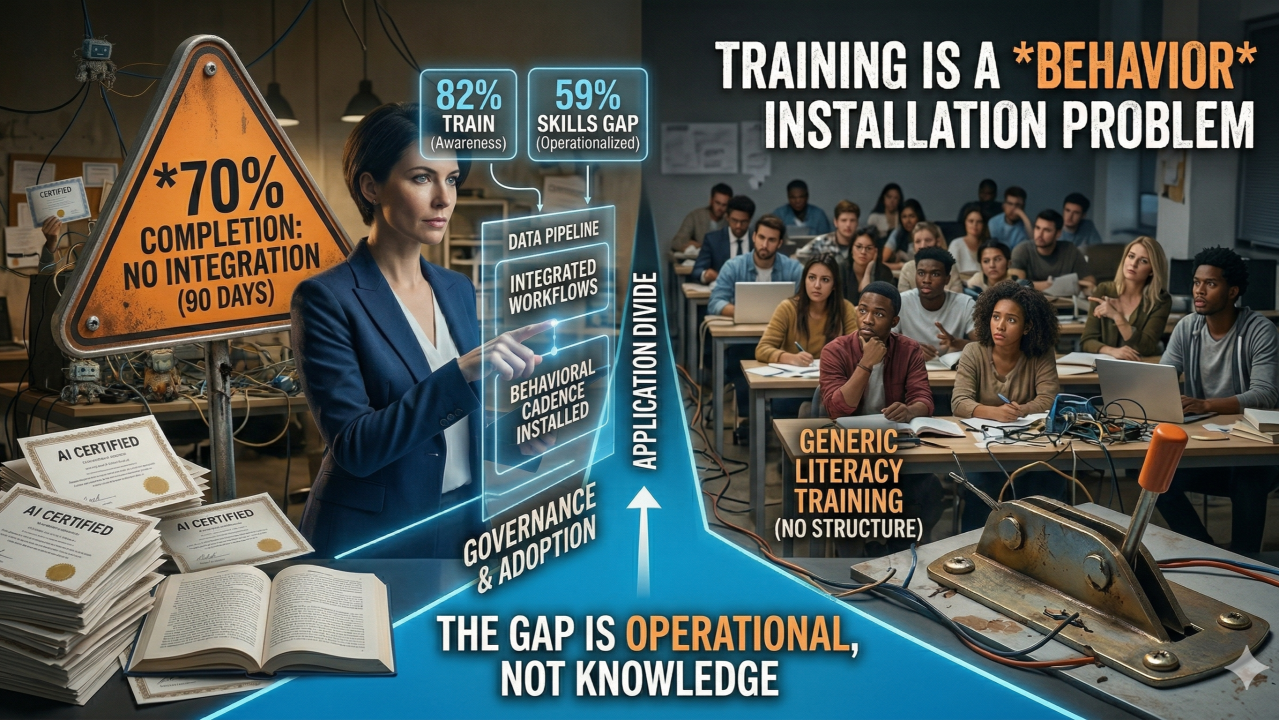
82% of enterprise leaders say their organization provides AI training.

59% still report an AI skills gap.

Read that again. The training is happening. The gap isn’t closing.

Why?

Because the gap isn’t about knowledge. It’s about application.

70% of employees who complete AI courses do not integrate AI tools into daily work within 90 days — without structured follow-up.

The research confirms what I’ve been saying for two years:

The problem isn’t that people don’t understand AI.

The problem is that no one has installed the operational structure that turns understanding into behavior.

Training teaches vocabulary.

Structure installs cadence.

One creates awareness. The other creates adoption.

This is why I stopped asking “How do I teach more people about AI?” and started asking “How do I build systems that make AI adoption inevitable?”

And it’s why, a few weeks ago, we partnered with Teri Moten as In-House AI Trainer at MyMobileLyfe.

What Installed Training Actually Looks Like

Teri doesn’t run generic AI literacy sessions.

Every training she leads is wired to a specific workflow, a specific team, and a specific outcome the business is trying to hit.

Before a session, we map what “installed” looks like for that group. What decision gets faster? What task gets offloaded? What behavior has to change? What’s the metric we’ll look at in 30 days to know whether the training actually landed?

After the session, we measure whether it actually got installed. Not whether people enjoyed it. Not whether they took good notes. Whether the behavior showed up in the work.

That’s the difference between training and installation.

One ends when the Zoom closes.

The other starts there.

I’m not sharing this to pitch a service. I’m sharing it because I refuse to add more noise to a market that already has too much of it.

If the 82/59 gap is going to close, it won’t be because somebody invented a better curriculum.

It’ll close because a small number of people decide to treat training as an installation problem — and build the structure around every session that makes the behavior stick.

That’s the work we’re doing.

And it’s the work I think a lot more of us should be doing.

The market doesn’t have a learning problem.

It has an installation problem.