Posts Tagged
‘Business Development’

Home / Business Development

LinkedIn just reported that Chief AI Officer job postings have tripled over the last five years.

It’s now officially one of technology’s fastest-growing executive roles.

But here’s what the headline misses:

Most companies still don’t have one.

Not because they don’t need AI leadership. Because the role, as typically defined, assumes a full-time executive with a dedicated budget and organizational authority.

Most mid-market companies — the ones actually struggling with AI adoption — can’t afford that.

So what happens?

AI ownership defaults to the CEO. Or the CTO. Or a committee.

And when something belongs to everyone, it belongs to no one.

This is exactly where the fractional model changes the game.

A Fractional CAIO isn’t a consultant who advises on AI.

It’s an installed leadership function that governs AI decisions, establishes cadence, and creates accountability — on a retainer, not a project.

The demand signal is clear.

The hiring data says companies want AI leadership.

The market reality says most can’t hire it full-time.

The opportunity for AI professionals who can install governance — not just deliver advice — has never been larger.

But it requires a structural shift.

From: “I help companies with AI.”

To: “I install the decision architecture that makes AI work.”

Those are different identities. Different revenue models. Different outcomes.

Do you see the fractional CAIO model gaining traction in your network? Or is it still mostly consultant-as-title?

DataCamp just published their 2026 AI workforce data.

Two numbers tell the whole story:

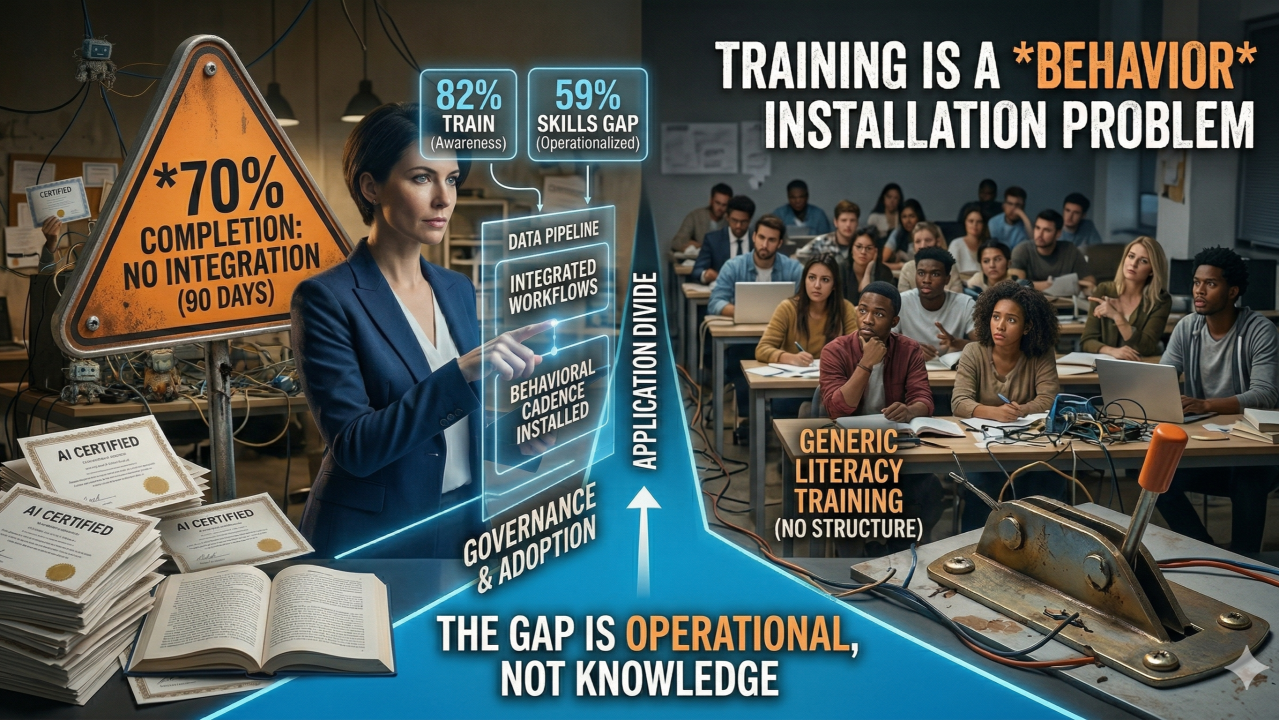
82% of enterprise leaders say their organization provides AI training.

59% still report an AI skills gap.

Read that again. The training is happening. The gap isn’t closing.

Why?

Because the gap isn’t about knowledge. It’s about application.

70% of employees who complete AI courses do not integrate AI tools into daily work within 90 days — without structured follow-up.

The research confirms what I’ve been saying for two years:

The problem isn’t that people don’t understand AI.

The problem is that no one has installed the operational structure that turns understanding into behavior.

Training teaches vocabulary.

Structure installs cadence.

One creates awareness. The other creates adoption.

This is why I stopped asking “How do I teach more people about AI?” and started asking “How do I build systems that make AI adoption inevitable?”

And it’s why, a few weeks ago, we partnered with Teri Moten as In-House AI Trainer at MyMobileLyfe.

What Installed Training Actually Looks Like

Teri doesn’t run generic AI literacy sessions.

Every training she leads is wired to a specific workflow, a specific team, and a specific outcome the business is trying to hit.

Before a session, we map what “installed” looks like for that group. What decision gets faster? What task gets offloaded? What behavior has to change? What’s the metric we’ll look at in 30 days to know whether the training actually landed?

After the session, we measure whether it actually got installed. Not whether people enjoyed it. Not whether they took good notes. Whether the behavior showed up in the work.

That’s the difference between training and installation.

One ends when the Zoom closes.

The other starts there.

I’m not sharing this to pitch a service. I’m sharing it because I refuse to add more noise to a market that already has too much of it.

If the 82/59 gap is going to close, it won’t be because somebody invented a better curriculum.

It’ll close because a small number of people decide to treat training as an installation problem — and build the structure around every session that makes the behavior stick.

That’s the work we’re doing.

And it’s the work I think a lot more of us should be doing.

The market doesn’t have a learning problem.

It has an installation problem.

Leadership development is important for every business. It improves productivity, innovation, employee engagement, and customer retention and reduces employee turnover. A structured leadership development plan highlights how a company intends to train and help employees hone their leadership skills. 

In most cases, leadership development occurs in a formal classroom setting. However, individual leadership development plans, such as reflective journaling, coaching, and constructive feedback, are also effective. Implementing a leadership development plan helps businesses avoid the leadership gap that occurs following the unavoidable retirement or step down of current leadership. 

Below are a few tips for creating a leadership development plan. 

  1. Evaluate your business goals and needs

Identifying business needs and goals is crucial to creating a leadership development plan. This essentially involves identifying leadership qualities that can benefit your organization. Knowing what type of leader your company needs should be a priority. You should ask yourself the following questions:

  • How many leaders does your company need?
  • Are there notable gaps that need improvement?
  • Which strategies work well for your company?
  • How will the new leaders commit to organizational goals?
  1. Consult your employees

Employees play a key role in determining the success and productivity of the company. Therefore, you should ask for their perspective on leadership. Ask them what they want or looking for in a leader. They can help you identify leadership strategies that are working or not working in your organization. Taking their input can help you design an effective leadership development plan. 

  1. Define the type of leaders your company needs 

You should also define the type of leaders your company requires. For this, consider reviewing key business objectives and how they can be achieved. Below are a few tips to consider:

  • Create a detailed list of the skills you expect to see in leaders that fit your company profile. 
  • If one of the departments requires better leadership, create a different profile for the department.
  • Assess your current level of leadership. Use emails, anonymous tips, and feedback from your employees. 
  • Create a list of employees who are talented enough and interested in management roles.
  1. Identify the best method of development 

As mentioned, leadership development was traditionally hinged on formal programs. While they are effective, you should consider other leadership training methods, such as mentorship programs, working groups, and task forces. You should also choose between conducting in-house training or hiring a third-party company. 

Conclusion

Around 77% of companies struggle with leadership gaps. This explains why 89% of company executives agree that strengthening leadership development should be a priority for most companies. Having a leadership training plan can help your company mold successful future managers.