Posts Tagged
‘Technology’

Home / Technology

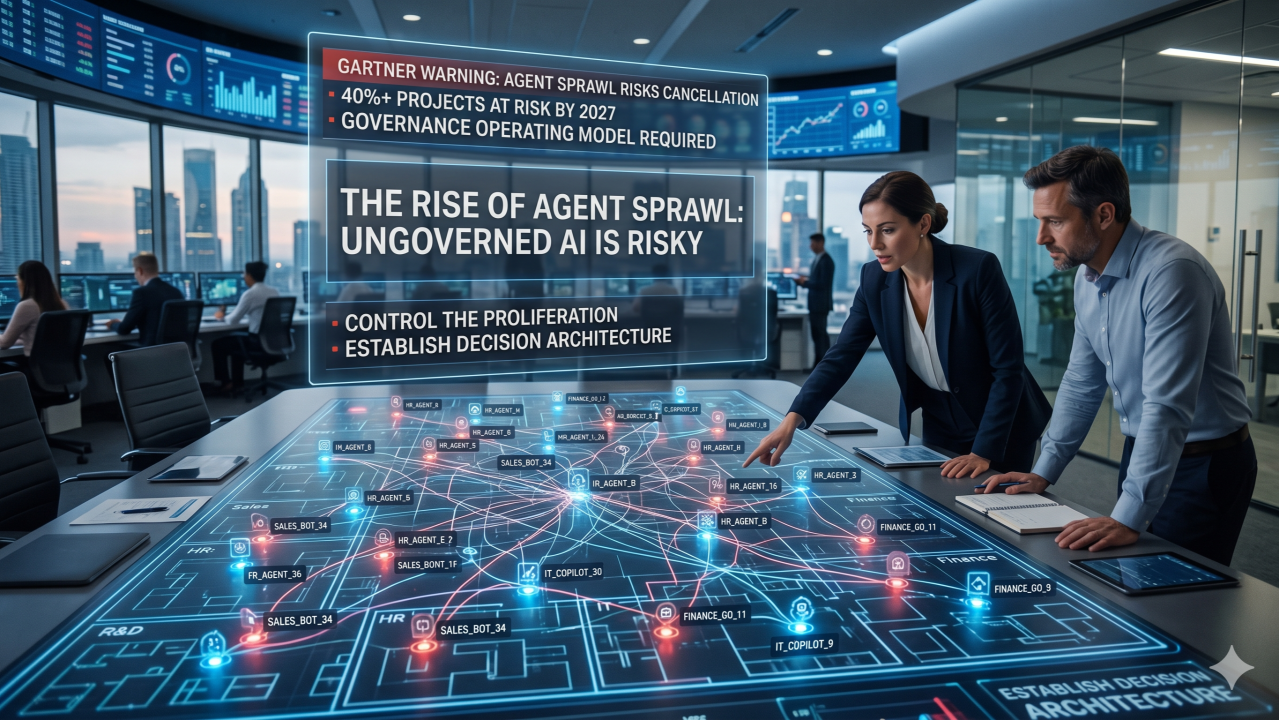
Gartner just issued a warning that should reshape how every AI professional thinks about the next 18 months:

More than 40% of agentic AI projects are at risk of cancellation by 2027.

Not because the agents don’t work.

Because of what researchers are calling “agent sprawl” — the uncontrolled proliferation of siloed, ungoverned AI agents across an enterprise.

It happens when business units move fast to solve immediate problems with AI, without:

A unifying strategy.

Shared data infrastructure.

Centralized oversight.

Sound familiar?

This is the same pattern I’ve been naming for two years — just at a larger scale.

When I said “most businesses adopt AI backwards — tools first, strategy never” — that was about chatbots and automation workflows.

Now multiply that by autonomous agents that make decisions, take actions, and operate across departments.

Without governance, it’s not just inefficiency.

It’s organizational risk.

The research is clear: the organizations that succeed with agentic AI won’t be the ones with the best agents.

They’ll be the ones with the clearest decision architecture.

Who approves what the agent does?

Who monitors outcomes?

Who escalates when something breaks?

Who owns the 90-day review?

Those aren’t technical questions.

They’re leadership questions.

And they require a governance operating model — not another pilot.

CTA: Is your organization building controls before it builds agents? Or the other way around?

Many AI professionals believe the shift from consultant to Fractional CAIO is a pricing upgrade.

It isn’t.

It’s an identity shift.

And most avoid it because it requires structural change, not just confidence.


The Misunderstanding

An AI consultant improves skill.

A Fractional CAIO improves position.

Those are not the same progression.

Consultants ask:

“How do I deliver more value?”

Fractional CAIOs ask:

“How do I install authority?”

The first question expands capability.

The second redesigns structure.


Skillset vs Position

You can:

• Earn certifications • Master frameworks • Understand AI strategy deeply • Deliver strong advisory insights

And still be positioned as an external expert.

External experts are valuable.

But they are not embedded leadership.

Consultants are brought in.

CAIOs are installed.

That is a positional difference — not a technical one.


Execution vs Governance

Consultants operate in execution cycles.

Assess. Recommend. Implement. Exit.

Fractional CAIOs operate in governance cycles.

Evaluate. Prioritize. Oversee. Report. Renew.

Execution is episodic.

Governance is continuous.

If your revenue depends on project flow, you are operating inside an execution identity.

No matter what title you use.


The Resistance

The identity shift is uncomfortable because it requires:

• Defining decision authority • Establishing governance cadence • Creating a 90-day oversight model • Embedding reporting structure • Designing renewal logic

Consulting can feel fluid.

Governance must be structured.

Many professionals prefer fluidity.

Executives require structure.


The Psychological Barrier

Consultants prove value repeatedly.

Fractional CAIOs design systems that make value visible automatically.

That requires confidence in architecture, not just expertise.

It also requires relinquishing the comfort of “expert for hire.”

Because once installed as governance, you are no longer optional support.

You are structural leadership.


The Real Shift

The shift is not:

More AI knowledge. More tools. More certifications.

The shift is:

From execution To governance.

From influence To oversight.

From service provider To installed operating model.


Closing

Many professionals are capable of operating as Fractional CAIOs.

Few redesign their position to do so.

Because the shift is not skill.

The shift is structure.

— Rick Hancock, Architect of Fractional CAIO Governance Systems

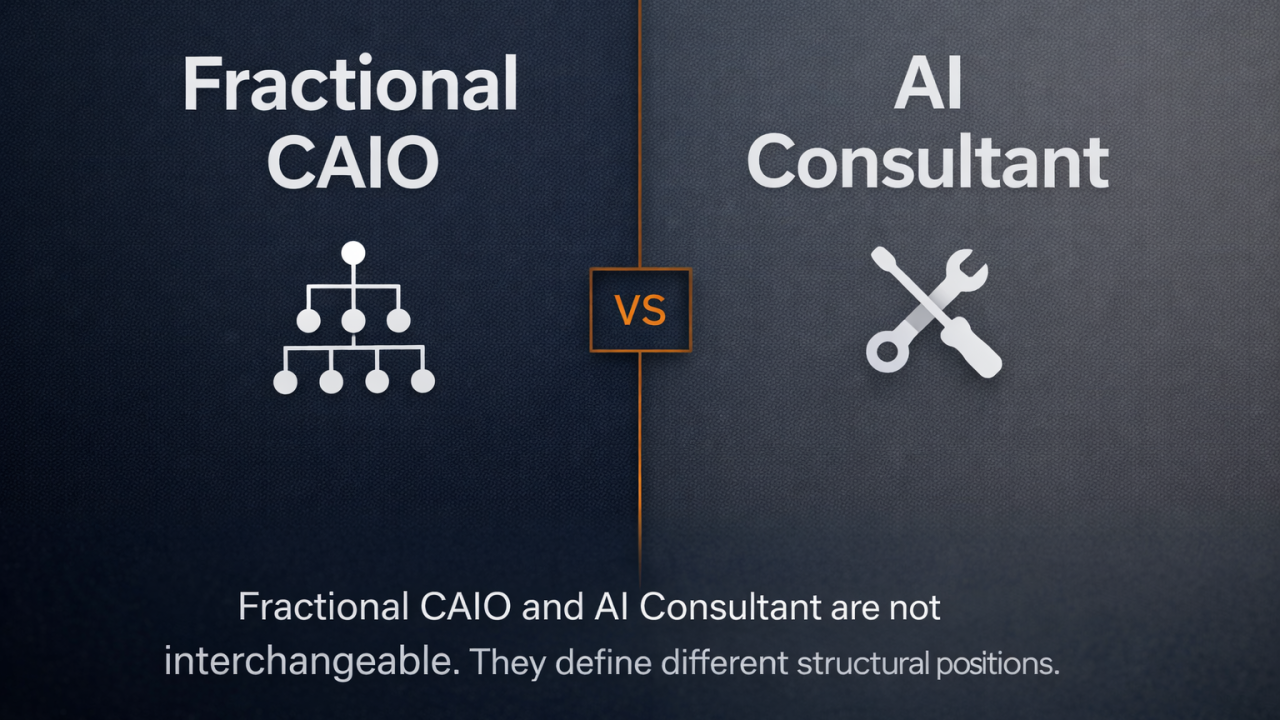
The terms are being used interchangeably.

They should not be.

“AI Consultant” and “Fractional CAIO” describe two different operating positions in the market.

The confusion is understandable.

The distinction is structural.


1️⃣ The AI Consultant

An AI consultant is brought in to:

• Advise on AI initiatives • Evaluate tools and vendors • Design implementation plans • Support execution • Deliver defined outcomes

Compensation Model: Project-based, milestone-based, or scoped advisory retainers.

Authority Level: Influence without ownership.

Identity: External expert.

The consultant’s role is directional.

They recommend.

They guide.

They deliver.

But they do not own governance.


2️⃣ The Fractional CAIO

A Fractional CAIO is installed to:

• Oversee AI governance • Define decision architecture • Establish executive cadence • Align AI initiatives with business objectives • Manage risk and prioritization • Report at leadership level

Compensation Model: Retainer-based executive function.

Authority Level: Oversight and structured decision influence.

Identity: Installed leadership role.

The Fractional CAIO does not simply recommend AI initiatives.

They design how AI decisions get made.

That distinction changes everything.


3️⃣ Influence vs Governance

Consultants answer:

“What should we do?”

Fractional CAIOs answer:

“How will AI decisions be structured, evaluated, and overseen over time?”

One solves problems.

The other installs systems.

One delivers insight.

The other defines operating rhythm.


4️⃣ Execution Model vs Governance Model

AI Consultant: Revenue tied to projects.

Fractional CAIO: Revenue tied to executive oversight.

Projects end.

Governance continues.

Projects must be resold.

Governance renews.


5️⃣ The Title Problem

Many professionals adopt the title “Fractional CAIO.”

Few install a governance model.

Title adoption without structural installation creates confusion in the market.

Fractional CAIO is not a branding upgrade.

It is an operating model.

Without:

• Defined governance cadence • Reporting structure • 90-day oversight rhythm • Budget prioritization logic • Risk management framework

You are operating as a consultant.

Not as a CAIO.


6️⃣ Why This Definition Matters

The AI market is expanding.

But advisory revenue volatility remains high.

The reason is not lack of demand.

It is structural misalignment.

When you operate as a consultant while attempting to earn as a governance executive, friction appears.

Clarity resolves friction.


Closing Definition

AI Consultant: Delivers AI expertise.

Fractional CAIO: Installs AI governance.

Both roles are valid.

They are not the same.

The shift is not skill.

The shift is structure.

Artificial intelligence, once relegated to the realm of science fiction, is rapidly transforming businesses across industries. The promise of increased efficiency, data-driven decision-making, and innovative products fuels the adoption of AI technologies. However, deploying AI effectively isn’t simply about acquiring the latest algorithms and hiring data scientists. The true key to unlocking AI’s potential lies in the human element: fostering a culture of collaboration, psychological safety, and shared understanding within the organization.

For HR, operations, and leadership teams, understanding this crucial interplay between technology and people is paramount. An AI project, no matter how technically brilliant, is destined to falter without the right environment to nurture its growth. This means moving beyond the siloed approach often seen in tech implementations and embracing a holistic perspective that prioritizes cross-functional collaboration and a sense of security for all involved.

Breaking Down Silos: The Power of Cross-Functional Teams

AI projects are inherently cross-functional. They require input and expertise from a diverse range of departments, including IT, data science, operations, marketing, and even HR. Imagine, for example, a project aimed at improving customer service using an AI-powered chatbot. While the IT team is responsible for developing and deploying the chatbot, the customer service team possesses invaluable insights into common customer pain points, frequently asked questions, and preferred communication styles. Marketing can contribute to crafting a chatbot persona that aligns with the brand’s voice and values. Data scientists analyze customer interactions to refine the chatbot’s responses and identify areas for improvement.

Without effective communication and collaboration between these teams, the chatbot is likely to miss the mark. It might provide technically accurate but unhelpful or even frustrating responses. It could fail to address the most pressing customer issues or alienate customers with an inappropriate tone.

To avoid these pitfalls, organizations need to actively break down silos and create dedicated, cross-functional AI teams. These teams should be composed of individuals with diverse skill sets and perspectives, all working towards a shared objective. Regular meetings, collaborative project management tools, and clear communication channels are essential for ensuring that everyone is on the same page. Furthermore, leadership must actively encourage and reward collaboration, recognizing that the success of the AI project depends on the collective effort of the entire team.

Psychological Safety: Fostering Innovation and Open Communication

The implementation of AI often involves experimentation and iteration. New models need to be trained, tested, and refined. This process inevitably involves failures and setbacks. If employees are afraid to admit mistakes or raise concerns, the AI project will suffer. This is where psychological safety comes into play.

Psychological safety, a concept popularized by Harvard Business School professor Amy Edmondson, refers to a shared belief within a team that it is safe to take interpersonal risks. In a psychologically safe environment, team members feel comfortable speaking up with ideas, asking questions, admitting errors, and challenging the status quo without fear of judgment, ridicule, or punishment.

Creating a psychologically safe environment is critical for AI projects for several reasons. First, it encourages experimentation and innovation. When employees feel safe to try new things and take risks, they are more likely to come up with creative solutions and identify novel applications for AI. Second, it promotes open communication. If employees feel comfortable raising concerns or pointing out potential problems, the team can address issues early on and prevent costly mistakes. Third, it fosters a culture of learning. When employees are not afraid to admit errors, they can learn from their mistakes and continuously improve their performance.

Leaders play a crucial role in fostering psychological safety. They should actively solicit feedback from team members, listen attentively to their concerns, and create a culture where mistakes are seen as learning opportunities. They should also be transparent about the project’s goals and challenges, and encourage team members to challenge their own assumptions and biases.

The Importance of Understanding the “Why” Behind AI

Beyond collaboration and psychological safety, successful AI initiatives require a shared understanding of the project’s goals and its impact on the organization. Often, technical teams focus primarily on the “how” – the technical implementation of the AI solution. However, it is equally important to understand the “why” – the underlying business problem that the AI is trying to solve and the intended benefits for the organization and its stakeholders.

This understanding needs to be shared across all departments, not just the technical teams. For example, if an AI project aims to automate certain tasks in the HR department, HR professionals need to understand how this automation will impact their roles and responsibilities. They need to be involved in the planning and implementation of the project to ensure that it meets their needs and aligns with their values. Similarly, employees in other departments need to understand how the AI project will affect their work and the organization as a whole. This understanding can help to alleviate fears about job displacement and foster a sense of shared ownership in the project’s success.

Addressing the Skills Gap and Promoting Continuous Learning

The rapid pace of innovation in AI requires a commitment to continuous learning. Organizations need to invest in training and development programs to equip their employees with the skills they need to work effectively with AI technologies. This includes not only technical skills, such as data science and machine learning, but also soft skills, such as critical thinking, problem-solving, and communication.

Furthermore, organizations should encourage employees to experiment with AI tools and technologies. Provide opportunities for employees to participate in AI-related workshops, conferences, and online courses. By fostering a culture of continuous learning, organizations can ensure that their employees are equipped to adapt to the ever-changing landscape of AI.

Beyond the Technical: Ethical Considerations

Finally, the successful deployment of AI requires careful consideration of ethical implications. AI systems can be biased, discriminatory, or unfair if they are not designed and implemented responsibly. Organizations need to establish ethical guidelines for the development and deployment of AI, and ensure that these guidelines are followed throughout the project lifecycle. This includes addressing issues such as data privacy, algorithmic bias, and transparency. By prioritizing ethical considerations, organizations can build trust with their employees, customers, and stakeholders, and ensure that AI is used for the benefit of society.

Ultimately, the success of AI depends not just on the technology itself, but on the people who build, deploy, and use it. By fostering a culture of collaboration, psychological safety, shared understanding, and continuous learning, organizations can unlock the full potential of AI and create a more innovative, efficient, and ethical future.

Are you ready to champion this human-centric approach to AI? Discover the strategies needed to navigate the complexities of AI adoption and build a high-performing, collaborative team. Learn how an often-unseen leader can drive success in your organization. Download our eBook, The Invisible Chief AI Officer: Why Many Businesses Need a Leader They May Not See, at https://store.mymobilelyfe.com/product-details/product/the-invisible-chief-artificial-intelligence-officer