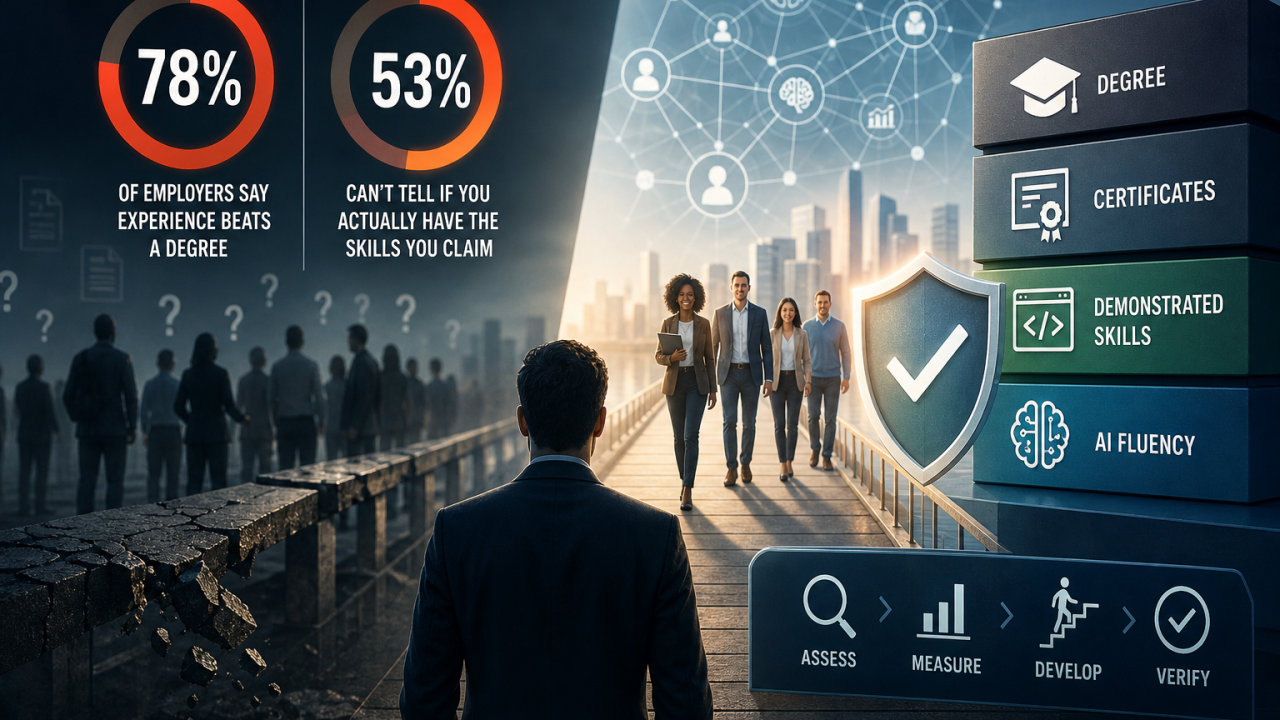
Two numbers from Western Governors University’s 2026 Workforce Decoded report tell you everything about where hiring is headed:
78% of employers now say work experience is equal to or more valuable than a college degree.
53% say their biggest hiring challenge is validating whether candidates actually possess the skills they claim.
Read those together.
Employers have already decided that degrees alone aren’t enough. But they haven’t figured out how to verify what replaced them.
The Readiness Portfolio
What’s emerging is something researchers are calling a “readiness portfolio” — a stacked combination of degree, certificate, demonstrated skill, and provable AI fluency that hiring managers are now evaluating together.
This isn’t the “degrees are dead” narrative. The data doesn’t support that. 68% of employers still say degrees are important. 86% say certificates are valuable.
But neither one is sufficient on its own anymore.
The skills employers rank as most critical aren’t narrowly technical. Critical thinking and problem solving: 60%. Time management: 41%. Adaptability: 40%. Emotional intelligence: 37%.
These are precisely the competencies that AI cannot replicate — and that working professionals develop through years of experience, not classroom instruction.
Which brings us back to the validation problem.
The Verification Gap
If the readiness portfolio is the new standard, then someone needs to build the verification infrastructure.
Right now, 52% of employers are using technical skills-based assessments or on-the-project evaluations to measure AI competency. 39% are evaluating real-world experience with tools like ChatGPT, Copilot, and Python libraries. 32% are looking at certifications from AWS, Microsoft Azure AI, and WGU.
But most of this is ad hoc. There’s no standard. There’s no shared framework. Every employer is inventing their own readiness rubric.
This is a massive opportunity — and it’s one that most AI consultants are completely ignoring.
Where AI Consultants and CAIOs Fit
If you’re an AI consultant or a Fractional CAIO, this is the part that should get your attention.
The organizations struggling hardest with the readiness portfolio aren’t asking for another tool recommendation. They’re asking:
“How do we assess whether our existing workforce is actually AI-ready?”
“What does a structured upskilling pathway look like — not a course catalog, but a measured progression?”
“How do we verify that training translated into capability?”
Those are consulting questions. They’re governance questions. And they’re workforce architecture questions.
The consultants who build frameworks for answering them — repeatable, installable, measurable — will own the workforce development conversation for the next three years.
Everyone else will still be selling tool demos.
CTA: How is your organization verifying AI readiness — structured assessments, or gut instinct? What’s working and what isn’t?


Recent Comments