Here’s the number that should keep every university president up at night:
Only 37% of employers believe higher education is adequately preparing graduates for the workforce.
That’s not a fringe opinion. That’s from a survey of 3,147 U.S. employers.
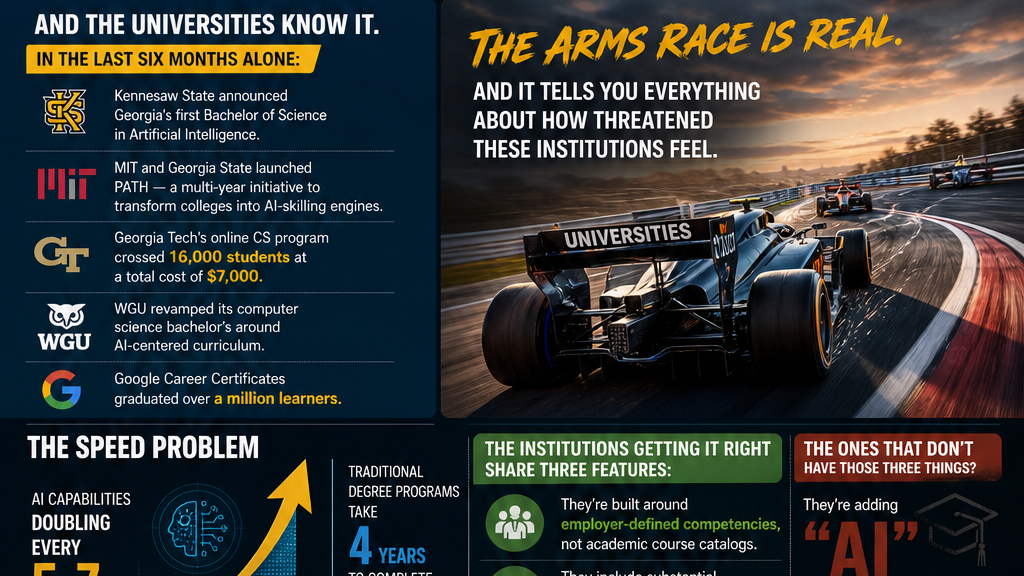
And the universities know it.
In the last six months alone:
Kennesaw State announced Georgia’s first Bachelor of Science in Artificial Intelligence.
MIT and Georgia State launched PATH — a multi-year initiative to transform colleges into AI-skilling engines.
Georgia Tech’s online CS program crossed 16,000 students at a total cost of $7,000.
WGU revamped its computer science bachelor’s around AI-centered curriculum.
Google Career Certificates graduated over a million learners.
The arms race is real. And it tells you everything about how threatened these institutions feel.
But here’s my concern:
Most of them are building faster versions of the same model that produced the 37% number in the first place.
The Speed Problem
AI capabilities are doubling roughly every five to seven months. Traditional degree programs take four years to complete and two to three years to design.
By the time a curriculum committee approves a new AI course, the tools it teaches may already be obsolete.
The institutions getting it right share three features:
They’re built around employer-defined competencies, not academic course catalogs.
They include substantial applied project work — not just theory.
They have public outcomes data that employers can actually verify.
The ones that don’t have those three things? They’re adding “AI” to their marketing copy and hoping nobody notices the syllabus hasn’t changed.
The Real Question
The question isn’t whether higher education will adapt. It will. Institutions that don’t will simply become irrelevant.
The question is whether they’ll adapt fast enough to matter for the workers who need reskilling right now — not in 2030.
Because here’s what the 37% number really means:
Employers have already started building their own pipelines. Internal training programs. Certificate partnerships. Skills-based hiring that bypasses degrees entirely.
The longer universities take to close the gap, the less the market will need them to.
That’s not a prediction.
That’s the math.
If you’re in higher education — what’s the single biggest barrier to moving faster? If you’re an employer — have you given up waiting for universities to catch up?


Recent Comments