Posts Tagged
‘Fractional CAIO’

Home / Fractional CAIO

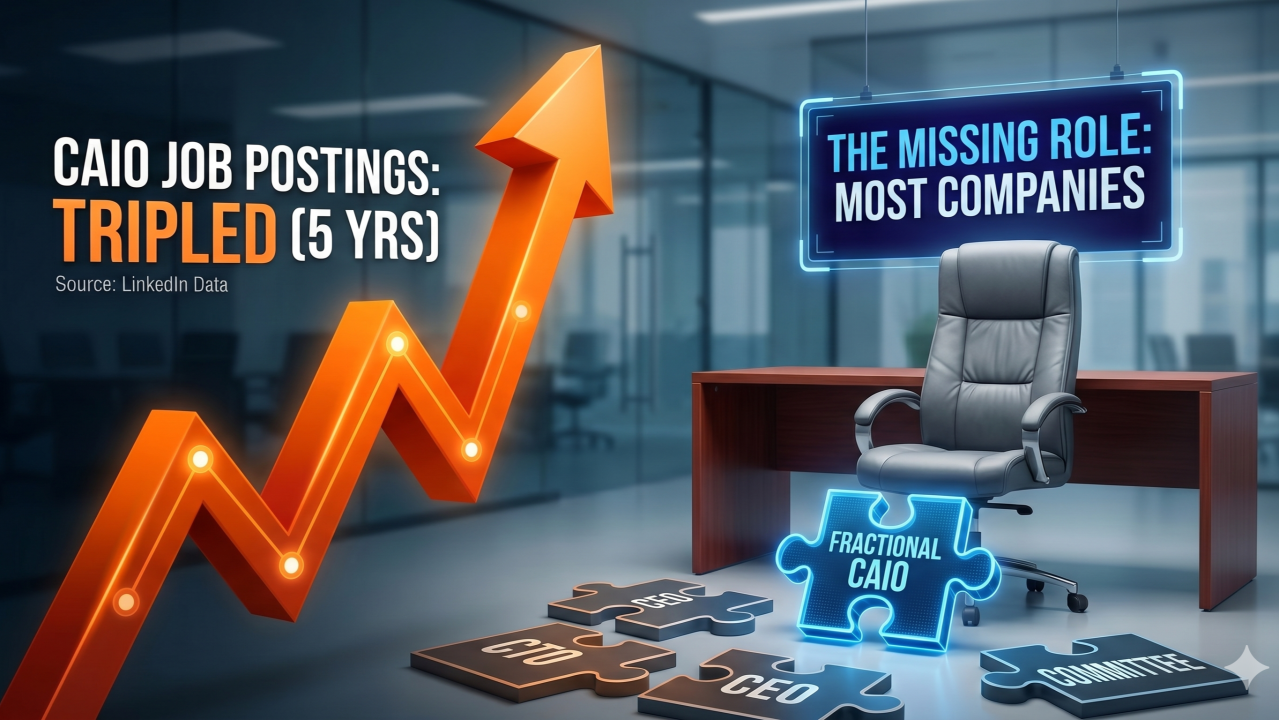
LinkedIn just reported that Chief AI Officer job postings have tripled over the last five years.

It’s now officially one of technology’s fastest-growing executive roles.

But here’s what the headline misses:

Most companies still don’t have one.

Not because they don’t need AI leadership. Because the role, as typically defined, assumes a full-time executive with a dedicated budget and organizational authority.

Most mid-market companies — the ones actually struggling with AI adoption — can’t afford that.

So what happens?

AI ownership defaults to the CEO. Or the CTO. Or a committee.

And when something belongs to everyone, it belongs to no one.

This is exactly where the fractional model changes the game.

A Fractional CAIO isn’t a consultant who advises on AI.

It’s an installed leadership function that governs AI decisions, establishes cadence, and creates accountability — on a retainer, not a project.

The demand signal is clear.

The hiring data says companies want AI leadership.

The market reality says most can’t hire it full-time.

The opportunity for AI professionals who can install governance — not just deliver advice — has never been larger.

But it requires a structural shift.

From: “I help companies with AI.”

To: “I install the decision architecture that makes AI work.”

Those are different identities. Different revenue models. Different outcomes.

Do you see the fractional CAIO model gaining traction in your network? Or is it still mostly consultant-as-title?

The digital evolution isn’t waiting for anyone.

For businesses today, the question is no longer if they should use AI: it’s who is orchestrating it. And more importantly, how.


A Personal Journey That Became a Platform

In mid-2024, I started exploring AI with one simple goal: find additional services I could offer through our digital marketing agency, MyMobileLyfe.

I wasn’t coming in as a technologist. I was a business strategist trying to figure out where AI fit into our clients’ worlds. And honestly? I didn’t know much.

I had never heard the title Chief AI Officer. I certainly didn’t understand what the role actually demanded — the governance responsibilities, the ethical frameworks, the strategic depth required to move a company from “we’re experimenting with AI” to measurable, scalable results.

But I started digging.

The deeper I went — including studying the work coming out of organizations like ChiefAIOfficer — the clearer it became: businesses desperately need structured AI leadership, and most of them don’t know where to find it.

That realization didn’t just lead me to write a book. It became the entire foundation for One-Click AI.ai — a platform built specifically for aspiring AI consultants and CAIOs who want to deliver real strategic value to their clients.


Announcing the Second Edition

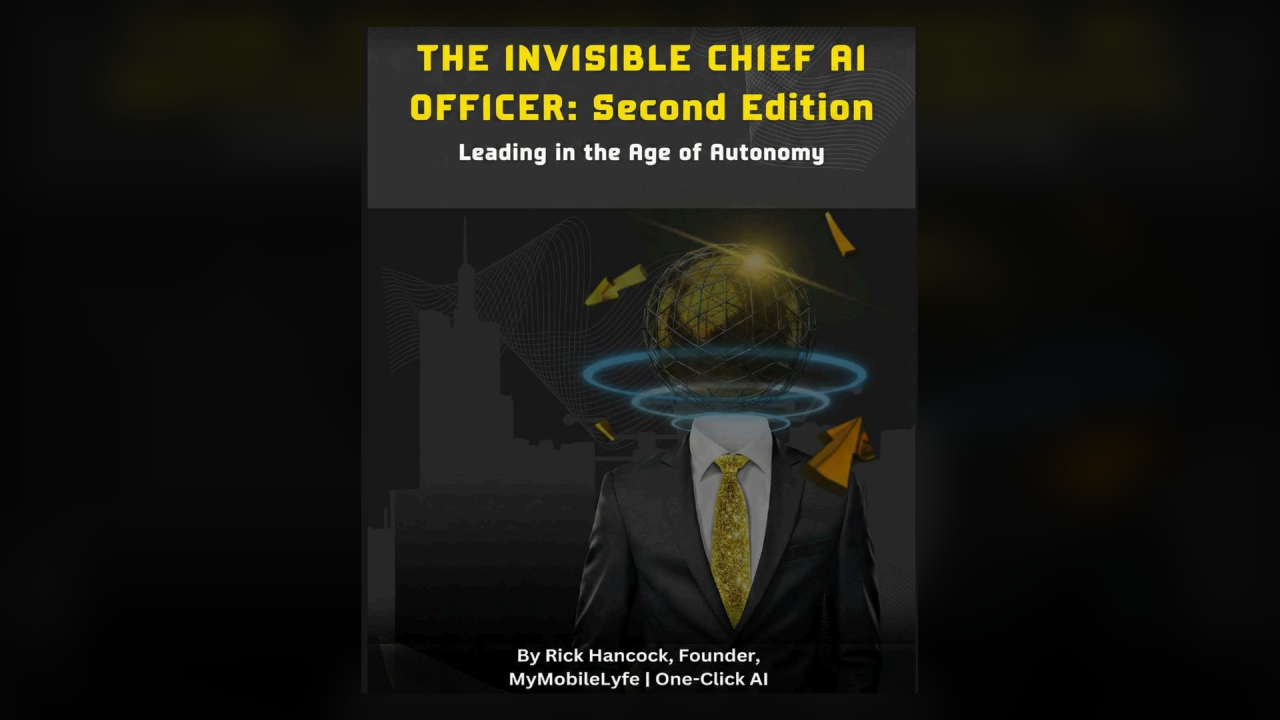
I’m thrilled to announce the release of the second edition of The Invisible Chief AI Officer: Leading in the Age of Autonomy.

This isn’t a book about AI tools. It’s a field guide for the people responsible for making AI work inside real organizations — business leaders, fractional partners, and especially non-technical certified AI consultants who are navigating clients through one of the most complex transitions in business history.

The second edition goes deeper on the core responsibilities this emerging role demands:

  • Strategic Mandates — Building a long-term AI vision that aligns with a company’s actual mission, not just its budget
  • The Silicon Workforce — Managing hybrid teams where humans and autonomous agentic systems work side by side
  • Governance & Ethics — Conducting bias audits, protecting data privacy, and building transparency into every deployment
  • Operational Models — Helping clients choose between Full-Time, Fractional, or On-Demand CAIO structures based on their specific needs and readiness

Why This Is Your Moment as an AI Consultant

Here’s what I want every non-technical certified AI consultant to understand: your value isn’t in knowing how to build models. It’s in knowing how to lead through them.

Your clients aren’t failing because they don’t have enough AI tools. They’re failing because they don’t have a coherent strategy. They’re stuck in pilot purgatory, burning budget on disconnected solutions that never add up to competitive advantage.

That’s the gap you fill.

You don’t need a hundred-million-dollar R&D budget to compete with industry giants anymore. Through models like the On-Demand CAIO, even small businesses can access the kind of strategic intelligence that was once reserved for the Fortune 500.

Whether you’re serving as a fractional partner or leveraging a platform like OneClickAI.ai to scale your practice, you are the architect of your clients’ AI future.


The Invisible Leader Is the Most Powerful One

We are operating in an era where work is increasingly autonomous — and the leaders who matter most aren’t the loudest ones in the room. They’re the ones quietly building the infrastructure, the governance, and the strategy that makes everything else possible.

That’s who this book is for.

I invite you to pick up the second edition of The Invisible Chief AI Officer and join me in bridging the gap between AI potential and profitable, sustainable business outcomes. I’ve dropped a link in the comments and you can download a Free digital copy.

The future belongs to those who act with intention.

Let’s get started.

There’s a moment many AI consultants experience but rarely talk about.

You’re certified. Capable. Confident in your knowledge.

Clients are interested.

The market is growing.

And yet…

Revenue still feels fragile.


The Instability No One Posts About

Not because you lack skill.

Not because there isn’t demand.

But because every engagement resets your position.

Each new client requires:

• Re-explaining your value • Re-justifying your pricing • Re-defining scope • Re-earning authority

That repetition creates something subtle:

Instability.


Competent — But Not Installed

You can be competent and still not be positioned.

Consultants are brought in.

They advise. They recommend. They deliver.

Then they exit.

And when they exit, so does their authority.

That cycle becomes exhausting.

Not physically.

Structurally.


The Psychological Tension

Here’s the part most won’t say publicly:

There’s a quiet anxiety in knowing your income depends on the next project closing.

Even if you’re good.

Even if you’re respected.

Even if your work delivers results.

When your position resets each time, security becomes temporary.

That’s not a capability problem.

That’s a structural one.


The Realization

I remember recognizing it.

Not dramatically.

Not all at once.

Just gradually understanding:

I wasn’t unstable because I lacked skill.

I was unstable because I was operating inside an execution model.

Projects must be resold.

Authority must be installed.

That distinction changed how I approached AI advisory work.


The Shift

The solution wasn’t more certifications.

It wasn’t lowering price.

It wasn’t expanding services.

It was redesigning the operating model.

From:

External expert To installed governance.

From:

Project revenue To executive cadence.

From:

Rotating advisory To structured oversight.


Closing

Most AI consultants are more capable than their positioning allows.

But capability does not protect you from structural fragility.

Governance does.

The shift is not skill.

The shift is structure.

— Rick Hancock, Architect of Fractional CAIO Governance Systems

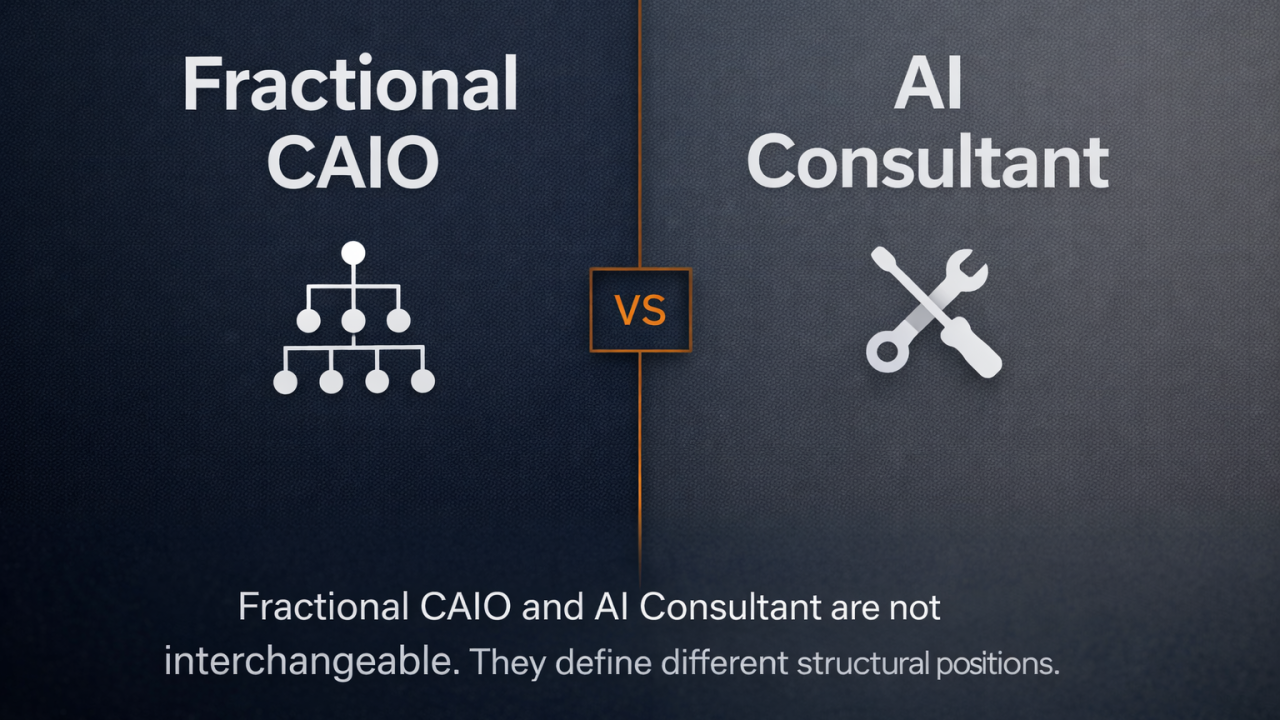
The terms are being used interchangeably.

They should not be.

“AI Consultant” and “Fractional CAIO” describe two different operating positions in the market.

The confusion is understandable.

The distinction is structural.


1️⃣ The AI Consultant

An AI consultant is brought in to:

• Advise on AI initiatives • Evaluate tools and vendors • Design implementation plans • Support execution • Deliver defined outcomes

Compensation Model: Project-based, milestone-based, or scoped advisory retainers.

Authority Level: Influence without ownership.

Identity: External expert.

The consultant’s role is directional.

They recommend.

They guide.

They deliver.

But they do not own governance.


2️⃣ The Fractional CAIO

A Fractional CAIO is installed to:

• Oversee AI governance • Define decision architecture • Establish executive cadence • Align AI initiatives with business objectives • Manage risk and prioritization • Report at leadership level

Compensation Model: Retainer-based executive function.

Authority Level: Oversight and structured decision influence.

Identity: Installed leadership role.

The Fractional CAIO does not simply recommend AI initiatives.

They design how AI decisions get made.

That distinction changes everything.


3️⃣ Influence vs Governance

Consultants answer:

“What should we do?”

Fractional CAIOs answer:

“How will AI decisions be structured, evaluated, and overseen over time?”

One solves problems.

The other installs systems.

One delivers insight.

The other defines operating rhythm.


4️⃣ Execution Model vs Governance Model

AI Consultant: Revenue tied to projects.

Fractional CAIO: Revenue tied to executive oversight.

Projects end.

Governance continues.

Projects must be resold.

Governance renews.


5️⃣ The Title Problem

Many professionals adopt the title “Fractional CAIO.”

Few install a governance model.

Title adoption without structural installation creates confusion in the market.

Fractional CAIO is not a branding upgrade.

It is an operating model.

Without:

• Defined governance cadence • Reporting structure • 90-day oversight rhythm • Budget prioritization logic • Risk management framework

You are operating as a consultant.

Not as a CAIO.


6️⃣ Why This Definition Matters

The AI market is expanding.

But advisory revenue volatility remains high.

The reason is not lack of demand.

It is structural misalignment.

When you operate as a consultant while attempting to earn as a governance executive, friction appears.

Clarity resolves friction.


Closing Definition

AI Consultant: Delivers AI expertise.

Fractional CAIO: Installs AI governance.

Both roles are valid.

They are not the same.

The shift is not skill.

The shift is structure.