Archive for the
‘Artificial Intelligence’ Category

The data on structured AI training is unambiguous:

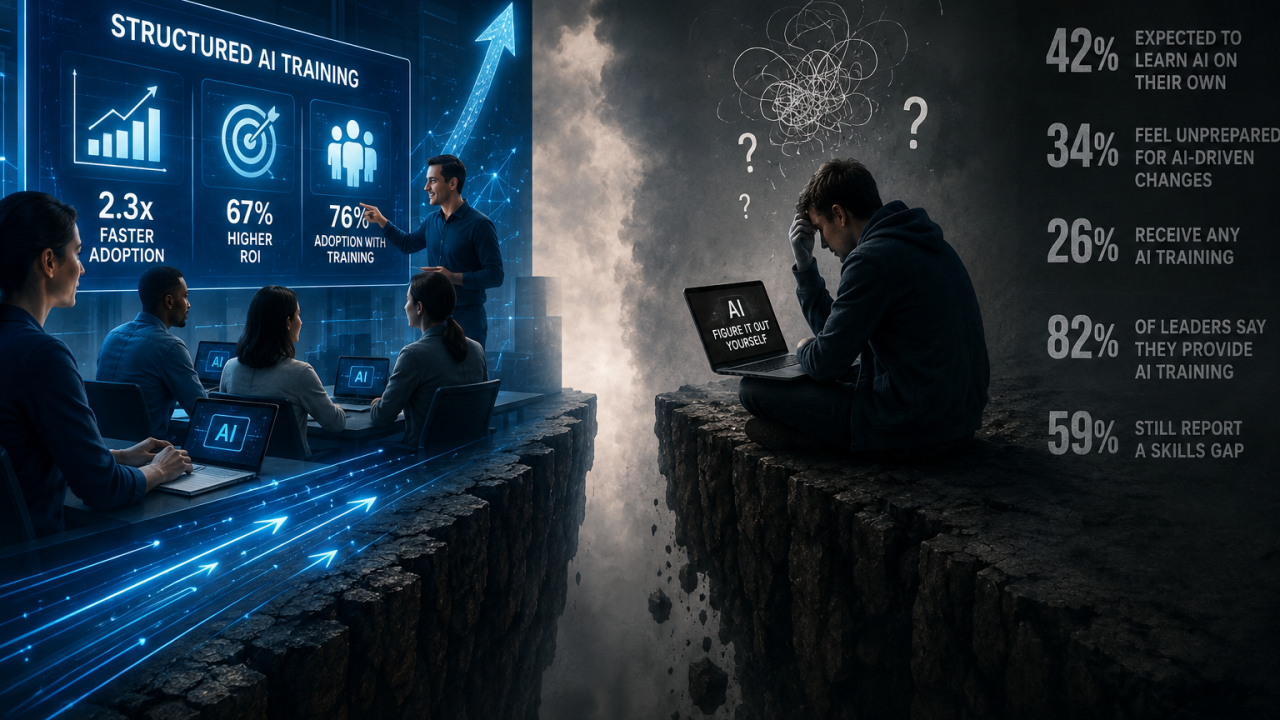
Organizations with formal AI training programs achieve 2.3x faster adoption and 67% higher AI ROI compared to those without structured programs.

When employers provide AI training, adoption jumps to 76%.

Without it? 25%.

That’s a 3x difference based on one variable: whether someone built the structure.

The Paradox

So if structured training produces dramatically better outcomes, you’d expect every organization to be investing in it.

Here’s what’s actually happening:

42% of employees say their employer expects them to learn AI on their own.

34% feel unprepared for AI-driven changes in their role.

Only 26% report receiving any training on how to collaborate with AI.

And the stat that should stop every executive in their tracks: 82% of enterprise leaders say their organization provides AI training — but 59% still report a skills gap.

We’ve seen this number before. It’s the same paradox. Training is happening. Capability isn’t.

Why the Gap Persists

The answer is the same one I’ve been naming for months.

Most AI training is designed to create awareness. Awareness doesn’t change behavior.

What changes behavior is structured follow-through. A specific workflow tied to a specific outcome. A 30-day measurement of whether the behavior showed up. An operational cadence that reinforces the learning after the session ends.

Without that structure, training is a check-the-box exercise. And the 82/59 gap — 82% training, 59% skills gap — is the proof.

The $5.5 Trillion Cost of Getting This Wrong

IDC projects that AI skills shortages could cost the global economy $5.5 trillion by the end of this decade.

That’s not lost revenue from bad technology. It’s lost revenue from unprepared people.

Over 90% of global enterprises are projected to face critical skills shortages by 2026. Not because AI talent doesn’t exist — but because organizations haven’t built the infrastructure to develop it internally.

The organizations closing the gap share three common investments:

Structured training wired to specific business outcomes — not generic AI literacy.

Measurement after the session — adoption metrics, not satisfaction surveys.

Internal AI champions who own follow-through — not just an L&D team that schedules the workshop.

What This Means for CAIOs and AI Consultants

This is the workforce development consulting market hiding inside every AI strategy engagement.

Every company that hires you to advise on AI adoption also has a workforce readiness problem. Most of them don’t know it yet. The ones that do don’t know how to solve it.

If you can build the structured training infrastructure — the assessment, the pathway, the measurement cadence — you’re not just an AI consultant anymore.

You’re a workforce architect.

And that’s a much bigger market.

Is your organization measuring AI training by completion rates or by behavior change? What’s the difference in outcomes?
This is the hiring trend that’s moving faster than most job seekers realize:

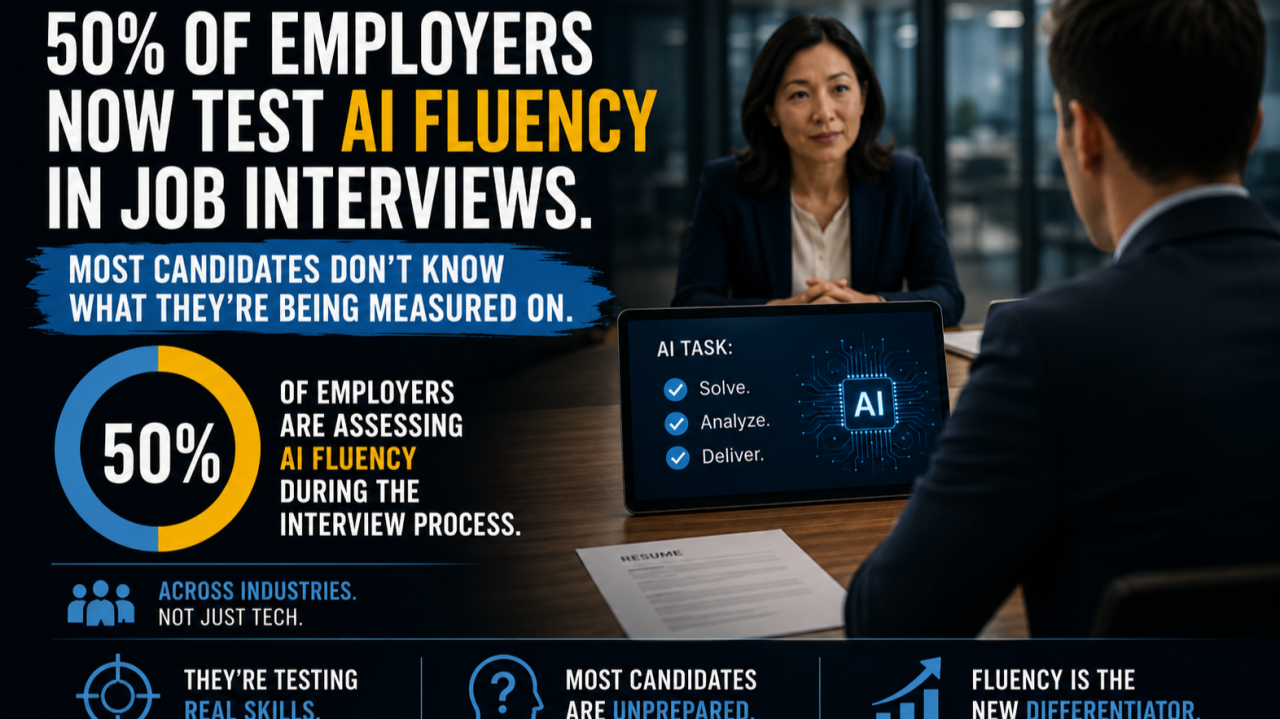
Half of all employers are now assessing AI fluency during the interview process.

Not in engineering roles. Across industries.

And what they’re measuring isn’t what most people think.

What Employers Actually Test

According to WGU’s 2026 Workforce Decoded report:

52% are using technical skills-based assessments or on-the-project evaluations. Not multiple choice. Not “tell me about a time you used AI.” Actual tasks. Actual output.

39% are evaluating real-world experience with tools like ChatGPT, Copilot, and Python libraries. They want to see what you’ve built, not what you’ve studied.

32% are looking for certifications — but not as standalone proof. As one signal among many in a broader readiness portfolio.

The shift is from “do you know what AI is?” to “can you use AI to produce something measurable?”

The Fluency Gap

Here’s where it gets uncomfortable.

Most AI training — corporate, academic, or self-directed — still focuses on awareness. What AI is. What it can do. How to write a prompt.

But employers aren’t hiring for awareness anymore. They’re hiring for fluency.

Fluency means you’ve integrated AI into your actual workflow. It means you can identify which tasks benefit from AI augmentation and which don’t. It means you can evaluate AI output critically — not just accept whatever the model gives you.

That gap — between awareness and fluency — is where most candidates are falling short. Not because they’re not smart. Because nobody taught them the difference.

Why This Matters for AI Consultants

If you’re advising organizations on AI adoption, this is the workforce side of the same governance problem.

Companies are testing for fluency in hiring but not building fluency in their existing teams. They’re assessing candidates on skills they haven’t structured internal training to develop.

That disconnect is a consulting opportunity hiding in plain sight.

The organizations that solve it won’t just hire better. They’ll retain better, adopt faster, and build the internal capability that makes AI investments actually pay off.

The ones that keep testing for fluency without building it? They’ll keep wondering why their AI initiatives stall.

If you’ve interviewed recently — did you get tested on AI fluency? What did they ask? And did it match what you actually know how to do?

Here’s the number that should keep every university president up at night:

Only 37% of employers believe higher education is adequately preparing graduates for the workforce.

That’s not a fringe opinion. That’s from a survey of 3,147 U.S. employers.

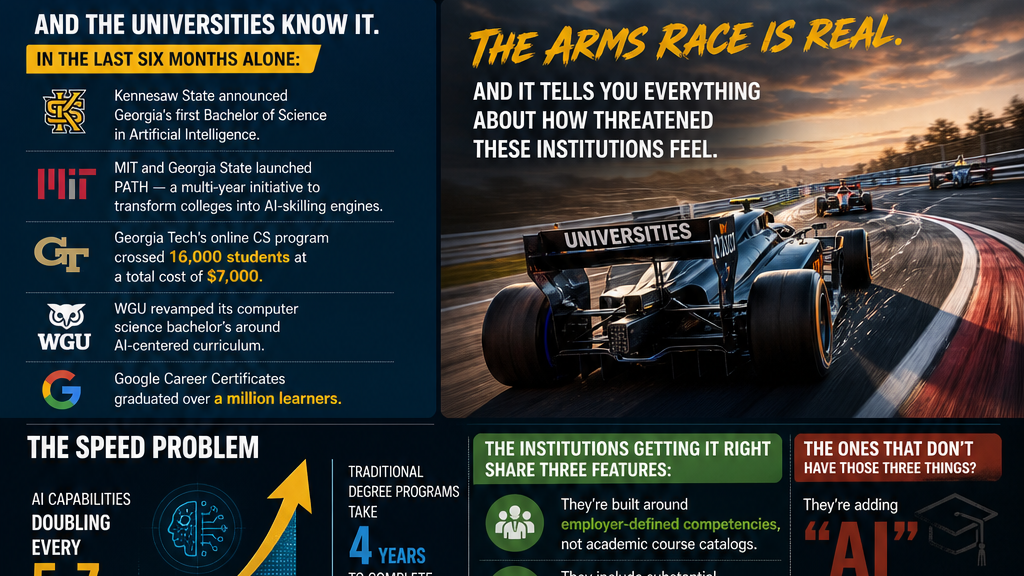
And the universities know it.

In the last six months alone:

Kennesaw State announced Georgia’s first Bachelor of Science in Artificial Intelligence.

MIT and Georgia State launched PATH — a multi-year initiative to transform colleges into AI-skilling engines.

Georgia Tech’s online CS program crossed 16,000 students at a total cost of $7,000.

WGU revamped its computer science bachelor’s around AI-centered curriculum.

Google Career Certificates graduated over a million learners.

The arms race is real. And it tells you everything about how threatened these institutions feel.

But here’s my concern:

Most of them are building faster versions of the same model that produced the 37% number in the first place.

The Speed Problem

AI capabilities are doubling roughly every five to seven months. Traditional degree programs take four years to complete and two to three years to design.

By the time a curriculum committee approves a new AI course, the tools it teaches may already be obsolete.

The institutions getting it right share three features:

They’re built around employer-defined competencies, not academic course catalogs.

They include substantial applied project work — not just theory.

They have public outcomes data that employers can actually verify.

The ones that don’t have those three things? They’re adding “AI” to their marketing copy and hoping nobody notices the syllabus hasn’t changed.

The Real Question

The question isn’t whether higher education will adapt. It will. Institutions that don’t will simply become irrelevant.

The question is whether they’ll adapt fast enough to matter for the workers who need reskilling right now — not in 2030.

Because here’s what the 37% number really means:

Employers have already started building their own pipelines. Internal training programs. Certificate partnerships. Skills-based hiring that bypasses degrees entirely.

The longer universities take to close the gap, the less the market will need them to.

That’s not a prediction.

That’s the math.

If you’re in higher education — what’s the single biggest barrier to moving faster? If you’re an employer — have you given up waiting for universities to catch up?

Two numbers from Western Governors University’s 2026 Workforce Decoded report tell you everything about where hiring is headed:

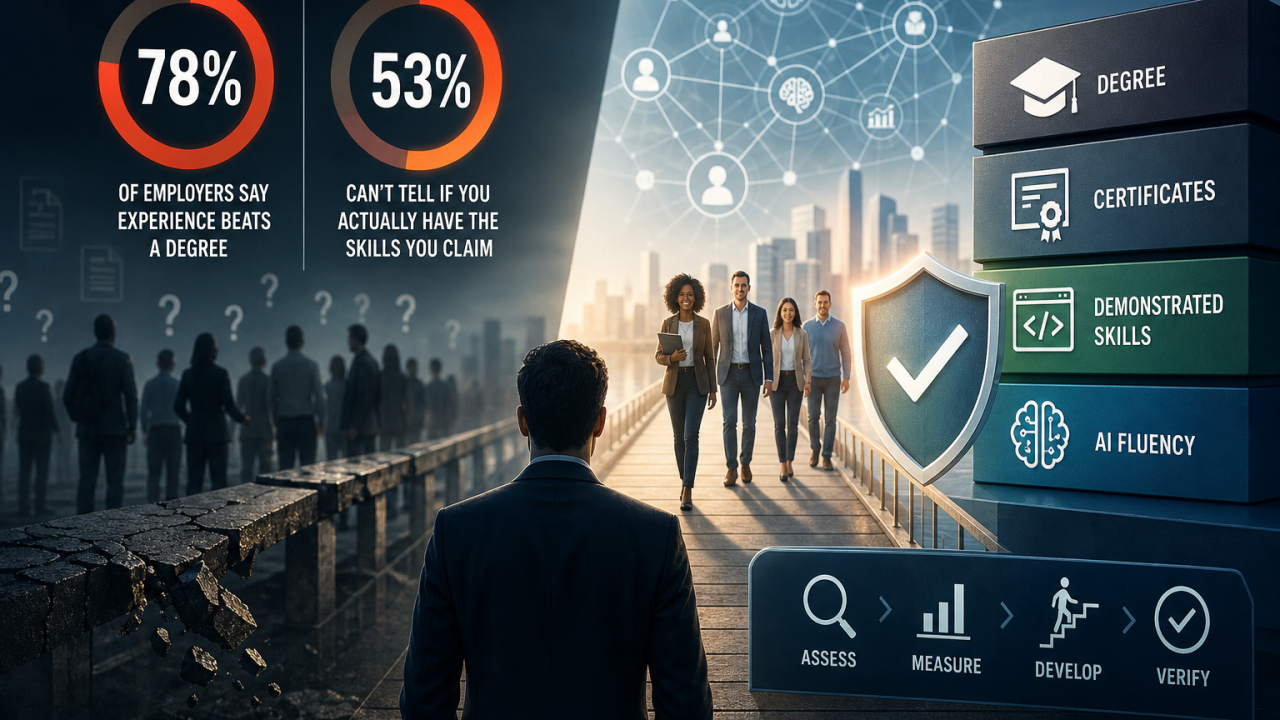
78% of employers now say work experience is equal to or more valuable than a college degree.

53% say their biggest hiring challenge is validating whether candidates actually possess the skills they claim.

Read those together.

Employers have already decided that degrees alone aren’t enough. But they haven’t figured out how to verify what replaced them.

The Readiness Portfolio

What’s emerging is something researchers are calling a “readiness portfolio” — a stacked combination of degree, certificate, demonstrated skill, and provable AI fluency that hiring managers are now evaluating together.

This isn’t the “degrees are dead” narrative. The data doesn’t support that. 68% of employers still say degrees are important. 86% say certificates are valuable.

But neither one is sufficient on its own anymore.

The skills employers rank as most critical aren’t narrowly technical. Critical thinking and problem solving: 60%. Time management: 41%. Adaptability: 40%. Emotional intelligence: 37%.

These are precisely the competencies that AI cannot replicate — and that working professionals develop through years of experience, not classroom instruction.

Which brings us back to the validation problem.

The Verification Gap

If the readiness portfolio is the new standard, then someone needs to build the verification infrastructure.

Right now, 52% of employers are using technical skills-based assessments or on-the-project evaluations to measure AI competency. 39% are evaluating real-world experience with tools like ChatGPT, Copilot, and Python libraries. 32% are looking at certifications from AWS, Microsoft Azure AI, and WGU.

But most of this is ad hoc. There’s no standard. There’s no shared framework. Every employer is inventing their own readiness rubric.

This is a massive opportunity — and it’s one that most AI consultants are completely ignoring.

Where AI Consultants and CAIOs Fit

If you’re an AI consultant or a Fractional CAIO, this is the part that should get your attention.

The organizations struggling hardest with the readiness portfolio aren’t asking for another tool recommendation. They’re asking:

“How do we assess whether our existing workforce is actually AI-ready?”

“What does a structured upskilling pathway look like — not a course catalog, but a measured progression?”

“How do we verify that training translated into capability?”

Those are consulting questions. They’re governance questions. And they’re workforce architecture questions.

The consultants who build frameworks for answering them — repeatable, installable, measurable — will own the workforce development conversation for the next three years.

Everyone else will still be selling tool demos.

CTA: How is your organization verifying AI readiness — structured assessments, or gut instinct? What’s working and what isn’t?

Here’s a number that should concern every hiring manager, career counselor, and workforce development leader in the country:

Junior tech job postings have declined 67% since 2022.

Not a slowdown. A collapse.

And it’s not just tech. LinkedIn’s hiring rate for entry-level workers dropped 6% between December 2025 and February 2026. Middle-management hiring declined 10% over the same window.

The mechanism is straightforward. Many of the tasks that used to fill entry-level roles — research, drafting, analysis, coordination — can now be accelerated or partially automated by generative AI tools. Companies under cost pressure responded by eliminating the roles that performed those tasks.

But here’s what nobody’s talking about:

We’re building a career ladder with no first rung.

Employers say they want mid-career professionals with five to ten years of experience. But the roles that used to produce those five to ten years are disappearing.

The Paradox Nobody’s Solving

Job postings now routinely demand two to three years of experience for what used to be entry-level positions. You need the job to get the experience. You need the experience to get the job.

Employment for 22-to-25-year-olds in AI-exposed occupations has dropped 13% since late 2022. For software developers in that age range, it’s down 20%.

This isn’t just a Gen Z problem. It’s a pipeline problem.

If you’re an employer cutting entry-level roles today, ask yourself: where does your mid-career talent come from in 2030?

If you’re a workforce development leader, ask yourself: what are you building for the people who can’t get on the ladder at all?

What the Adaptive Workers Are Doing

The workers who are navigating this aren’t waiting for the ladder to come back. They’re building their own.

They’re stacking credentials — not just degrees, but certificates, portfolio projects, and documented AI-augmented work samples.

They’re treating continuous learning as a job requirement, not an extracurricular.

They’re gaining experience through freelance projects, open-source contributions, and apprenticeship-style arrangements before they ever land a full-time role.

It’s not the path anyone drew up. But it’s the path that’s working.

The question for the rest of us — employers, educators, consultants, policymakers — is whether we’re going to keep pretending the old ladder still exists.

Or start building a new one.

If you’re hiring right now — are you still requiring experience that entry-level candidates have no way to get? What would it take to rethink that?

Everyone’s still debating whether AI will take their job.

That debate is already over.

Not because AI replaced anyone. Because it changed what employers are looking for — and 76% of them already made the switch.

That’s the number from Western Governors University’s 2026 Workforce Decoded report. Seventy-six percent of employers say AI has already shifted the types of candidates they’re hiring.

Not “plan to shift.” Already shifted.

And here’s what the shift actually looks like:

More than 40% of employers now say mid-career professionals — five to ten years of experience — are their most in-demand hires.

38% are actively reducing entry-level hiring because of AI.

78% say work experience is now equal to or more valuable than a degree.

This isn’t a technology story. It’s a labor market story.

The people losing ground right now aren’t the ones who refuse to learn AI. They’re the ones who learned AI — the vocabulary, the certifications, the LinkedIn posts about prompt engineering — but never installed it into their actual work.

Employers aren’t asking “do you know what AI is?”

They’re asking “have you used it to produce something we can measure?”

That’s a different question entirely. And most people aren’t ready for it.

The threat was never replacement.

The threat was repositioning.

And if you didn’t notice the job description changed, you’re already behind.

When did you first notice the hiring criteria in your industry had shifted? Was it gradual — or did it hit all at once?

Here’s the stat that should end every debate about whether AI adoption is a training problem:

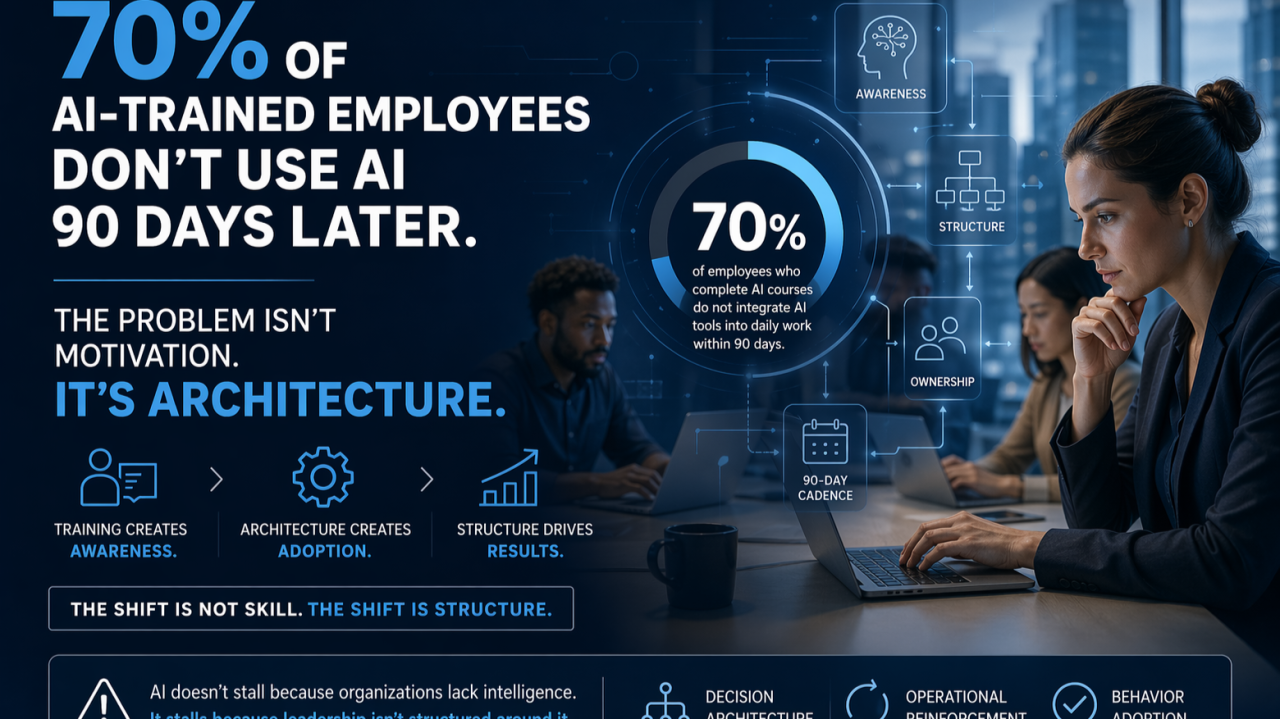
70% of employees who complete AI courses do not integrate AI tools into daily work within 90 days.

Not because they didn’t learn.

Not because they weren’t motivated.

Because there was no structured follow-up.

No operational reinforcement.

No system that turned awareness into behavior.

This is the same pattern at every level:

At the individual level: people learn AI but don’t use it.

At the consultant level: people get certified but can’t close clients.

At the enterprise level: companies pilot AI agents but can’t get them to production.

The thread connecting all three?

The absence of operational architecture.

Training creates awareness.

Architecture creates adoption.

This distinction is the single most important idea in AI right now. And it’s the one almost nobody is building for.

Everyone is building more courses. More tools. More certifications. More agents.

Almost nobody is building the governance layer — the decision architecture, the ownership model, the 90-day cadence — that makes any of it stick.

That’s the gap.

And the people who fill it won’t be the most technically fluent AI professionals.

They’ll be the ones who understand something deeper:

AI doesn’t stall because organizations lack intelligence.

It stalls because leadership isn’t structured around it.

The shift is not skill.

The shift is structure.

The AI consulting market is projected to hit $14 billion this year.

By 2035, it’s expected to reach $116 billion.

But here’s what the growth headlines don’t tell you:

The market isn’t growing evenly.

It’s splitting.

Industry research is showing a clear bifurcation:

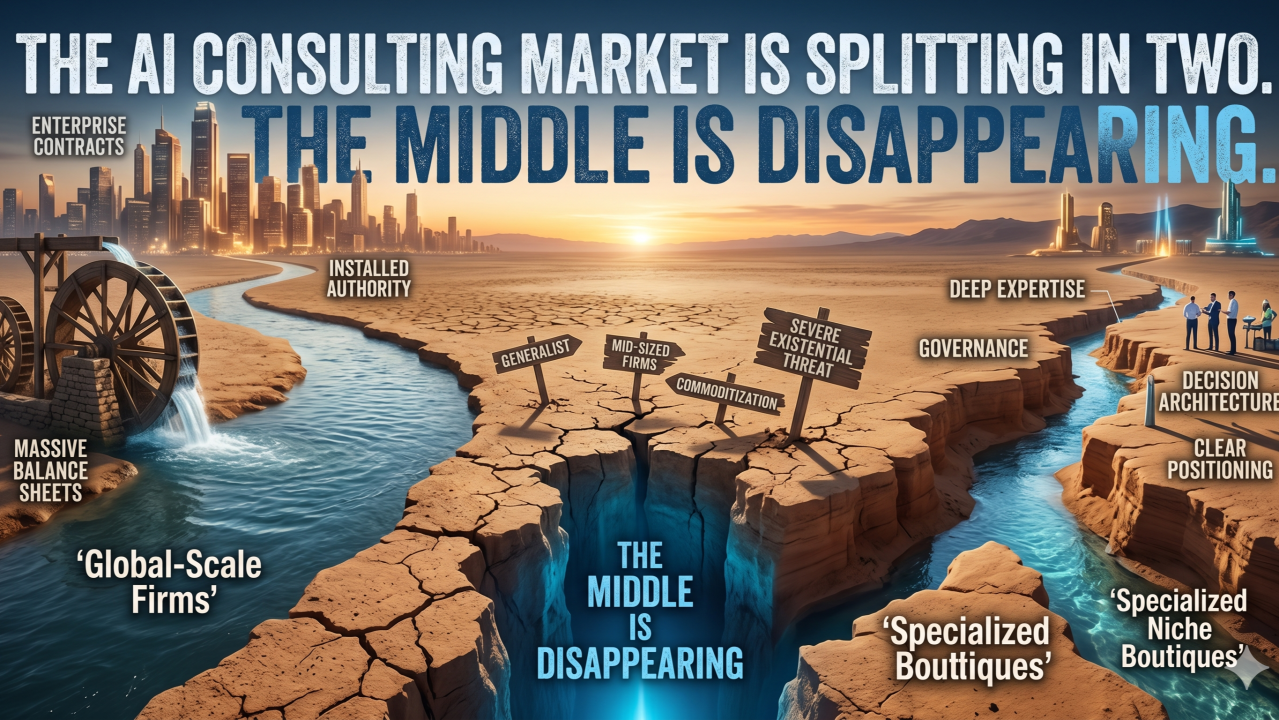
On one side: global-scale firms (Deloitte, Accenture, McKinsey) with massive balance sheets and enterprise contracts.

On the other: specialized niche boutiques with deep expertise and clear positioning.

The middle? It’s disappearing.

Mid-sized firms without either the scale to compete for enterprise work or the specialization to compete on depth are facing what researchers are calling “a severe existential threat.”

This isn’t a prediction. It’s already happening.

And it maps directly to what I’m seeing with individual AI consultants:

The generalist — “I help companies with AI” — is being commoditized.

Basic AI implementation tasks are increasingly handled by automated systems or standardized frameworks.

What’s not commoditizable?

Governance. Decision architecture. Industry-specific readiness assessment. Structured certification pathways.

The consultants who are thriving aren’t trying to be everything.

They’re choosing a lane and going deep.

Then they’re building ecosystems with partners who own the lanes they don’t.

The market rewards specificity. It rewards installed authority.

It does not reward being “pretty good at everything.”

If you’re an AI consultant reading this: the question isn’t whether the market is growing.

It’s whether you’re positioned in the part of the market that’s growing — or the part that’s collapsing.

Where do you see yourself in this split — scaling toward enterprise, or deepening into a niche?

Six months ago, I was trying to be the smartest AI person in the room.

Today, I’m building an ecosystem with people who are smarter than me in areas I’ll never own.

That shift changed everything.

Here’s what I’ve come to believe:

The solo AI consultant — the one who knows the tools, runs the assessments, builds the roadmaps, leads the implementation, and tries to be everything to every client — is a dying model.

Not because they’re not good.

Because the market has gotten too complex for one person to credibly cover.

Agentic AI. Governance. Training. Certification. Industry-specific implementation. Security. Data architecture.

No single consultant can hold all of that.

The consultants I see winning right now aren’t the ones with the deepest expertise.

They’re the ones building partnerships.

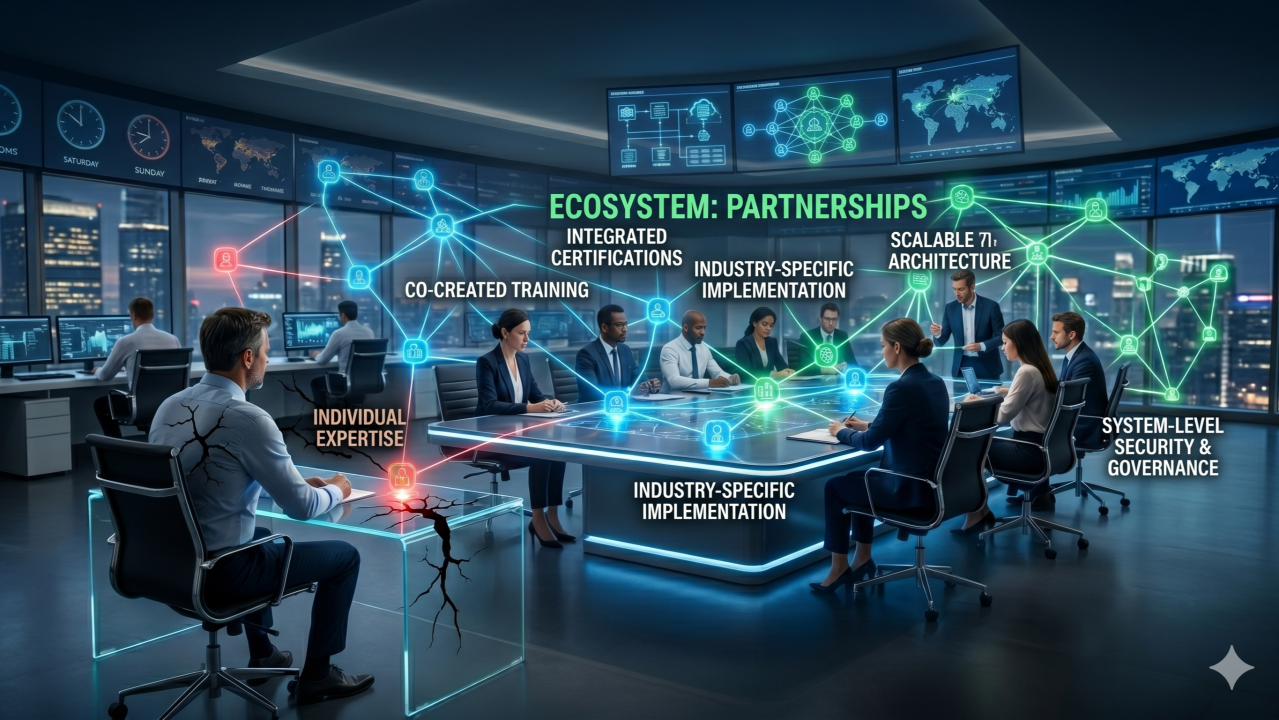
Embedding their methodology into existing certification programs.

Co-creating training with people who own the classroom.

Layering platforms over partner ecosystems instead of selling one seat at a time.

In the last 90 days, we’ve moved from “here’s our tool” to:

“Let’s embed this into your existing curriculum.”

“Let’s co-create a certification tier together.”

“Let’s build infrastructure that scales through your network, not mine.”

That’s not a product pivot.

That’s an identity shift.

From: I am the expert.

To: I architect the system that makes experts operational.

The solo consultant model worked when AI was new and clients just needed someone to explain it.

We’re past that now.

The question isn’t “who knows the most?”

It’s “who has built something that holds without them in the room?”

Are you still trying to be the single expert? Or have you started building partnerships that extend your reach?

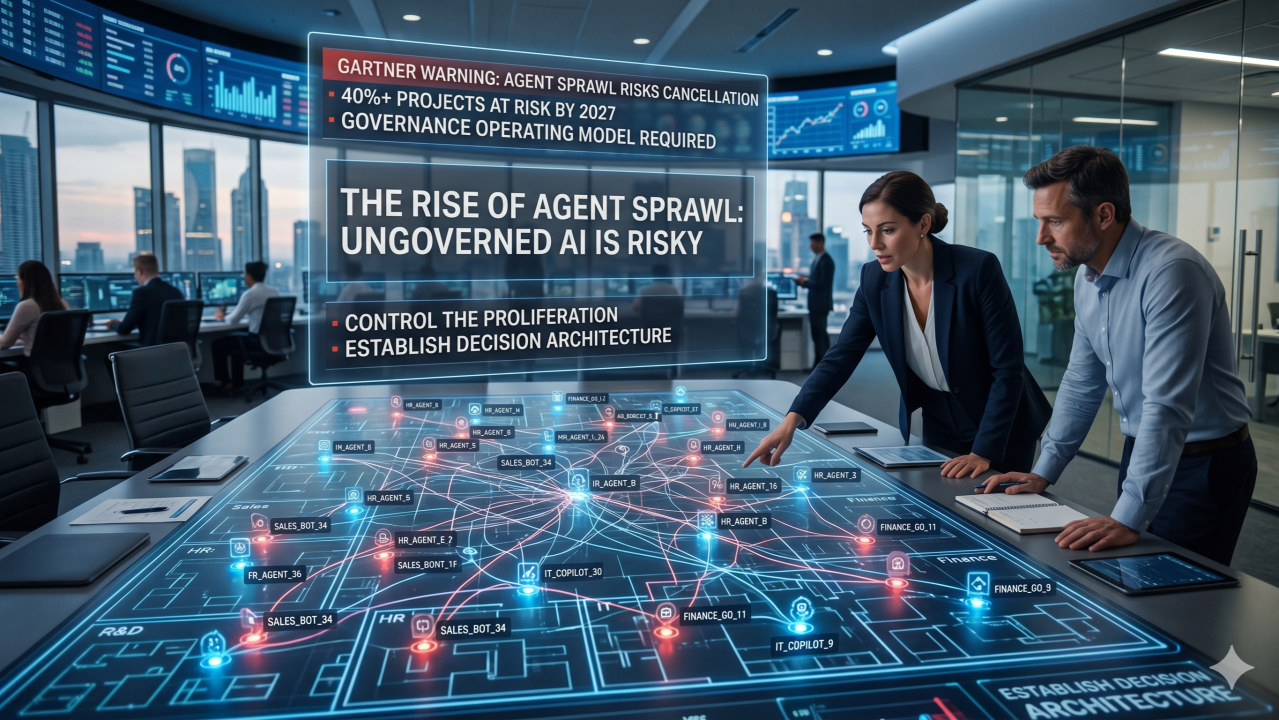
Gartner just issued a warning that should reshape how every AI professional thinks about the next 18 months:

More than 40% of agentic AI projects are at risk of cancellation by 2027.

Not because the agents don’t work.

Because of what researchers are calling “agent sprawl” — the uncontrolled proliferation of siloed, ungoverned AI agents across an enterprise.

It happens when business units move fast to solve immediate problems with AI, without:

A unifying strategy.

Shared data infrastructure.

Centralized oversight.

Sound familiar?

This is the same pattern I’ve been naming for two years — just at a larger scale.

When I said “most businesses adopt AI backwards — tools first, strategy never” — that was about chatbots and automation workflows.

Now multiply that by autonomous agents that make decisions, take actions, and operate across departments.

Without governance, it’s not just inefficiency.

It’s organizational risk.

The research is clear: the organizations that succeed with agentic AI won’t be the ones with the best agents.

They’ll be the ones with the clearest decision architecture.

Who approves what the agent does?

Who monitors outcomes?

Who escalates when something breaks?

Who owns the 90-day review?

Those aren’t technical questions.

They’re leadership questions.

And they require a governance operating model — not another pilot.

CTA: Is your organization building controls before it builds agents? Or the other way around?