
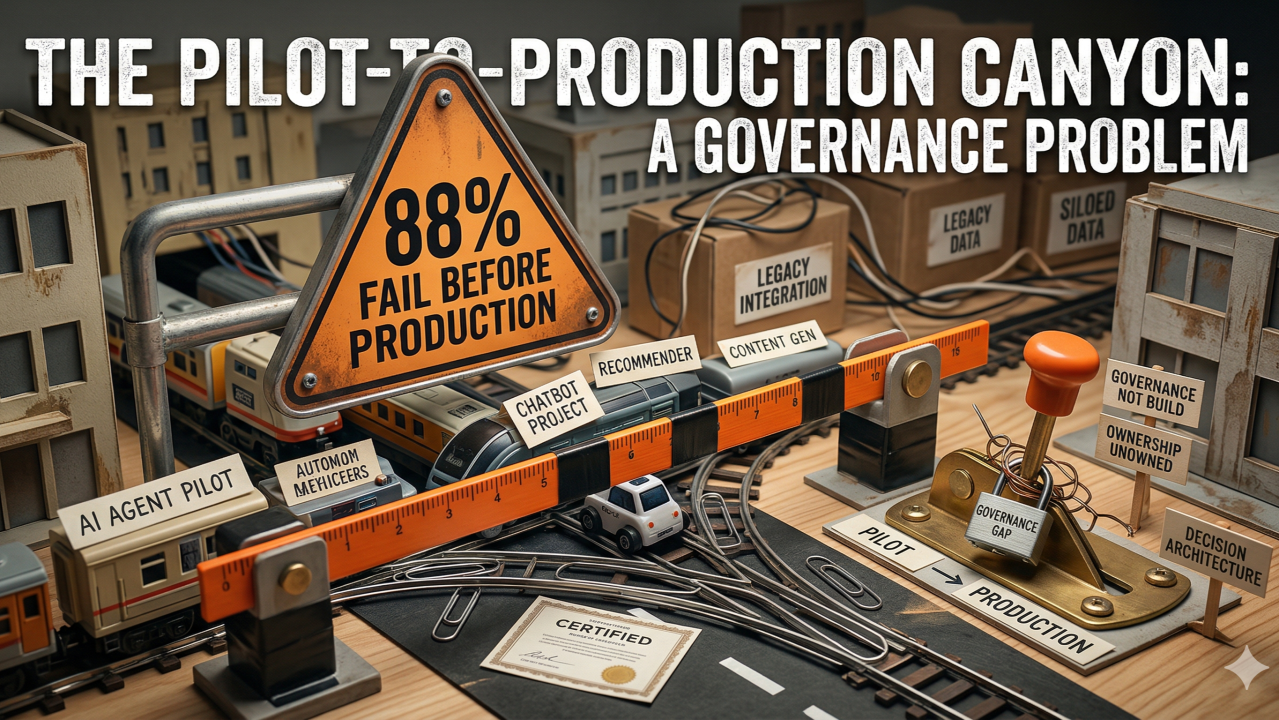
88% of AI Agents Fail Before Production. The Reason Isn’t Technical. Consultants Must Wake Up!
Here’s the number everyone in AI should be paying attention to right now:
88% of AI agent projects fail to reach production.
Not because the technology doesn’t work.
Not because the models aren’t good enough.
Because — according to the research — “teams build agents before they build controls.”
Let that sink in.
—
The Deployment Backlog Nobody’s Talking About
78% of enterprises now have AI agent pilots running.
Only 14% have successfully scaled to production.
That’s not a gap. That’s a canyon.
And it gets worse. A March 2026 survey of 650 enterprise technology leaders found that even when pilots show meaningful results — and 67% of them do — only 10% ever make it across the finish line.
This is the largest deployment backlog in enterprise technology history. Double the failure rate of traditional IT projects.
The agents work in the lab. They work in the demo. They impress the steering committee.
And then they stall.
—
Five Root Causes — And Only One Is Technical
New research has identified the five root causes that account for 89% of scaling failures:
Integration complexity with legacy systems.
Inconsistent output quality at volume.
Absence of monitoring tooling.
Unclear organizational ownership.
Insufficient domain training data.
Look at that list carefully.
Only one — integration complexity — is a technology problem.
The rest? Ownership. Monitoring. Quality control. Governance.
These are leadership problems wearing technical disguises.
And they’re interrelated in a way that makes them compound. Ownership gaps leave monitoring gaps unfilled. Monitoring gaps make quality problems invisible. Invisible quality problems erode executive trust. Eroded trust kills budget.
It’s a chain reaction. And it starts — every time — with the same missing variable:
Nobody owns this.
—
Agent Sprawl: The Term You’ll Be Hearing Everywhere
There’s a new concept emerging in enterprise AI that perfectly captures what’s happening:
Agent sprawl.
It’s the uncontrolled proliferation of siloed, ungoverned AI agents across an enterprise. It happens when business units move fast to solve immediate problems with AI — without a unifying strategy, shared data infrastructure, or centralized oversight.
Sound familiar?
It should. It’s the same pattern I’ve been naming for two years. I called it “Duct-Tape Adoption” — sticking AI onto broken processes and hoping it creates magic.
The only difference now? The stakes are higher.
When it was chatbots and automation workflows, duct-tape adoption wasted time and budget.
When it’s autonomous agents making decisions, accessing databases, and operating across departments — duct-tape adoption creates organizational risk.
The security data backs this up. 88% of organizations reported confirmed or suspected AI agent security incidents in the last year. 80% documented risky agent behaviors including unauthorized system access and data exposure. And 64% of companies with revenue above $1 billion reported losses exceeding $1 million tied to AI system failures.
These aren’t hypothetical risks. They’re happening right now, in production environments, at scale.
—
The Readiness Gap in Four Numbers
Research now quantifies exactly how unprepared most organizations are to govern agentic AI. Four readiness categories tell the story:
Infrastructure readiness: 43%.
Data management readiness: 40%.
Governance readiness: 30%.
Talent readiness: 20%.
That last number should stop every AI consultant and advisor in their tracks.
Only 20% of organizations are talent-ready for agentic AI.
And governance — the single most critical variable for moving agents from pilot to production — sits at 30%.
This is why Gartner is now warning that 40%+ of agentic AI projects may be cancelled by 2027.
Not for lack of capability.
For lack of structure.
—
What This Means If You’re an AI Consultant
This data is both a warning and an opportunity.
The warning: implementation advice alone won’t save a stalled agent deployment. If you’re still leading with tool recommendations and feature demos, you’re solving a problem the market has already moved past.
The opportunity: the organizations that need you most right now aren’t asking “what tool should we use?”
They’re asking something harder:
“How do we govern what we’ve already built?”
“Who owns the decision about what this agent is allowed to do?”
“What happens when it breaks — and who’s accountable?”
Those aren’t consulting questions. They’re governance questions. And they require a fundamentally different operating model than most AI consultants are running.
The consultants who step into that gap — who can install decision architecture, define ownership, and build the 90-day oversight cadence — will own the most valuable real estate in the AI market for the next three years.
The ones who keep leading with tools will wonder why their pipeline dried up.
—
The Bottom Line
The agentic AI wave isn’t failing because the technology is immature.
It’s failing because organizations are building agents the same way they adopted every other AI tool:
Fast. Excited. Unstructured.
And for the first time, the consequences of that approach aren’t just wasted budget.
They’re security incidents. Unauthorized access. Million-dollar losses.
The market doesn’t need more agents.
It needs more architecture.
—
Source data:
– 88% failure rate, 78% piloting / 14% production (Apify enterprise research, Digital Applied March 2026 survey)
– 67% of pilots show meaningful results, only 10% scale (Digital Applied)
– 5 root causes account for 89% of failures (ZBrain, HarrisonAIX)
– Agent sprawl and security incidents: 88% confirmed/suspected incidents, 80% risky behaviors (Gravitee State of AI Agent Security 2026)
– 64% of $1B+ companies report $1M+ AI losses (Accelirate)
– Readiness gaps: Governance 30%, Talent 20% (Decidr US AI Readiness Index 2026)
– Gartner: 40%+ agentic AI project cancellation risk by 2027
– Only 22% treat agents as independent identities (Security Boulevard)


















































































































































































Recent Comments