
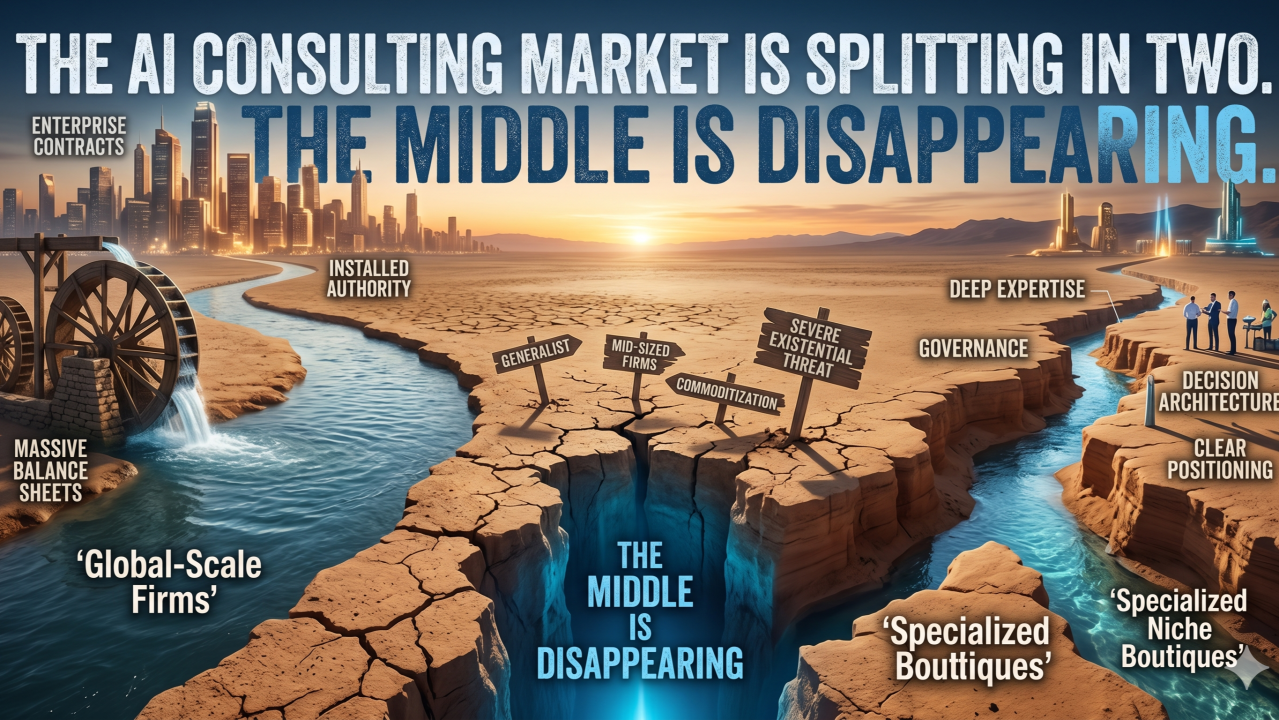
The AI Consulting Market Is Splitting in Two. The Middle Is Disappearing.
The AI consulting market is projected to hit $14 billion this year.
By 2035, it’s expected to reach $116 billion.
But here’s what the growth headlines don’t tell you:
The market isn’t growing evenly.
It’s splitting.
Industry research is showing a clear bifurcation:
On one side: global-scale firms (Deloitte, Accenture, McKinsey) with massive balance sheets and enterprise contracts.
On the other: specialized niche boutiques with deep expertise and clear positioning.
The middle? It’s disappearing.
Mid-sized firms without either the scale to compete for enterprise work or the specialization to compete on depth are facing what researchers are calling “a severe existential threat.”
This isn’t a prediction. It’s already happening.
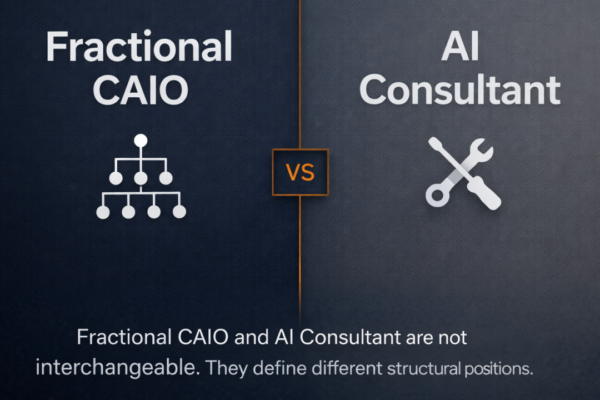
And it maps directly to what I’m seeing with individual AI consultants:
The generalist — “I help companies with AI” — is being commoditized.
Basic AI implementation tasks are increasingly handled by automated systems or standardized frameworks.
What’s not commoditizable?
Governance. Decision architecture. Industry-specific readiness assessment. Structured certification pathways.
The consultants who are thriving aren’t trying to be everything.
They’re choosing a lane and going deep.
Then they’re building ecosystems with partners who own the lanes they don’t.
The market rewards specificity. It rewards installed authority.
It does not reward being “pretty good at everything.”
If you’re an AI consultant reading this: the question isn’t whether the market is growing.
It’s whether you’re positioned in the part of the market that’s growing — or the part that’s collapsing.
Where do you see yourself in this split — scaling toward enterprise, or deepening into a niche?

































































































































































































Recent Comments